Sisay Birhanu, Simiyu Josephine, Mendesil Esayas, Likhayo Paddy, Ayalew Gashawbeza, Mohamed Samira, Subramanian Sevgan, Tefera Tadele
Plant Health Theme, International Center of Insect Physiology & Ecology (ICIPE), P.O. Box 5689, Addis Ababa, Ethiopia.
School of Pant Sciences, Haramaya University, P.O. Box 138, Dire Dawa, Ethiopia.
Insects. 2019 Jul 3;10(7):195. doi: 10.3390/insects10070195.
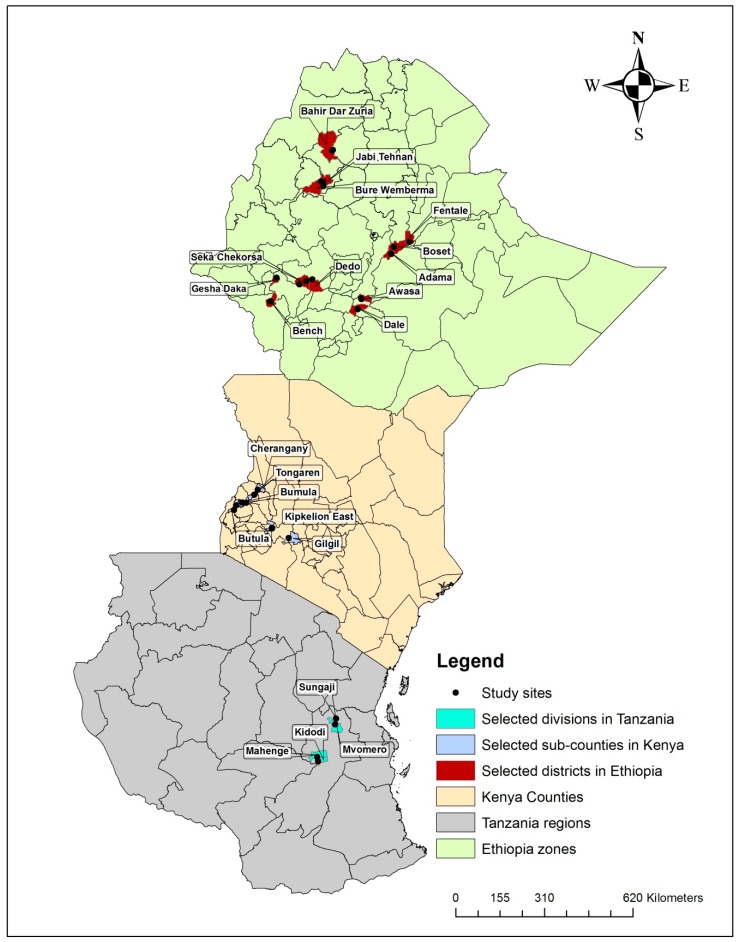
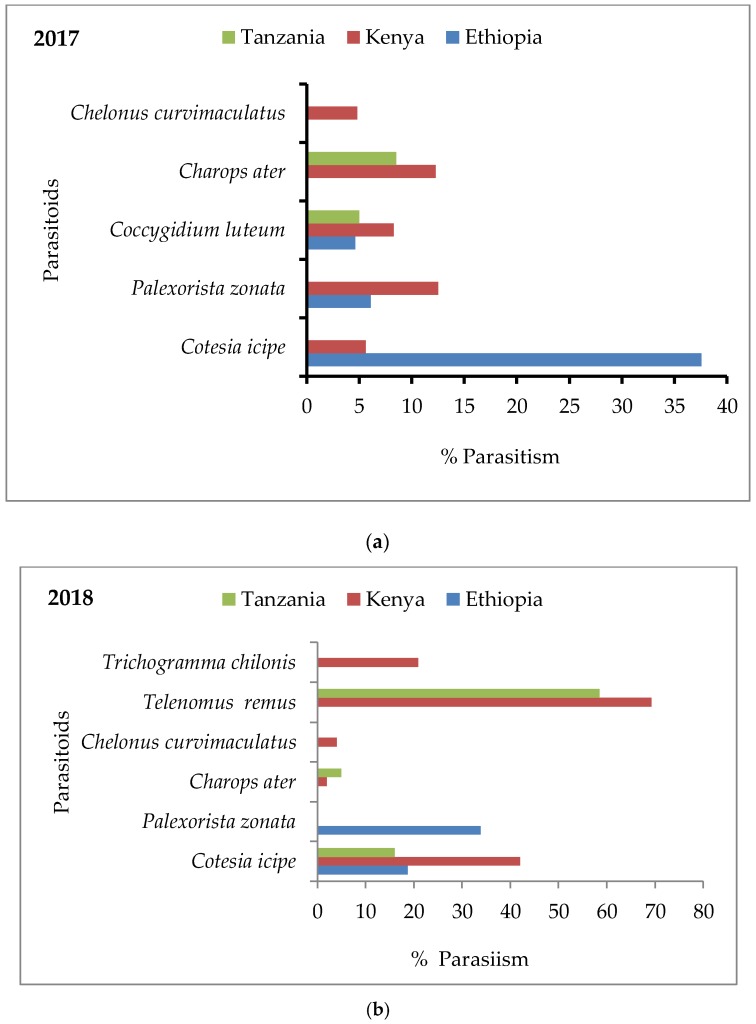
The fall armyworm (FAW), , threatens maize production in Africa. A survey was conducted to determine the distribution of FAW and its natural enemies and damage severity in Ethiopia, Kenya and Tanzania in 2017 and 2018. A total of 287 smallholder maize farms (holding smaller than 2 hectares of land) were randomly selected and surveyed. FAW is widely distributed in the three countries and the percent of infested maize fields ranged from 33% to 100% in Ethiopia, 93% to 100% in Tanzania and 100% in Kenya in 2017, whereas they ranged from 80% to 100% and 82.2% to 100% in Ethiopia and Kenya, respectively, in 2018. The percent of FAW infestation of plants in the surveyed fields ranged from 5% to 100%. In 2017, the leaf damage score of the average of the fields ranged from 1.8 to 7 (9 = highest level of damage), while 2018, it ranged from 1.9 to 6.8. In 2017, five different species of parasitoids were recovered from FAW eggs and larvae. (Hymenoptera: Braconidae) was the main parasitoid recorded in Ethiopia, with a percent parasitism rate of 37.6%. Cameron (Hymenoptera: Braconidae) was the only egg-larval parasitoid recorded in Kenya and had a 4.8% parasitism rate. In 2018, six species of egg and larval parasitoids were recovered with being the dominant larval parasitoid, with percentage parasitism ranging from 16% to 42% in the three surveyed countries. In Kenya, (Hymenoptera: Scelionidae) was the dominant egg parasitoid, causing up to 69.3% egg parasitism as compared to only 4% by . Although FAW has rapidly spread throughout these three countries, we were encouraged to see a reasonable level of biological control in place. Augmentative biological control can be implemented to suppress FAW in East Africa.
草地贪夜蛾对非洲的玉米生产构成威胁。2017年和2018年在埃塞俄比亚、肯尼亚和坦桑尼亚开展了一项调查,以确定草地贪夜蛾及其天敌的分布情况以及危害严重程度。总共随机选取并调查了287个小农户玉米农场(土地面积小于2公顷)。草地贪夜蛾在这三个国家广泛分布,2017年埃塞俄比亚受侵染玉米田的比例在33%至100%之间,坦桑尼亚为93%至100%,肯尼亚为100%;而在2018年,埃塞俄比亚和肯尼亚受侵染玉米田的比例分别为80%至100%和82.2%至100%。调查田块中受草地贪夜蛾侵染的植株比例在5%至100%之间。2017年,田块平均叶片损害评分在1.8至7之间(9为最高损害级别),而在2018年,该评分在1.9至6.8之间。2017年,从草地贪夜蛾的卵和幼虫中发现了5种不同的寄生蜂物种。(膜翅目:茧蜂科)是埃塞俄比亚记录到的主要寄生蜂,寄生率为37.6%。卡梅伦茧蜂(膜翅目:茧蜂科)是肯尼亚记录到的唯一一种卵 - 幼虫寄生蜂,寄生率为4.8%。2018年,发现了6种卵和幼虫寄生蜂,是主要的幼虫寄生蜂,在三个被调查国家的寄生率在16%至42%之间。在肯尼亚,(膜翅目:缘腹细蜂科)是主要的卵寄生蜂,卵寄生率高达69.3%,而的卵寄生率仅为4%。尽管草地贪夜蛾已在这三个国家迅速传播,但看到现有的生物防治水平合理,我们感到鼓舞。可实施增殖性生物防治来抑制东非的草地贪夜蛾。