Sato Masahiro, Saitoh Issei, Inada Emi, Nakamura Shingo, Watanabe Satoshi
Section of Gene Expression Regulation, Frontier Science Research Center, Kagoshima University, Kagoshima 890-8544, Japan.
Division of Pediatric Dentistry, Graduate School of Medical and Dental Science, Niigata University, Niigata 951-8514, Japan.
Stem Cells Int. 2019 Jun 2;2019:5129526. doi: 10.1155/2019/5129526. eCollection 2019.
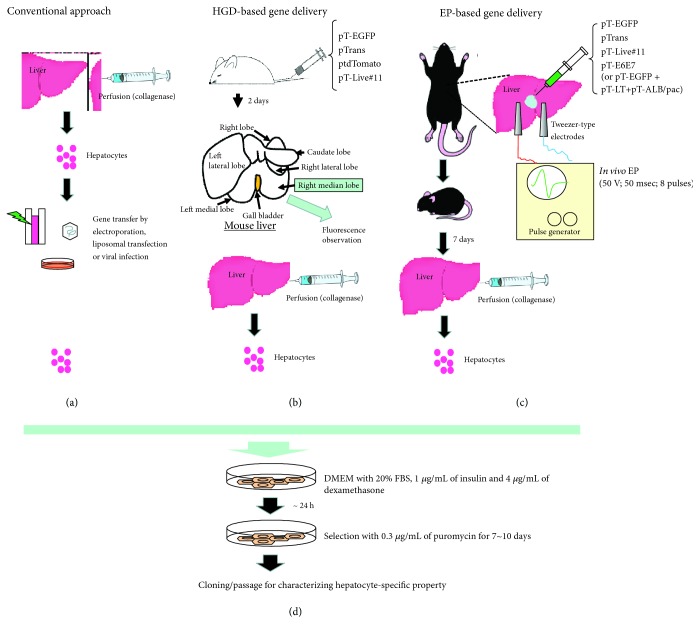
Isolation of hepatocytes and their culture represent important avenues to explore the function of such cells. However, these studies are often difficult to perform because of the inability of hepatocytes to proliferate . Immortalization of isolated hepatocytes is thus an important step toward continuous culture. For cellular immortalization, integration of relevant genes into the host chromosomes is a prerequisite. Transposons, which are mobile genetic elements, are known to facilitate integration of genes of interest (GOI) into chromosomes and . Here, we proposed that a combination of transposon- and liver-directed introduction of nucleic acids may confer acquisition of unlimited cellular proliferative potential on hepatocytes, enabling the possible isolation of immortalized hepatocyte cell lines, which has often failed using more traditional immortalization methods.
肝细胞的分离及其培养是探索此类细胞功能的重要途径。然而,由于肝细胞无法增殖,这些研究往往难以开展。因此,分离的肝细胞永生化是实现连续培养的重要一步。对于细胞永生化而言,将相关基因整合到宿主染色体是一个先决条件。转座子作为可移动的遗传元件,已知其有助于将目的基因(GOI)整合到染色体中。在此,我们提出,转座子与肝脏定向核酸导入相结合,可能赋予肝细胞无限的细胞增殖潜能,从而有可能分离出永生化肝细胞系,而使用更传统的永生化方法往往无法做到这一点。