Department of Wine and Food Science, The University of Adelaide (UA), PMB 1, Glen Osmond, SA 5064, Australia.
Australian Research Council Training Centre for Innovative Wine Production, UA, PMB 1, Glen Osmond, SA 5064, Australia.
Molecules. 2019 Jul 5;24(13):2472. doi: 10.3390/molecules24132472.
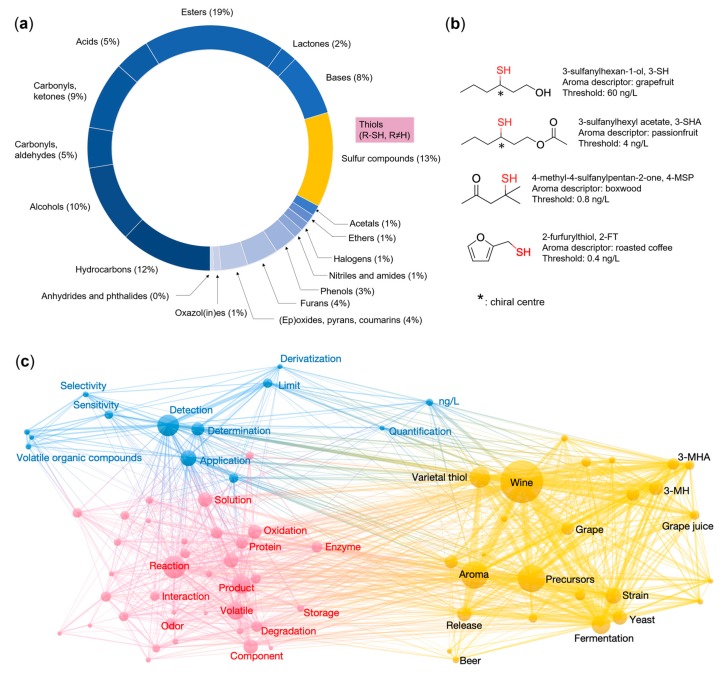
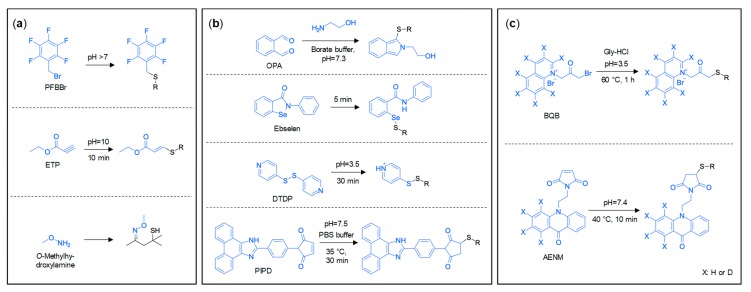
Certain volatile thiols are some of the most potent odour-active molecules that are found in nature. Thiols play significant roles in the aroma qualities of a range of foods and beverages, including wine, with extremely low odour detection thresholds (nanogram per litre range). A fundamental understanding of their formation, fate, and impact essentially depends on the development of suitable analytical methods. The analysis of volatile thiols in foods and beverages is a challenging task when considering (1) the complexity of food and beverage matrices and (2) that thiols are highly reactive, low molecular-weight volatiles that are generally present at trace to ultra-trace concentrations. For the past three decades, the analytical evaluation of volatile thiols has been intensively performed in various foods and beverages, and many novel techniques related to derivatisation, isolation, separation, and detection have been developed, particularly by wine researchers. This review aims to provide an up-to-date overview of the major analytical methodologies that are proposed for potent volatile thiol analysis in wine, foods, and other beverages. The analytical challenges for thiol analysis in foods and beverages are outlined, and the main analytical methods and recent advances in methodology are summarised and evaluated for their strengths and limitations. The key analytical aspects reviewed include derivatisation and sample preparation techniques, chromatographic separation, mass spectrometric detection, matrix effects, and quantitative analysis. In addition, future perspectives on volatile thiol research are also suggested.
某些挥发性硫醇是自然界中最具活性的气味分子之一。硫醇在包括葡萄酒在内的一系列食品和饮料的香气质量中发挥着重要作用,其气味检测阈值极低(纳克/升范围)。对其形成、命运和影响的基本理解本质上取决于合适的分析方法的发展。考虑到(1)食品和饮料基质的复杂性,以及(2)硫醇是高度反应性的、低分子量的挥发性物质,通常以痕量至超痕量浓度存在,因此分析食品和饮料中的挥发性硫醇是一项具有挑战性的任务。在过去的三十年中,对各种食品和饮料中的挥发性硫醇进行了广泛的分析评估,并且开发了许多与衍生化、分离、分离和检测相关的新技术,特别是葡萄酒研究人员。本文旨在提供一份最新的综述,概述了用于葡萄酒、食品和其他饮料中强挥发性硫醇分析的主要分析方法。概述了食品和饮料中硫醇分析的分析挑战,并对主要分析方法和最新方法进展进行了总结和评估,以了解其优缺点。综述的关键分析方面包括衍生化和样品制备技术、色谱分离、质谱检测、基质效应和定量分析。此外,还对挥发性硫醇研究的未来展望进行了探讨。