
1 型糖尿病小鼠模型中 Na1.7 和甲基乙二醛介导的 TRPA1 激活在瘙痒和痛觉过敏中的作用。
The role of Na1.7 and methylglyoxal-mediated activation of TRPA1 in itch and hypoalgesia in a murine model of type 1 diabetes.
机构信息
Jiangsu Key Laboratory of Neuropsychiatric Diseases and the Second Affiliated Hospital of Soochow University, Suzhou 215004, P.R. China.
Institute of Neuroscience, Soochow University, Suzhou, 215021, P.R. China.
出版信息
Theranostics. 2019 May 31;9(15):4287-4307. doi: 10.7150/thno.36077. eCollection 2019.
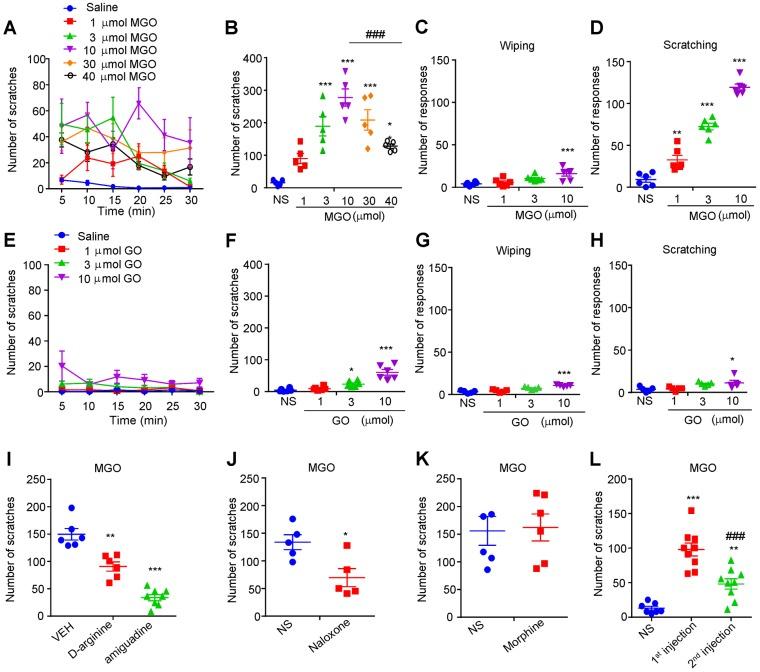
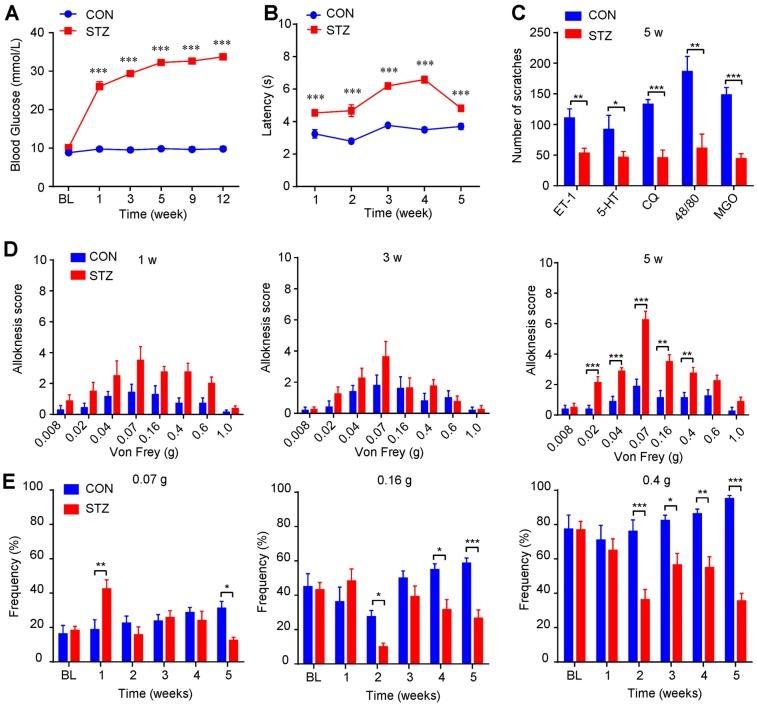
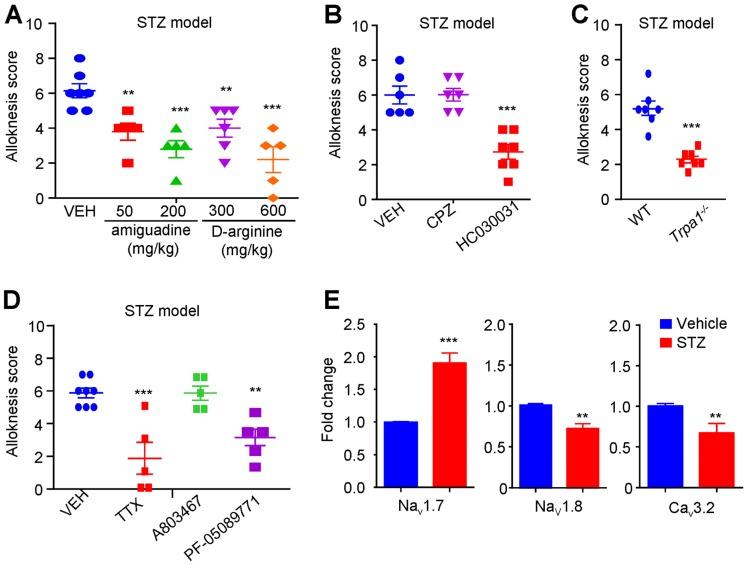
Methylglyoxal (MGO), an endogenous reactive carbonyl compound, plays a key role in the pathogenesis of diabetic neuropathy. The aim of this study is to investigate the role of MGO in diabetic itch and hypoalgesia, two common symptoms associated with diabetic neuropathy. : Scratching behavior, mechanical itch (alloknesis), and thermal hypoalgesia were quantified after intradermal (i.d.) injection of MGO in naïve mice or in diabetic mice induced by intraperitoneal (i.p.) injection of streptozotocin (STZ). Behavioral testing, patch-clamp recording, transgenic mice, and gene expression analysis were used to investigate the mechanisms underlying diabetic itch and hypoalgesia in mice. : I.d. injection of MGO evoked dose-dependent scratching in normal mice. Addition of MGO directly activated transient receptor potential ankyrin 1 (TRPA1) to induce inward currents and calcium influx in dorsal root ganglia (DRG) neurons or in TRPA1-expressing HEK293 cells. Mechanical itch, but not spontaneous itch was developed in STZ-induced diabetic mice. Genetic ablation of ( ), pharmacological blockade of TRPA1 and Na1.7, antioxidants, and mitogen-activated protein kinase kinase enzyme (MEK) inhibitor U0126 abrogated itch induced by MGO or in STZ-induced diabetic mice. Thermal hypoalgesia was induced by intrathecal (i.t.) injection of MGO or in STZ-induced diabetic mice, which was abolished by MGO scavengers, intrathecal injection of TRPA1 blockers, and in mice. : This study revealed that Na1.7 and MGO-mediated activation of TRPA1 play key roles in itch and hypoalgesia in a murine model of type 1 diabetes. Thereby, we provide a novel potential therapeutic strategy for the treatment of itch and hypoalgesia induced by diabetic neuropathy.
甲基乙二醛(MGO)是一种内源性反应性羰基化合物,在糖尿病性神经病发病机制中起关键作用。本研究旨在探讨 MGO 在糖尿病性瘙痒和痛觉减退(与糖尿病性神经病相关的两种常见症状)中的作用。在未处理的小鼠或通过腹腔注射链脲佐菌素(STZ)诱导的糖尿病小鼠中,经皮(i.d.)注射 MGO 后,量化搔抓行为、机械性瘙痒(alloknesis)和热痛觉减退。使用行为测试、膜片钳记录、转基因小鼠和基因表达分析来研究导致小鼠糖尿病性瘙痒和痛觉减退的机制。在正常小鼠中,i.d.注射 MGO 会诱发剂量依赖性搔抓。MGO 的直接添加可激活瞬时受体电位锚蛋白 1(TRPA1),以在背根神经节(DRG)神经元或表达 TRPA1 的 HEK293 细胞中诱导内向电流和钙内流。在 STZ 诱导的糖尿病小鼠中,会产生机械性瘙痒,但不会自发瘙痒。( )的基因缺失、TRPA1 和 Na1.7 的药理学阻断、抗氧化剂和丝裂原激活蛋白激酶激酶酶(MEK)抑制剂 U0126 可消除 MGO 诱导的瘙痒或 STZ 诱导的糖尿病小鼠中的瘙痒。经鞘内(i.t.)注射 MGO 或在 STZ 诱导的糖尿病小鼠中可诱导热痛觉减退,经鞘内注射 TRPA1 阻断剂和在 小鼠中可消除这种减退。这项研究揭示了 Na1.7 和 MGO 介导的 TRPA1 激活在 1 型糖尿病小鼠模型中的瘙痒和痛觉减退中起关键作用。因此,我们为治疗由糖尿病性神经病引起的瘙痒和痛觉减退提供了一种新的潜在治疗策略。







 Zotero 插件