Institut de Ciències del Mar, Spanish National Research Council (CSIC), Barcelona, Spain.
The New Zealand Institute for Plant & Food Research, Nelson, New Zealand.
Mol Biol Evol. 2019 Oct 1;36(10):2252-2264. doi: 10.1093/molbev/msz153.
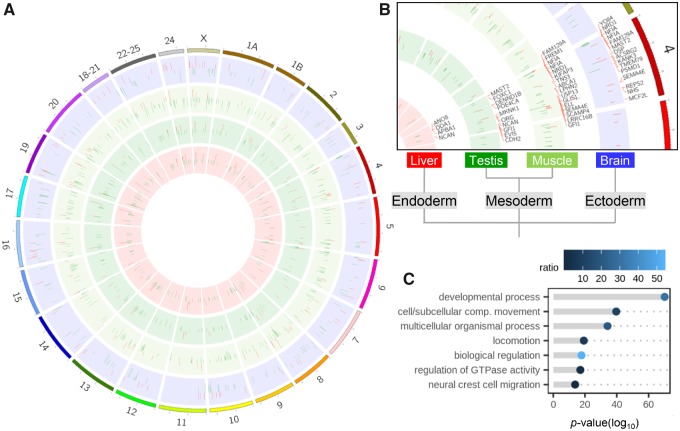
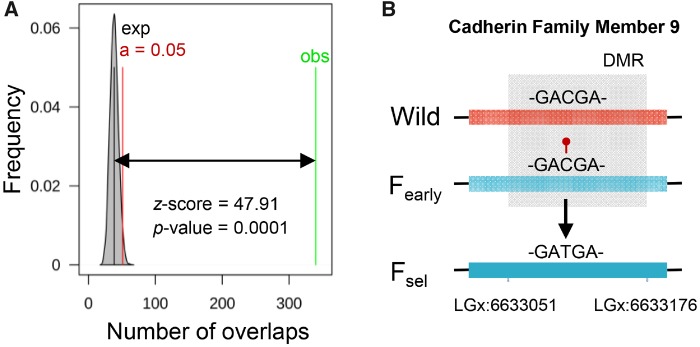
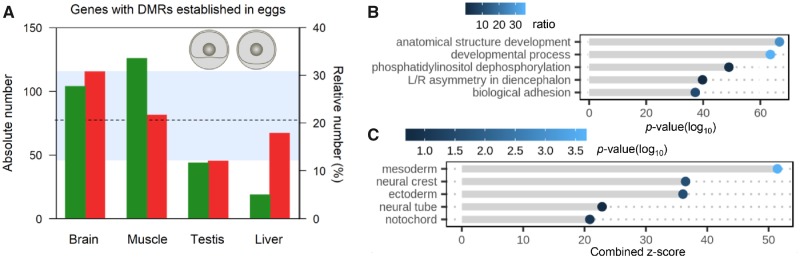
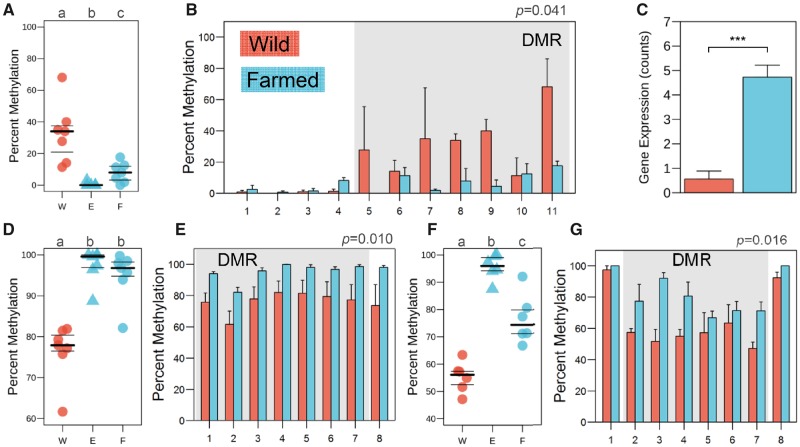
Domestication of wild animals induces a set of phenotypic characteristics collectively known as the domestication syndrome. However, how this syndrome emerges is still not clear. Recently, the neural crest cell deficit hypothesis proposed that it is generated by a mildly disrupted neural crest cell developmental program, but clear support is lacking due to the difficulties of distinguishing pure domestication effects from preexisting genetic differences between farmed and wild mammals and birds. Here, we use a farmed fish as model to investigate the role of persistent changes in DNA methylation (epimutations) in the process of domestication. We show that early domesticates of sea bass, with no genetic differences with wild counterparts, contain epimutations in tissues with different embryonic origins. About one fifth of epimutations that persist into adulthood are established by the time of gastrulation and affect genes involved in developmental processes that are expressed in embryonic structures, including the neural crest. Some of these genes are differentially expressed in sea bass with lower jaw malformations, a key feature of domestication syndrome. Interestingly, these epimutations significantly overlap with cytosine-to-thymine polymorphisms after 25 years of selective breeding. Furthermore, epimutated genes coincide with genes under positive selection in other domesticates. We argue that the initial stages of domestication include dynamic alterations in DNA methylation of developmental genes that affect the neural crest. Our results indicate a role for epimutations during the beginning of domestication that could be fixed as genetic variants and suggest a conserved molecular process to explain Darwin's domestication syndrome across vertebrates.
野生动物的驯化诱导出一组表型特征,统称为驯化综合征。然而,这种综合征是如何出现的还不清楚。最近,神经嵴细胞缺陷假说提出,它是由轻度破坏的神经嵴细胞发育程序产生的,但由于难以区分纯粹的驯化效应与养殖和野生哺乳动物和鸟类之间存在的固有遗传差异,因此缺乏明确的支持。在这里,我们使用养殖鱼类作为模型来研究 DNA 甲基化(表观遗传)在驯化过程中的作用。我们表明,鲈鱼的早期驯化种与野生种没有遗传差异,但在不同胚胎起源的组织中存在表观遗传变化。大约五分之一在成年期持续存在的表观遗传变化是在原肠胚形成时期建立的,并且影响在胚胎结构中表达的发育过程相关基因,包括神经嵴。其中一些基因在具有下颌骨畸形的鲈鱼中差异表达,这是驯化综合征的一个关键特征。有趣的是,这些表观遗传变化与 25 年选择性繁殖后的胞嘧啶到胸腺嘧啶多态性显著重叠。此外,表观遗传变化的基因与其他驯化种中受正选择作用的基因相吻合。我们认为,驯化的初始阶段包括发育基因中 DNA 甲基化的动态改变,这会影响神经嵴。我们的结果表明,在驯化的早期阶段,表观遗传变化可能作为遗传变异而固定下来,并提出了一个保守的分子过程来解释达尔文的脊椎动物驯化综合征。