Hospital for Special Surgery, New York, NY, USA.
Weill Cornell Medical College, New York, NY, USA.
Aging Cell. 2019 Oct;18(5):e13006. doi: 10.1111/acel.13006. Epub 2019 Jul 10.
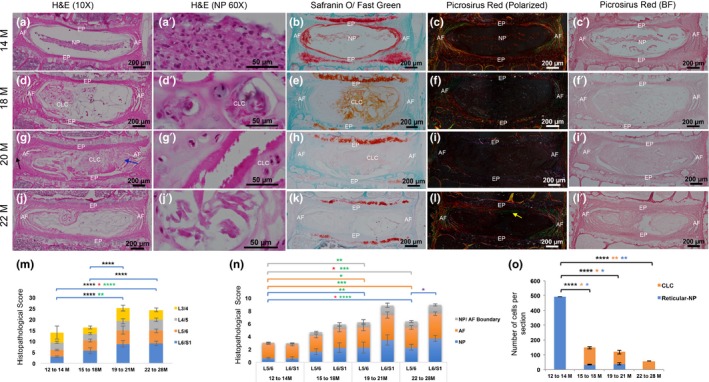
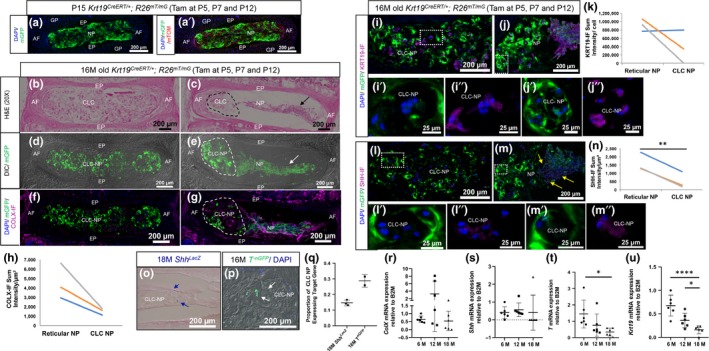
Aging is a major risk factor of intervertebral disc degeneration and a leading cause of back pain. Pathological changes associated with disc degeneration include the absence of large, vacuolated and reticular-shaped nucleus pulposus cells, and appearance of smaller cells nested in lacunae. These small nested cells are conventionally described as chondrocyte-like cells; however, their origin in the intervertebral disc is unknown. Here, using a genetic mouse model and a fate mapping strategy, we have found that the chondrocyte-like cells in degenerating intervertebral discs are, in fact, nucleus pulposus cells. With aging, the nucleus pulposus cells fuse their cell membranes to form the nested lacunae. Next, we characterized the expression of sonic hedgehog (SHH), crucial for the maintenance of nucleus pulposus cells, and found that as intervertebral discs age and degenerate, expression of SHH and its target Brachyury is gradually lost. The results indicate that the chondrocyte-like phenotype represents a terminal stage of differentiation preceding loss of nucleus pulposus cells and disc collapse.
衰老是椎间盘退变的一个主要危险因素,也是导致腰痛的主要原因。与椎间盘退变相关的病理变化包括大而空泡状和网状形状的髓核细胞缺失,以及出现嵌套在腔隙中的较小细胞。这些小的嵌套细胞通常被描述为软骨样细胞;然而,它们在椎间盘内的起源尚不清楚。在这里,我们使用遗传小鼠模型和示踪策略发现,退变椎间盘内的软骨样细胞实际上是髓核细胞。随着年龄的增长,髓核细胞融合其细胞膜形成嵌套的腔隙。接下来,我们对关键性的维持髓核细胞的 Sonic Hedgehog (SHH)的表达进行了特征描述,结果发现,随着椎间盘的衰老和退变,SHH 及其靶基因 Brachyury 的表达逐渐丢失。结果表明,软骨样表型代表了细胞丢失和椎间盘塌陷之前的一个终末分化阶段。