Department of Environmental Health, Rollins School of Public Health, Emory University, Atlanta, GA, USA.
Center for Global Safe Water, Sanitation, and Hygiene, Rollins School of Public Health, Emory University, Atlanta, GA, USA.
BMC Public Health. 2019 Jul 10;19(1):926. doi: 10.1186/s12889-019-7268-1.
Open drains are common methods of transporting solid waste and excreta in low-income urban neighborhoods. Open drains can overflow due to blockages with solid waste and during rainfall, posing exposure risks. The goal of this study was to evaluate whether pediatric enteric infection was associated with open drains and flooding in a dense, low-income, urban neighborhood.
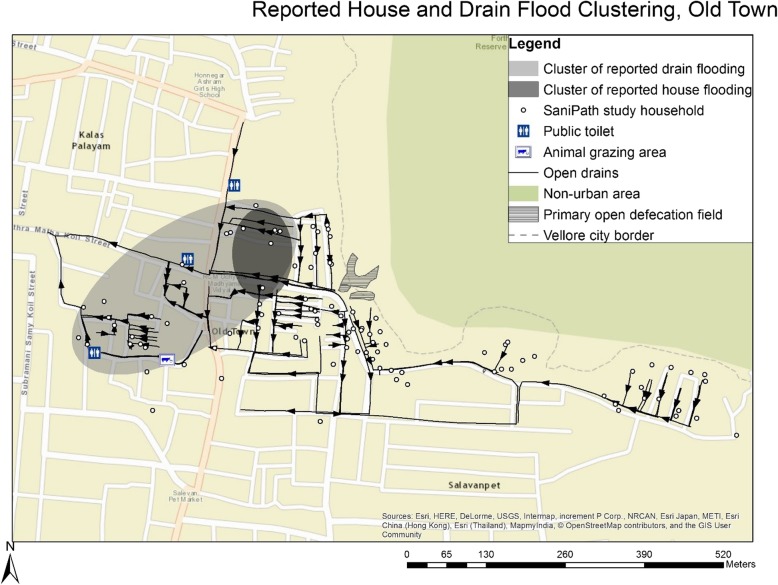
As part of the MAL-ED study in Vellore, India, a cohort of 230 children provided stool specimens at 14-17 scheduled home visits and during diarrheal episodes in the first two years of life. All specimens were analyzed for enteric pathogens. Caregivers in 100 households reported on flooding of drains and households and monthly frequency of contact with open drains and flood water. Household GPS points were collected. Monthly rainfall totals for the Vellore district were collected from the Indian Meteorological Department. Clustering of reported drain and house flooding were identified by Kulldorff's Bernoulli Spatial Scan. Differences in enteric infection were assessed for household responses and spatial clusters, with interactions between reported flooding and rainfall to approximate monthly drain flooding retrospectively, using multivariable, mixed-effects logistic regression models.
Coverage of household toilets was low (33%), and most toilets (82%) discharged directly into open drains, suggesting poor neighborhood fecal sludge management. Odds of enteric infection increased significantly with total monthly rainfall for children who lived in households that reported that the nearby drain flooded (4% increase per cm of rain: OR: 1.04, 95% CI: 1.00-1.08) and for children in households in a downstream spatial cluster of reported drain flooding (5% increase per cm of rain: OR: 1.05, 95% CI: 1.01-1.09). There was no association between odds of enteric infection and frequency of reported contact with drain or floodwater.
Children in areas susceptible to open drain flooding had increased odds of enteric infection as rainfall increased. Results suggested that infection increased with rainfall due to neighborhood infrastructure (including poor fecal sludge management) and not frequency of contact. Thus, these exposures may not be mitigated by changes in personal behaviors alone. These results underscore the importance of improving the neighborhood environment to improve children's health in low-income, urban settings.
在低收入城市社区,明渠是运输固体废物和排泄物的常用方法。明渠可能会因固体废物堵塞和降雨而溢出,从而带来暴露风险。本研究的目的是评估在密集、低收入的城市社区中,小儿肠道感染是否与明渠和洪水有关。
作为印度维洛尔 MAL-ED 研究的一部分,230 名儿童在生命的头两年中,每 14-17 次定期家访和腹泻发作时提供粪便样本。所有标本均分析肠道病原体。100 户家庭的护理人员报告了明渠和家庭的洪水情况以及每月接触明渠和洪水的频率。收集家庭的 GPS 点。从印度气象局收集维洛尔地区的每月降雨量总和。使用 Kulldorff 的 Bernoulli 空间扫描识别报告的明渠和房屋洪水的聚类。使用多变量混合效应逻辑回归模型,评估家庭对肠道感染的反应和空间聚类的差异,并评估报告的洪水和降雨之间的相互作用,以回顾性地近似每月明渠洪水,
家庭厕所的覆盖率较低(33%),大多数厕所(82%)直接排入明渠,表明附近社区的粪便处理管理不善。对于报告附近明渠洪水的家庭,肠道感染的几率随着每月总降雨量显著增加(每厘米降雨增加 4%:OR:1.04,95%CI:1.00-1.08),对于处于报告明渠洪水下游空间聚类的家庭,肠道感染的几率也显著增加(每厘米降雨增加 5%:OR:1.05,95%CI:1.01-1.09)。肠道感染的几率与报告的接触明渠或洪水的频率之间没有关联。
易受明渠洪水影响的地区的儿童,随着降雨量的增加,患肠道感染的几率增加。结果表明,由于邻里基础设施(包括粪便处理不善)而不是接触频率,感染随降雨量增加而增加。因此,这些暴露可能不能仅通过改变个人行为来缓解。这些结果强调了改善邻里环境以改善低收入城市环境中儿童健康的重要性。