Division of Psychology and Mental Health, School of Health Sciences, Faculty of Biology, Medicine and Health, Manchester Academic Health Science Centre, The University of Manchester, Oxford Road, Manchester, M13 9PL, UK.
Division of Nursing, Midwifery and Social Work, School of Health Sciences, Faculty of Biology, Medicine and Health, Manchester Academic Health Science Centre, The University of Manchester, Oxford Road, Manchester, M13 9PL, UK.
BMC Psychiatry. 2019 Jul 10;19(1):217. doi: 10.1186/s12888-019-2195-3.
Previous research has shown that our perceptions about illness are important determinants of how we respond and adjust to health threats. To examine whether illness perceptions affect illness responses in OCD (e.g. help-seeking), this study aimed to develop and test the psychometric properties of a new OCD-specific tool to assess illness perceptions, the illness perceptions questionnaire for OCD (IPQ-O).
A cross-sectional questionnaire-based design was used. Following adaptation of the IPQ-R based on qualitative interviews with people with OCD, adults (age ≥ 16) with OCD completed the IPQ-O (online or postal), alongside measures of depression, anxiety, OCD severity, attitudes to seeking mental health services and behaviours (e.g. treatment seeking intentions). A sub-sample re-completed the IPQ-O after two-weeks to obtain test-retest reliability. Factor analysis was used to derive the IPQ-O factor structure; internal consistency of subscales was calculated. Convergent validity was explored.
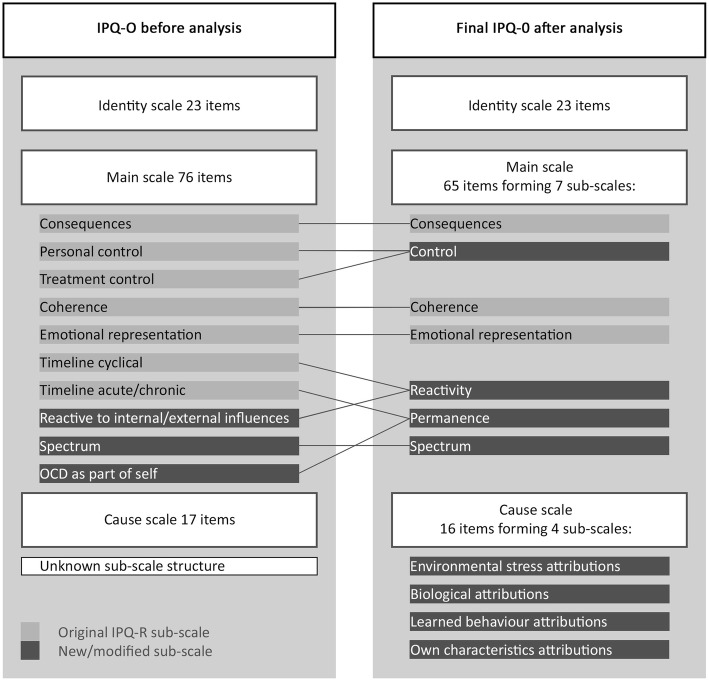
Three hundred forty-eight people with OCD completed the IPQ-O. After factor analysis, seven main sub-scales and four cause sub-scales were identified, explaining 45.5 and 41.6% of the variance after extraction and rotation respectively. Three sub-scales from the original IPQ-R were validated; other dimensions differed from original IPQ-R sub-scales. The new 'spectrum' sub-scale measures the strength of the view that OCD is a trait that presents to varying extents within the general population. The IPQ-O demonstrated internal consistency, test re-test reliability (Kendall's tau = .51-.75) and convergent validity. Illness perceptions were associated with important aspects of adjustment (depression, anxiety) and condition management (receipt of treatment, plans to seek help). In particular, emerging data showed that those who had not received medication for OCD endorsed stronger spectrum beliefs. Though longitudinal study is needed to verify the direction of this association, this raises the question of whether spectrum beliefs deter people with OCD from using pharmacological treatments.
The IPQ-O provides a valuable tool for subsequent testing of whether illness perceptions drive outcomes as proposed by the CSM. If perceptions are found to drive adjustment and behaviour, therapists could elicit and subsequently challenge perceptions that have negative effects on adjustment and coping, as part of psychological therapy.
既往研究表明,我们对疾病的认知是影响我们应对健康威胁的重要决定因素。为了检验疾病认知是否会影响强迫症(OCD)患者的疾病反应(例如寻求帮助),本研究旨在开发和测试一种新的 OCD 特异性工具来评估疾病认知,即强迫症疾病认知问卷(IPQ-O),并检验其信度和效度。
采用横断面问卷调查设计。在对 OCD 患者进行定性访谈后,对 IPQ-R 进行改编,然后让成年 OCD 患者(年龄≥16 岁)在线或邮寄填写 IPQ-O(同时填写抑郁、焦虑、OCD 严重程度、对寻求心理健康服务的态度和行为(如治疗意愿)等)。一小部分患者在两周后重新填写 IPQ-O,以获得重测信度。采用因子分析得出 IPQ-O 的因子结构;计算各分量表的内部一致性。探索了聚合效度。
348 名 OCD 患者完成了 IPQ-O。经过因子分析,确定了 7 个主要分量表和 4 个病因分量表,分别解释了提取和旋转后 45.5%和 41.6%的变异。原 IPQ-R 中的 3 个分量表得到验证;其他维度与原 IPQ-R 分量表不同。新的“谱”分量表用于衡量 OCD 是一种特质的观点,该观点在一般人群中以不同程度出现。IPQ-O 具有内部一致性、重测信度(Kendall tau=0.51-0.75)和聚合效度。疾病认知与调整(抑郁、焦虑)和病情管理(接受治疗、寻求帮助的计划)的重要方面有关。特别是,新出现的数据表明,那些没有接受过 OCD 药物治疗的患者,其谱信念更强烈。尽管需要进行纵向研究来验证这种关联的方向,但这提出了一个问题,即谱信念是否会阻止 OCD 患者使用药物治疗。
IPQ-O 为后续检验 CSM 提出的疾病认知是否会影响结果提供了有价值的工具。如果发现认知会影响调整和行为,治疗师可以在心理治疗中引出并随后挑战那些对调整和应对产生负面影响的认知。