School of Chemistry.
Manchester Institute of Biotechnology, and.
Blood Adv. 2019 Jul 23;3(14):2069-2081. doi: 10.1182/bloodadvances.2019000098.
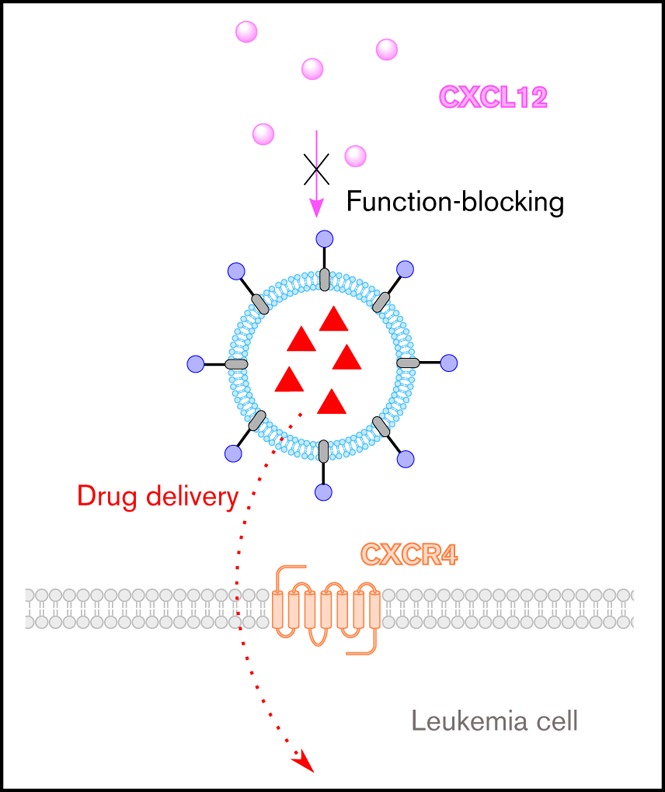
CXC chemokine receptor 4 (CXCR4) is overexpressed by a broad range of hematological disorders, and its interaction with CXC chemokine ligand 12 (CXCL12) is of central importance in the retention and chemoprotection of neoplastic cells in the bone marrow and lymphoid organs. In this article, we describe the biological evaluation of a new CXCR4-targeting and -antagonizing molecule (BAT1) that we designed and show that, when incorporated into a liposomal drug delivery system, it can be used to deliver cancer therapeutics at high levels to chronic lymphocytic leukemia (CLL) cells. CXCR4 targeting and antagonism by BAT1 were demonstrated alone and following its incorporation into liposomes (BAT1-liposomes). Antagonism of BAT1 against the CXCR4/CXCL12 interaction was demonstrated through signaling inhibition and function blocking: BAT1 reduced ERK phosphorylation and cell migration to levels equivalent to those seen in the absence of CXCL12 stimulation ( < .001). Specific uptake of BAT1-liposomes and delivery of a therapeutic cargo to the cell nucleus was seen within 3 hours of incubation and induced significantly more CLL cell death after 24 hours than control liposomes ( = .004). The BAT1 drug-delivery system is modular, versatile, and highly clinically relevant, incorporating elements of proven clinical efficacy. The combined capabilities to block CXCL12-induced migration and intracellular signaling while simultaneously delivering therapeutic cargo mean that the BAT1-liposome drug-delivery system could be a timely and relevant treatment of a range of hematological disorders, particularly because the therapeutic cargo can be tailored to the disease being treated.
CXC 趋化因子受体 4(CXCR4)在广泛的血液系统疾病中过度表达,其与 CXC 趋化因子配体 12(CXCL12)的相互作用对于恶性细胞在骨髓和淋巴器官中的保留和化学保护具有核心重要性。在本文中,我们描述了一种新的 CXCR4 靶向和拮抗分子(BAT1)的生物学评估,该分子是我们设计的,并表明当它被整合到脂质体药物递送系统中时,它可以用于将癌症治疗药物高水平递送到慢性淋巴细胞白血病(CLL)细胞。BAT1 单独靶向和拮抗 CXCR4/CXCL12 相互作用,以及其被整合到脂质体中(BAT1-脂质体)后。BAT1 对 CXCR4/CXCL12 相互作用的拮抗作用通过信号抑制和功能阻断得到证实:BAT1 降低 ERK 磷酸化和细胞迁移至与不存在 CXCL12 刺激时相当的水平(<.001)。在孵育 3 小时内观察到 BAT1-脂质体的特异性摄取和治疗货物递送到细胞核,并在 24 小时后诱导显著更多的 CLL 细胞死亡,而对照脂质体(=.004)。BAT1 药物递送系统是模块化、多功能的,并且高度与临床相关,包含已证明具有临床疗效的元素。同时阻断 CXCL12 诱导的迁移和细胞内信号以及同时递送治疗货物的组合能力意味着 BAT1-脂质体药物递送系统可以及时、相关地治疗一系列血液系统疾病,特别是因为治疗货物可以根据所治疗的疾病进行定制。