From Translational Neuroscience and Aging Laboratory (J.K.-R., Y.E.G.) and Departments of Psychiatry and Psychology (Y.E.G.) and Neurology (Y.E.G.), Mayo Clinic, Scottsdale, AZ; Departments of Health Sciences Research (J.A.S., M.V., M.M. Mielke, W.K.K., Y.E.G.), Psychiatry and Psychology (M.M. Machulda), and Neurology (M.M. Mielke, D.S.K., R.C.P.), Mayo Clinic, Rochester, MN; and Institute of Sports and Sports Science (J.K.-R.), Karlsruhe Institute of Technology, Germany.
Neurology. 2019 Aug 6;93(6):e548-e558. doi: 10.1212/WNL.0000000000007897. Epub 2019 Jul 10.
To investigate whether timing, number, and frequency of mentally stimulating activities in midlife and late life are associated with the risk of incident mild cognitive impairment (MCI).
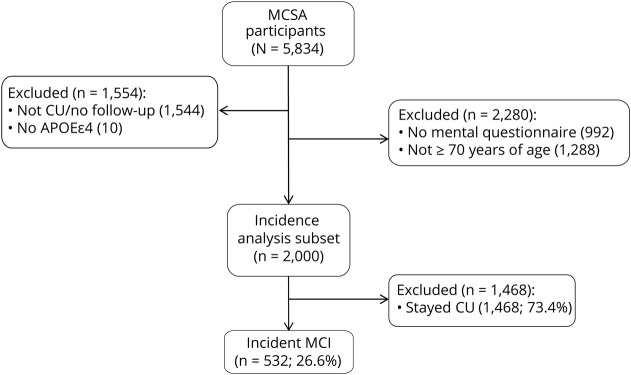
We conducted a prospective cohort study in the setting of the population-based Mayo Clinic Study of Aging in Olmsted County, Minnesota, including 2,000 individuals aged ≥70 years who were cognitively unimpaired at baseline and were followed for a median of 5.0 years. Participants completed a self-reported survey on timing, number, and frequency of engagement in 5 mentally stimulating activities (reading books, computer use, social activities, playing games, craft activities) at baseline.
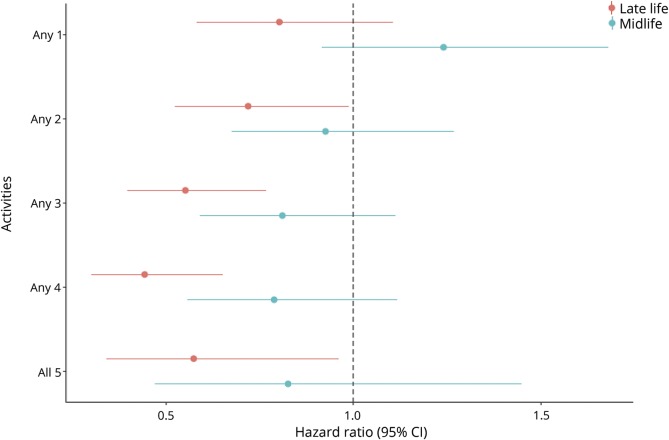
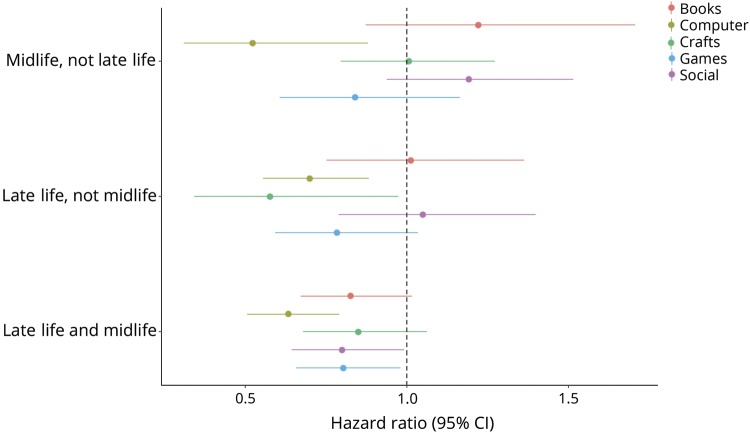
The risk of incident MCI was significantly reduced for participants who engaged in social activities (hazard ratio [95% confidence interval] 0.80 [0.64-0.99]) and playing games (0.80 [0.66-0.98]) in both late life and midlife combined. Using a computer was associated with a decreased risk regardless of timing (not late life but midlife: 0.52 [0.31-0.88]; late life but not midlife: 0.70 [0.56-0.88]; late life and midlife: 0.63 [0.51-0.79]). Craft activities were associated with a reduced risk of incident MCI only when carried out in late life but not midlife (0.58 [0.34-0.97]). Furthermore, engaging in a higher number of activities in late life was associated with a significantly reduced risk of incident MCI (any 2 activities: 0.72 [0.53-0.99], any 3: 0.55 [0.40-0.77], any 4: 0.44 [0.30-0.65], all 5: 0.57 [0.34-0.96]).
Engaging in a higher number of mentally stimulating activities, particularly in late life, is associated with a decreased risk of MCI among community-dwelling older persons.
研究中年和晚年时精神刺激活动的时间、数量和频率是否与轻度认知障碍(MCI)的发病风险相关。
我们在明尼苏达州奥姆斯特德县的基于人群的梅奥诊所衰老研究中进行了一项前瞻性队列研究,纳入了 2000 名基线时认知正常且中位随访时间为 5.0 年的年龄≥70 岁的个体。参与者在基线时完成了一份关于参与 5 种精神刺激活动(阅读书籍、使用计算机、社交活动、玩游戏、手工艺活动)的时间、数量和频率的自我报告调查。
在中年和晚年均参与社交活动(危险比[95%置信区间]0.80 [0.64-0.99])和玩游戏(0.80 [0.66-0.98])的参与者中,MCI 发病风险显著降低。无论时间如何,使用计算机都与风险降低相关(非晚年但中年:0.52 [0.31-0.88];晚年但非中年:0.70 [0.56-0.88];晚年和中年:0.63 [0.51-0.79])。手工艺活动仅在晚年进行时与 MCI 发病风险降低相关(0.58 [0.34-0.97])。此外,晚年参与更多的活动与 MCI 发病风险显著降低相关(任何 2 项活动:0.72 [0.53-0.99],任何 3 项:0.55 [0.40-0.77],任何 4 项:0.44 [0.30-0.65],所有 5 项:0.57 [0.34-0.96])。
在社区居住的老年人中,参与更多的精神刺激活动,尤其是晚年参与更多的活动,与 MCI 发病风险降低相关。