Dale Matthew, Miller Julian F, Stepney Susan, Trefzer Martin A
Department of Computer Science, University of York, York YO10 5DD, UK.
York Cross-disciplinary Centre for Systems Analysis, University of York, York YO10 5DD, UK.
Proc Math Phys Eng Sci. 2019 Jun;475(2226):20180723. doi: 10.1098/rspa.2018.0723. Epub 2019 Jun 19.
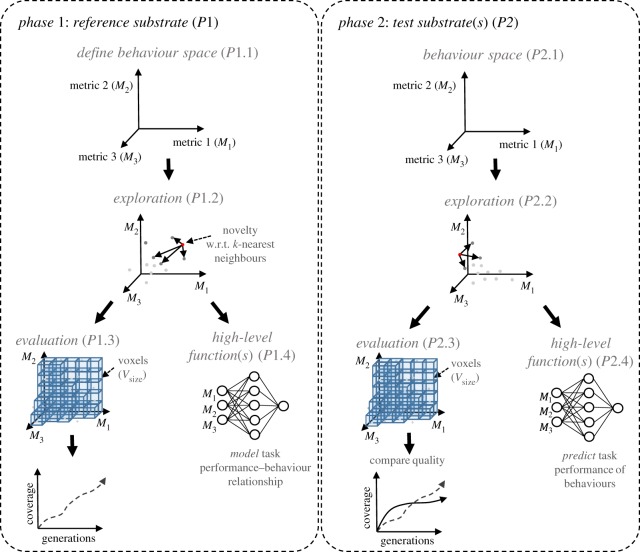
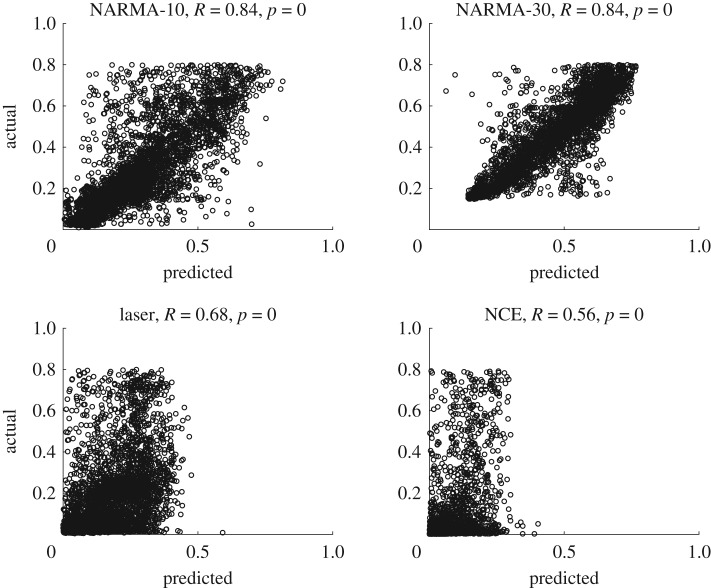
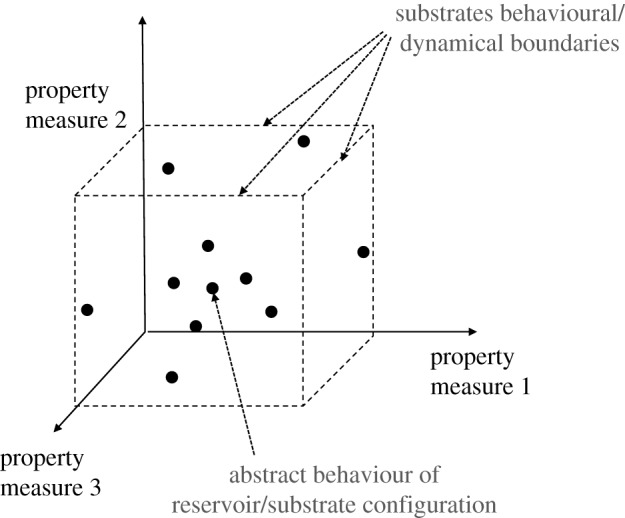
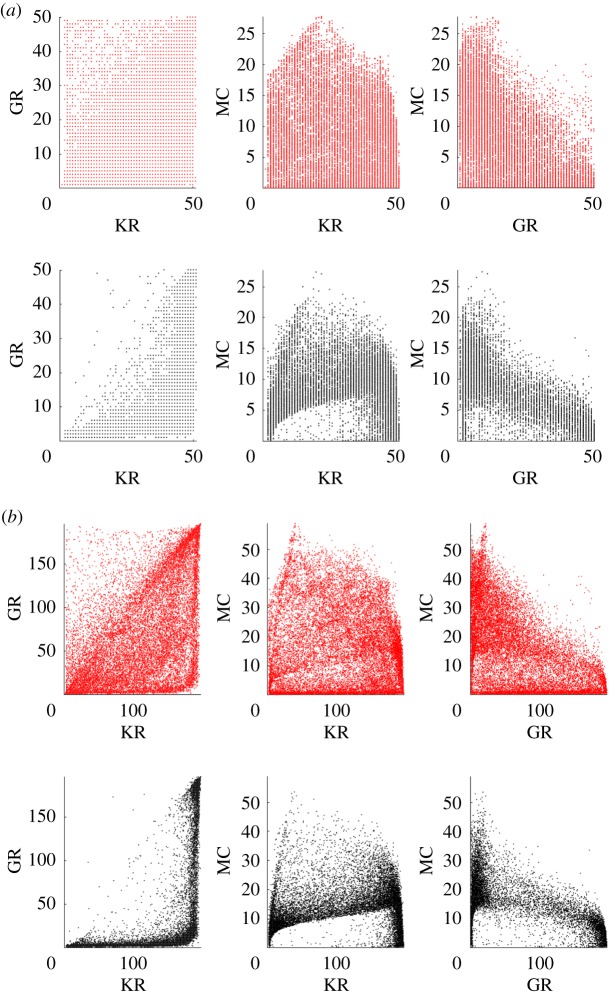
The reservoir computing (RC) framework states that any nonlinear, input-driven dynamical system (the ) exhibiting properties such as a fading memory and input separability can be trained to perform computational tasks. This broad inclusion of systems has led to many new physical substrates for RC. Properties essential for reservoirs to compute are tuned through reconfiguration of the substrate, such as change in virtual topology or physical morphology. As a result, each substrate possesses a unique 'quality'-obtained through reconfiguration-to realize different reservoirs for different tasks. Here we describe an experimental framework to characterize the quality of potentially substrate for RC. Our framework reveals that a definition of quality is not only useful to compare substrates, but can help map the non-trivial relationship between properties and task performance. In the wider context, the framework offers a greater understanding as to what makes a dynamical system compute, helping improve the design of future substrates for RC.
储层计算(RC)框架指出,任何表现出诸如渐逝记忆和输入可分离性等特性的非线性、输入驱动动力系统( )都可以经过训练来执行计算任务。这种对系统的广泛涵盖催生了许多用于RC的新物理基板。通过对基板进行重新配置(如虚拟拓扑或物理形态的改变)来调整储层进行计算所必需的属性。因此,每个基板都具有通过重新配置获得的独特“品质”,以实现适用于不同任务的不同储层。在此,我们描述了一个用于表征RC潜在基板品质的实验框架。我们的框架表明,品质的定义不仅有助于比较基板,还能帮助描绘属性与任务性能之间的重要关系。在更广泛的背景下,该框架有助于更深入地理解使动力系统进行计算的因素,从而有助于改进未来RC基板的设计。