Costa-Ferreira Willian, Morais-Silva Gessynger, Gomes-de-Souza Lucas, Marin Marcelo T, Crestani Carlos C
School of Pharmaceutical Sciences, São Paulo State University (UNESP), Araraquara, Brazil.
Joint UFSCar-UNESP Graduate Program in Physiological Sciences, São Carlos, Brazil.
Front Pharmacol. 2019 Jun 21;10:705. doi: 10.3389/fphar.2019.00705. eCollection 2019.
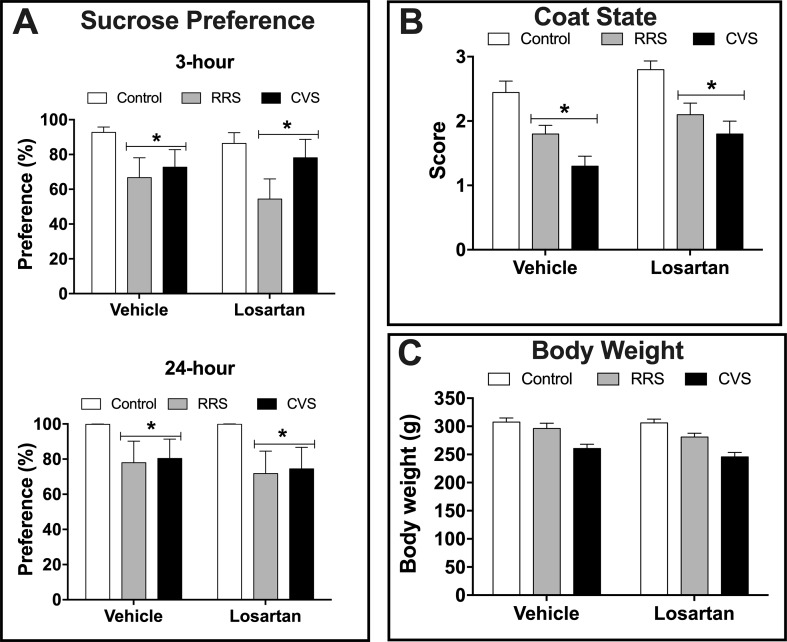
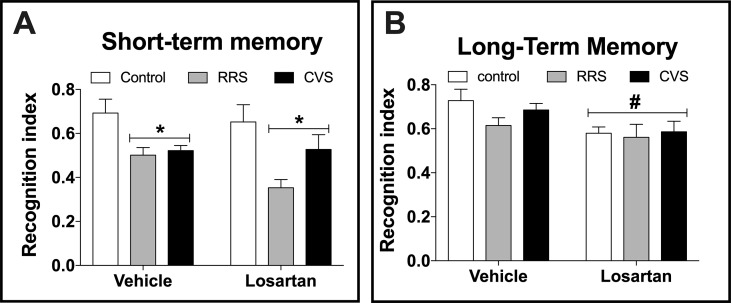
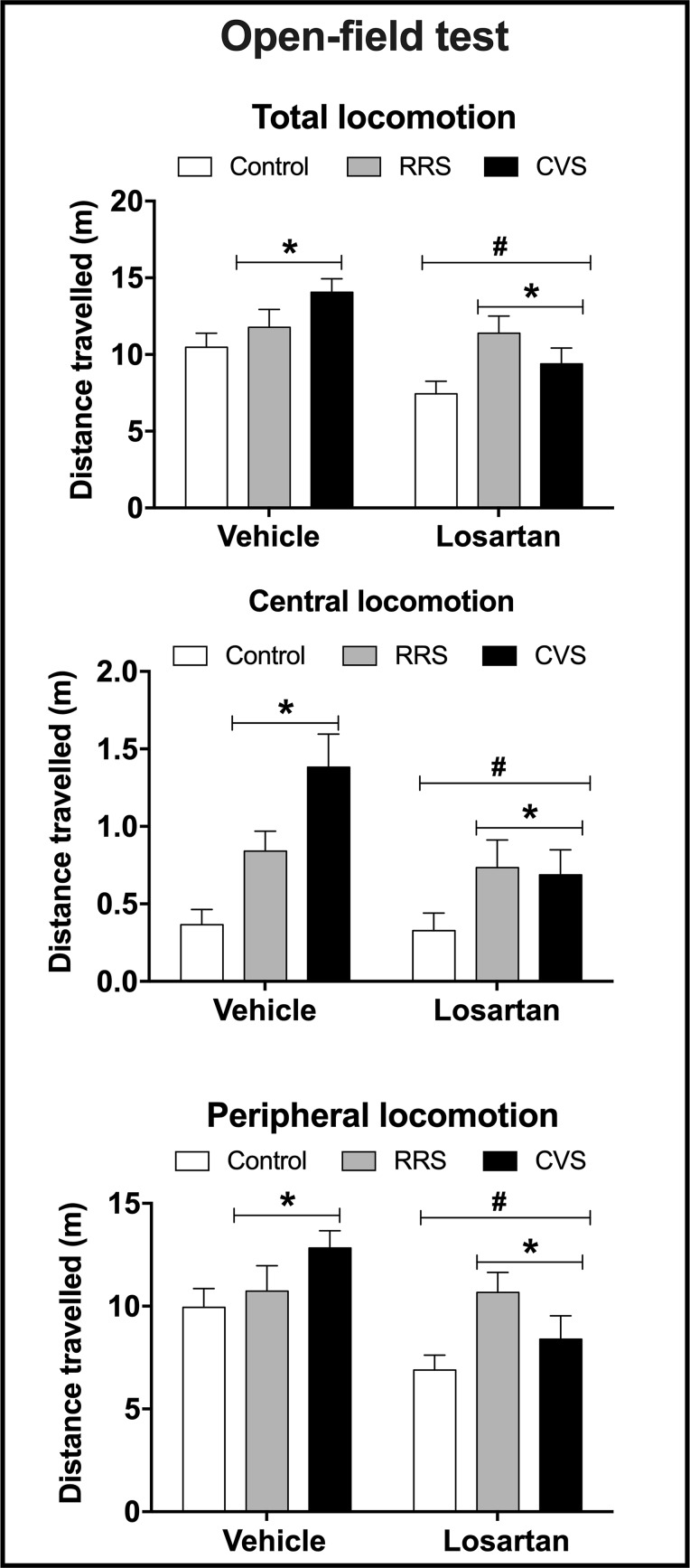
The present study investigated the effect of the treatment with the angiotensin II type 1 receptor (AT) antagonist losartan in the depressive-like state and memory impairment evoked by exposure to either homotypic (i.e., repeated exposure to the same type of stressor) or heterotypic (i.e., exposure to different aversive stimuli) chronic stressors in rats. For this, male Wistar rats were subjected to a 10 days regimen of repeated restraint stress (RRS, homotypic stressor) or chronic variable stress (CVS, heterotypic stressor) while being concurrently treated daily with losartan (30 mg/kg/day, p.o.). Depressive-like state was evaluated by analysis of the alterations considered as markers of depression (decreased sucrose preference and body weight and coat state deterioration), whereas cognitive non-emotional performance was tested using the novel object recognition (NOR) test. Locomotor activity was also evaluated in the open field test. Both RRS and CVS impaired sucrose preference and caused coat state deterioration, whereas only CVS impaired body weight gain. Besides, RRS impaired short-term memory (but not long-term memory) in the NOR test. Neither depressive-like state nor memory impairment evoked by the chronic stressors was affected by the treatment with losartan. Nevertheless, CVS increased the locomotion, which was inhibited by losartan. Taken together, these results provide evidence that the chronic treatment with losartan does not affect the depressive-like state and memory impairment evoked by either homotypic or heterotypic chronic stress regimens in rats.
本研究调查了1型血管紧张素II受体(AT)拮抗剂氯沙坦对大鼠因暴露于同型(即反复暴露于同一类型应激源)或异型(即暴露于不同厌恶刺激)慢性应激源所诱发的抑郁样状态和记忆损伤的治疗效果。为此,雄性Wistar大鼠接受为期10天的反复束缚应激(RRS,同型应激源)或慢性可变应激(CVS,异型应激源)方案,同时每天口服氯沙坦(30 mg/kg/天)。通过分析被视为抑郁标志物的改变(蔗糖偏好降低、体重减轻和皮毛状态恶化)来评估抑郁样状态,而使用新物体识别(NOR)测试来检测认知非情绪表现。还在旷场试验中评估了运动活动。RRS和CVS均损害了蔗糖偏好并导致皮毛状态恶化,而只有CVS损害了体重增加。此外,RRS在NOR测试中损害了短期记忆(但不影响长期记忆)。氯沙坦治疗对慢性应激源诱发的抑郁样状态和记忆损伤均无影响。然而,CVS增加了运动活动,而氯沙坦抑制了这种运动活动。综上所述,这些结果表明,氯沙坦的慢性治疗不会影响大鼠因同型或异型慢性应激方案所诱发的抑郁样状态和记忆损伤。