• 文献检索
  • 文档翻译
  • 深度研究
  • 学术资讯
  • Suppr Zotero 插件Zotero 插件
  • 邀请有礼
  • 套餐&价格
  • 历史记录
应用&插件
Suppr Zotero 插件Zotero 插件浏览器插件Mac 客户端Windows 客户端微信小程序
定价
高级版会员购买积分包购买API积分包
服务
文献检索文档翻译深度研究API 文档MCP 服务
关于我们
关于 Suppr公司介绍联系我们用户协议隐私条款
关注我们

Suppr 超能文献

核心技术专利:CN118964589B侵权必究
粤ICP备2023148730 号-1Suppr @ 2026

文献检索

告别复杂PubMed语法,用中文像聊天一样搜索,搜遍4000万医学文献。AI智能推荐,让科研检索更轻松。

立即免费搜索

文件翻译

保留排版,准确专业,支持PDF/Word/PPT等文件格式,支持 12+语言互译。

免费翻译文档

深度研究

AI帮你快速写综述,25分钟生成高质量综述,智能提取关键信息,辅助科研写作。

立即免费体验

脑肾素-血管紧张素系统与小胶质细胞极化:对衰老和神经退行性变的影响

Brain Renin-Angiotensin System and Microglial Polarization: Implications for Aging and Neurodegeneration.

作者信息

Labandeira-Garcia Jose L, Rodríguez-Perez Ana I, Garrido-Gil Pablo, Rodriguez-Pallares Jannette, Lanciego Jose L, Guerra Maria J

机构信息

Laboratory of Neuroanatomy and Experimental Neurology, Department of Morphological Sciences, Center for Research in Molecular Medicine and Chronic Diseases (CIMUS), University of Santiago de CompostelaSantiago de Compostela, Spain.

Networking Research Center on Neurodegenerative Diseases (CIBERNED)Madrid, Spain.

出版信息

Front Aging Neurosci. 2017 May 3;9:129. doi: 10.3389/fnagi.2017.00129. eCollection 2017.

DOI:10.3389/fnagi.2017.00129
PMID:28515690
原文链接:https://pmc.ncbi.nlm.nih.gov/articles/PMC5413566/
Abstract

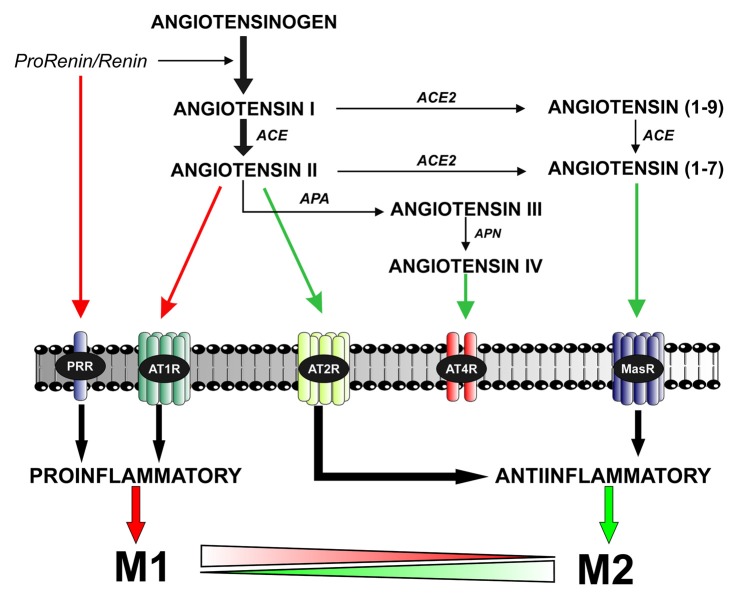
Microglia can transform into proinflammatory/classically activated (M1) or anti-inflammatory/alternatively activated (M2) phenotypes following environmental signals related to physiological conditions or brain lesions. An adequate transition from the M1 (proinflammatory) to M2 (immunoregulatory) phenotype is necessary to counteract brain damage. Several factors involved in microglial polarization have already been identified. However, the effects of the brain renin-angiotensin system (RAS) on microglial polarization are less known. It is well known that there is a "classical" circulating RAS; however, a second RAS (local or tissue RAS) has been observed in many tissues, including brain. The locally formed angiotensin is involved in local pathological changes of these tissues and modulates immune cells, which are equipped with all the components of the RAS. There are also recent data showing that brain RAS plays a major role in microglial polarization. Level of microglial NADPH-oxidase (Nox) activation is a major regulator of the shift between M1/proinflammatory and M2/immunoregulatory microglial phenotypes so that Nox activation promotes the proinflammatory and inhibits the immunoregulatory phenotype. Angiotensin II (Ang II), via its type 1 receptor (AT1), is a major activator of the NADPH-oxidase complex, leading to pro-oxidative and pro-inflammatory effects. However, these effects are counteracted by a RAS opposite arm constituted by Angiotensin II/AT2 receptor signaling and Angiotensin 1-7/Mas receptor (MasR) signaling. In addition, activation of prorenin-renin receptors may contribute to activation of the proinflammatory phenotype. Aged brains showed upregulation of AT1 and downregulation of AT2 receptor expression, which may contribute to a pro-oxidative pro-inflammatory state and the increase in neuron vulnerability. Several recent studies have shown interactions between the brain RAS and different factors involved in microglial polarization, such as estrogens, Rho kinase (ROCK), insulin-like growth factor-1 (IGF-1), tumor necrosis factor α (TNF)-α, iron, peroxisome proliferator-activated receptor gamma, and toll-like receptors (TLRs). Metabolic reprogramming has recently been involved in the regulation of the neuroinflammatory response. Interestingly, we have recently observed a mitochondrial RAS, which is altered in aged brains. In conclusion, dysregulation of brain RAS plays a major role in aging-related changes and neurodegeneration by exacerbation of oxidative stress (OS) and neuroinflammation, which may be attenuated by pharmacological manipulation of RAS components.

摘要

小胶质细胞可根据与生理状况或脑损伤相关的环境信号转变为促炎/经典激活(M1)或抗炎/替代激活(M2)表型。从M1(促炎)表型到M2(免疫调节)表型的适当转变对于对抗脑损伤是必要的。已经确定了几种参与小胶质细胞极化的因素。然而,脑肾素-血管紧张素系统(RAS)对小胶质细胞极化的影响尚鲜为人知。众所周知,存在一种“经典的”循环RAS;然而,在包括脑在内的许多组织中都观察到了第二种RAS(局部或组织RAS)。局部形成的血管紧张素参与这些组织的局部病理变化并调节配备有RAS所有成分的免疫细胞。最近也有数据表明脑RAS在小胶质细胞极化中起主要作用。小胶质细胞NADPH氧化酶(Nox)的激活水平是M1/促炎和M2/免疫调节小胶质细胞表型之间转变的主要调节因子,因此Nox激活促进促炎表型并抑制免疫调节表型。血管紧张素II(Ang II)通过其1型受体(AT1)是NADPH氧化酶复合物的主要激活剂,导致促氧化和促炎作用。然而,这些作用被由血管紧张素II/AT2受体信号传导和血管紧张素1-7/Mas受体(MasR)信号传导构成的RAS相反臂所抵消。此外,肾素原-肾素受体的激活可能有助于促炎表型的激活。老年大脑显示AT1上调和AT2受体表达下调,这可能导致促氧化促炎状态以及神经元易损性增加。最近的几项研究表明脑RAS与参与小胶质细胞极化的不同因素之间存在相互作用,如雌激素、Rho激酶(ROCK)、胰岛素样生长因子-1(IGF-1)、肿瘤坏死因子α(TNF)-α、铁、过氧化物酶体增殖物激活受体γ和 Toll样受体(TLR)。代谢重编程最近参与了神经炎症反应的调节。有趣的是,我们最近观察到一种线粒体RAS,其在老年大脑中发生了改变。总之,脑RAS失调通过加剧氧化应激(OS)和神经炎症在衰老相关变化和神经退行性变中起主要作用,这可能通过对RAS成分的药理学操作而减轻。
https://cdn.ncbi.nlm.nih.gov/pmc/blobs/c1d4/5413566/6907809ed60c/fnagi-09-00129-g0004.jpg
https://cdn.ncbi.nlm.nih.gov/pmc/blobs/c1d4/5413566/8045ea1b1b4b/fnagi-09-00129-g0001.jpg
https://cdn.ncbi.nlm.nih.gov/pmc/blobs/c1d4/5413566/841a26a2ede3/fnagi-09-00129-g0002.jpg
https://cdn.ncbi.nlm.nih.gov/pmc/blobs/c1d4/5413566/bcabb26198a8/fnagi-09-00129-g0003.jpg
https://cdn.ncbi.nlm.nih.gov/pmc/blobs/c1d4/5413566/6907809ed60c/fnagi-09-00129-g0004.jpg
https://cdn.ncbi.nlm.nih.gov/pmc/blobs/c1d4/5413566/8045ea1b1b4b/fnagi-09-00129-g0001.jpg
https://cdn.ncbi.nlm.nih.gov/pmc/blobs/c1d4/5413566/841a26a2ede3/fnagi-09-00129-g0002.jpg
https://cdn.ncbi.nlm.nih.gov/pmc/blobs/c1d4/5413566/bcabb26198a8/fnagi-09-00129-g0003.jpg
https://cdn.ncbi.nlm.nih.gov/pmc/blobs/c1d4/5413566/6907809ed60c/fnagi-09-00129-g0004.jpg

相似文献

1
Brain Renin-Angiotensin System and Microglial Polarization: Implications for Aging and Neurodegeneration.脑肾素-血管紧张素系统与小胶质细胞极化:对衰老和神经退行性变的影响
Front Aging Neurosci. 2017 May 3;9:129. doi: 10.3389/fnagi.2017.00129. eCollection 2017.
2
Vitamin D receptor activation regulates microglia polarization and oxidative stress in spontaneously hypertensive rats and angiotensin II-exposed microglial cells: Role of renin-angiotensin system.维生素 D 受体激活调节自发性高血压大鼠和血管紧张素 II 暴露的小胶质细胞中的小胶质细胞极化和氧化应激:肾素-血管紧张素系统的作用。
Redox Biol. 2019 Sep;26:101295. doi: 10.1016/j.redox.2019.101295. Epub 2019 Aug 8.
3
The role of the brain renin-angiotensin system in Parkinson´s disease.脑肾素-血管紧张素系统在帕金森病中的作用。
Transl Neurodegener. 2024 Apr 15;13(1):22. doi: 10.1186/s40035-024-00410-3.
4
NADPH-Oxidase, Rho-Kinase and Autophagy Mediate the (Pro)renin-Induced Pro-Inflammatory Microglial Response and Enhancement of Dopaminergic Neuron Death.烟酰胺腺嘌呤二核苷酸磷酸氧化酶、Rho激酶和自噬介导(前)肾素诱导的小胶质细胞促炎反应及多巴胺能神经元死亡的增强。
Antioxidants (Basel). 2021 Aug 25;10(9):1340. doi: 10.3390/antiox10091340.
5
Insulin-Like Growth Factor-1 and Neuroinflammation.胰岛素样生长因子-1与神经炎症
Front Aging Neurosci. 2017 Nov 3;9:365. doi: 10.3389/fnagi.2017.00365. eCollection 2017.
6
Dopamine modulates astroglial and microglial activity via glial renin-angiotensin system in cultures.多巴胺通过培养物中的神经胶质肾素-血管紧张素系统调节神经胶质细胞和小胶质细胞的活性。
Brain Behav Immun. 2017 May;62:277-290. doi: 10.1016/j.bbi.2017.02.013. Epub 2017 Feb 21.
7
Angiotensin type 2 receptors: Role in aging and neuroinflammation in the substantia nigra.血管紧张素 2 型受体:在衰老和黑质神经炎症中的作用。
Brain Behav Immun. 2020 Jul;87:256-271. doi: 10.1016/j.bbi.2019.12.011. Epub 2019 Dec 19.
8
Brain renin-angiotensin system and dopaminergic cell vulnerability.脑肾素-血管紧张素系统与多巴胺能细胞易损性。
Front Neuroanat. 2014 Jul 8;8:67. doi: 10.3389/fnana.2014.00067. eCollection 2014.
9
Activation of angiotensin-converting enzyme 2/angiotensin (1-7)/mas receptor axis triggers autophagy and suppresses microglia proinflammatory polarization via forkhead box class O1 signaling.血管紧张素转换酶 2/血管紧张素(1-7)/Mas 受体轴的激活触发自噬,并通过叉头框 O1 信号抑制小胶质细胞的促炎极化。
Aging Cell. 2021 Oct;20(10):e13480. doi: 10.1111/acel.13480. Epub 2021 Sep 16.
10
Paracrine and Intracrine Angiotensin 1-7/Mas Receptor Axis in the Substantia Nigra of Rodents, Monkeys, and Humans.啮齿类动物、猴子和人类黑质中的旁分泌和内源性血管紧张素 1-7/马受体轴。
Mol Neurobiol. 2018 Jul;55(7):5847-5867. doi: 10.1007/s12035-017-0805-y. Epub 2017 Oct 30.

引用本文的文献

1
Telmisartan is neuroprotective in a hiPSC-derived spinal microtissue model for C9orf72 ALS via inhibition of neuroinflammation.在一种用于C9orf72型肌萎缩侧索硬化症(ALS)的人诱导多能干细胞(hiPSC)衍生的脊髓微组织模型中,替米沙坦通过抑制神经炎症发挥神经保护作用。
Stem Cell Reports. 2025 Jul 8;20(7):102535. doi: 10.1016/j.stemcr.2025.102535. Epub 2025 Jun 19.
2
Serum angiotensin type-1 receptor autoantibodies and neurofilament light chain as markers of neuroaxonal damage in post-COVID patients.血清1型血管紧张素受体自身抗体和神经丝轻链作为新冠康复患者神经轴突损伤的标志物
Front Immunol. 2025 Apr 22;16:1571027. doi: 10.3389/fimmu.2025.1571027. eCollection 2025.
3

本文引用的文献

1
Dopamine modulates astroglial and microglial activity via glial renin-angiotensin system in cultures.多巴胺通过培养物中的神经胶质肾素-血管紧张素系统调节神经胶质细胞和小胶质细胞的活性。
Brain Behav Immun. 2017 May;62:277-290. doi: 10.1016/j.bbi.2017.02.013. Epub 2017 Feb 21.
2
Expression of angiotensinogen and receptors for angiotensin and prorenin in the rat and monkey striatal neurons and glial cells.血管紧张素原以及血管紧张素和肾素原受体在大鼠和猴纹状体神经元及神经胶质细胞中的表达。
Brain Struct Funct. 2017 Aug;222(6):2559-2571. doi: 10.1007/s00429-016-1357-z. Epub 2017 Feb 4.
3
Microglial activation in Parkinson's disease using [F]-FEPPA.
Associations among Angiotensin-Converting Enzyme, Neuroinflammation, and Cerebrospinal Fluid Biomarkers of Alzheimer's Disease in Non-Dementia Adults.
非痴呆成年人中血管紧张素转换酶、神经炎症与阿尔茨海默病脑脊液生物标志物之间的关联
Neurotox Res. 2025 Apr 4;43(2):20. doi: 10.1007/s12640-025-00740-8.
4
The relationship between kidney health and neurodegenerative diseases.肾脏健康与神经退行性疾病之间的关系。
Brain. 2025 Aug 1;148(8):2616-2630. doi: 10.1093/brain/awaf113.
5
Development of cerebral microhemorrhages in a mouse model of hypertension.高血压小鼠模型中脑微出血的发生发展
J Neuroinflammation. 2025 Mar 5;22(1):67. doi: 10.1186/s12974-025-03378-7.
6
Microglial polarization pathways and therapeutic drugs targeting activated microglia in traumatic brain injury.创伤性脑损伤中微胶质细胞极化途径及靶向活化微胶质细胞的治疗药物
Neural Regen Res. 2024 Dec 7;21(1):39-56. doi: 10.4103/NRR.NRR-D-24-00810.
7
The Contribution of the Renin-Angiotensin System to Alzheimer's Disease.肾素-血管紧张素系统对阿尔茨海默病的影响
Curr Top Behav Neurosci. 2025;69:107-127. doi: 10.1007/7854_2024_525.
8
Modulation of Mitochondrial Dynamics by the Angiotensin System in Dopaminergic Neurons and Microglia.多巴胺能神经元和小胶质细胞中血管紧张素系统对线粒体动力学的调节
Aging Dis. 2024 Oct 31. doi: 10.14336/AD.2024.0981.
9
Angiotensin II, blood-brain barrier permeability, and microglia interplay during the transition from pre-to hypertensive phase in spontaneously hypertensive rats.自发性高血压大鼠从前期到高血压阶段转变过程中血管紧张素II、血脑屏障通透性和小胶质细胞的相互作用
Front Physiol. 2024 Sep 12;15:1452959. doi: 10.3389/fphys.2024.1452959. eCollection 2024.
10
Carvacrol improves cognitive dysfunction by decreasing amyloid-β accumulation and regulating neuroinflammation in ovariectomized renovascular hypertensive rats.香芹酚通过减少去卵巢肾血管性高血压大鼠的β-淀粉样蛋白积累和调节神经炎症来改善认知功能障碍。
Naunyn Schmiedebergs Arch Pharmacol. 2025 Mar;398(3):2797-2813. doi: 10.1007/s00210-024-03442-8. Epub 2024 Sep 16.
使用[F]-FEPPA研究帕金森病中的小胶质细胞激活
J Neuroinflammation. 2017 Jan 11;14(1):8. doi: 10.1186/s12974-016-0778-1.
4
Role of the receptor Mas in macrophage-mediated inflammation in vivo.Mas受体在体内巨噬细胞介导的炎症中的作用。
Proc Natl Acad Sci U S A. 2016 Dec 6;113(49):14109-14114. doi: 10.1073/pnas.1612668113. Epub 2016 Nov 21.
5
Mitochondrial angiotensin receptors in dopaminergic neurons. Role in cell protection and aging-related vulnerability to neurodegeneration.多巴胺能神经元中的线粒体血管紧张素受体。在细胞保护及与衰老相关的神经退行性变易感性中的作用。
Cell Death Dis. 2016 Oct 20;7(10):e2427. doi: 10.1038/cddis.2016.327.
6
Menopause and Parkinson's disease. Interaction between estrogens and brain renin-angiotensin system in dopaminergic degeneration.更年期与帕金森病。多巴胺能神经元变性过程中雌激素与脑肾素-血管紧张素系统的相互作用。
Front Neuroendocrinol. 2016 Oct;43:44-59. doi: 10.1016/j.yfrne.2016.09.003. Epub 2016 Sep 29.
7
Angiotensin Converting Enzyme Inhibitors Ameliorate Brain Inflammation Associated with Microglial Activation: Possible Implications for Alzheimer's Disease.血管紧张素转化酶抑制剂可改善与小胶质细胞激活相关的脑炎症:对阿尔茨海默病的可能影响。
J Neuroimmune Pharmacol. 2016 Dec;11(4):774-785. doi: 10.1007/s11481-016-9703-8. Epub 2016 Aug 25.
8
Crosstalk between insulin-like growth factor-1 and angiotensin-II in dopaminergic neurons and glial cells: role in neuroinflammation and aging.胰岛素样生长因子-1与血管紧张素-II在多巴胺能神经元和神经胶质细胞中的相互作用:在神经炎症和衰老中的作用
Oncotarget. 2016 May 24;7(21):30049-67. doi: 10.18632/oncotarget.9174.
9
Angiotensin converting enzyme inhibitors and angiotensin II receptor antagonist attenuate tumor growth via polarization of neutrophils toward an antitumor phenotype.血管紧张素转换酶抑制剂和血管紧张素II受体拮抗剂通过使中性粒细胞向抗肿瘤表型极化来减弱肿瘤生长。
Oncoimmunology. 2015 Aug 12;5(1):e1067744. doi: 10.1080/2162402X.2015.1067744. eCollection 2016.
10
Angiotensin-converting enzyme 2 activator diminazene aceturate prevents lipopolysaccharide-induced inflammation by inhibiting MAPK and NF-κB pathways in human retinal pigment epithelium.血管紧张素转换酶2激活剂乙酰氨基阿维菌素通过抑制人视网膜色素上皮细胞中的丝裂原活化蛋白激酶和核因子κB信号通路来预防脂多糖诱导的炎症。
J Neuroinflammation. 2016 Feb 9;13:35. doi: 10.1186/s12974-016-0489-7.