Miart Fabien, Fournet Françoise, Dubrulle Nelly, Petit Emmanuel, Demailly Hervé, Dupont Loic, Zabijak Luciane, Marcelo Paulo, Boudaoud Arezki, Pineau Christophe, Guénin Stéphanie, Van Wuytswinkel Olivier, Mesnard François, Pageau Karine
Unité Biologie des Plantes et Innovation, EA-3900, Université de Picardie Jules Verne, UFR des Sciences, Amiens, France.
Reproduction et Développement des Plantes, Université de Lyon, École Normale Supérieure de Lyon, Université Claude Bernard Lyon 1, Institut National de la Recherche Agronomique, Centre National de la Recherche Scientifique, Lyon, France.
Front Plant Sci. 2019 Jun 21;10:684. doi: 10.3389/fpls.2019.00684. eCollection 2019.
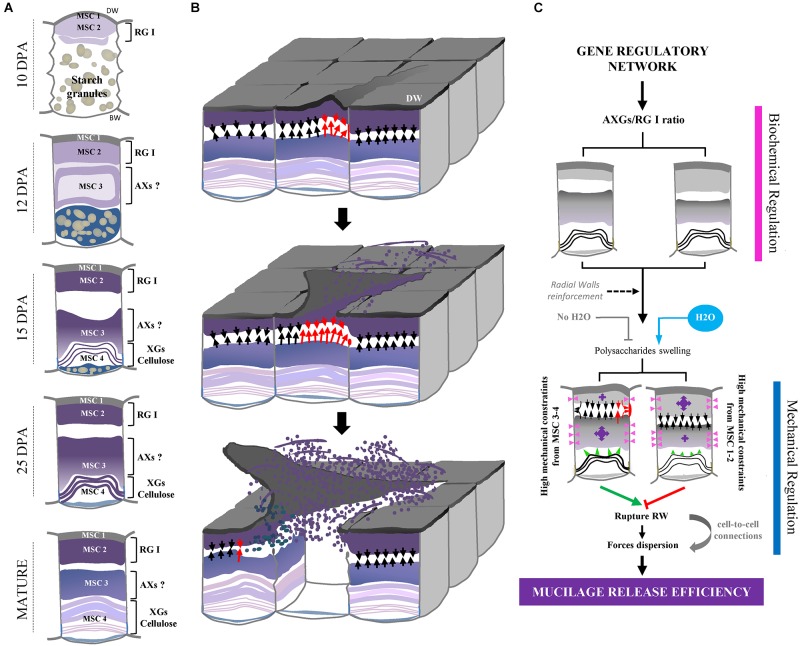
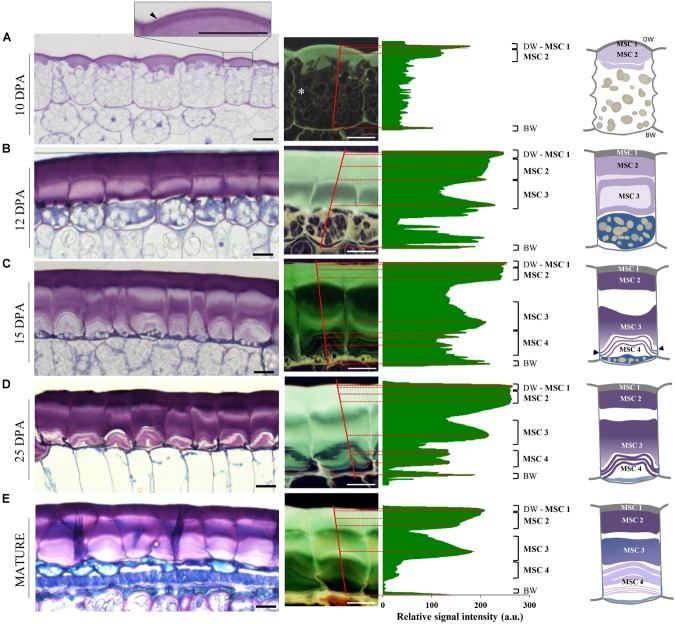
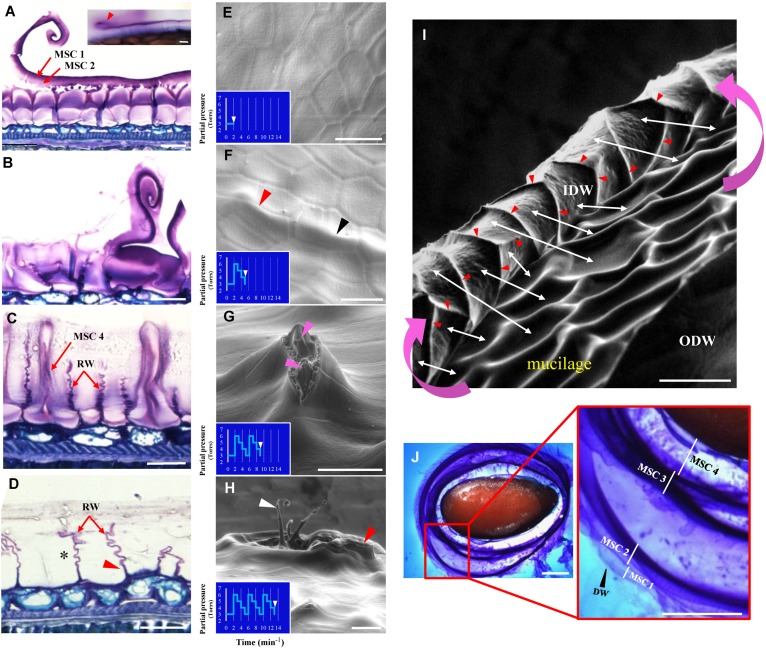
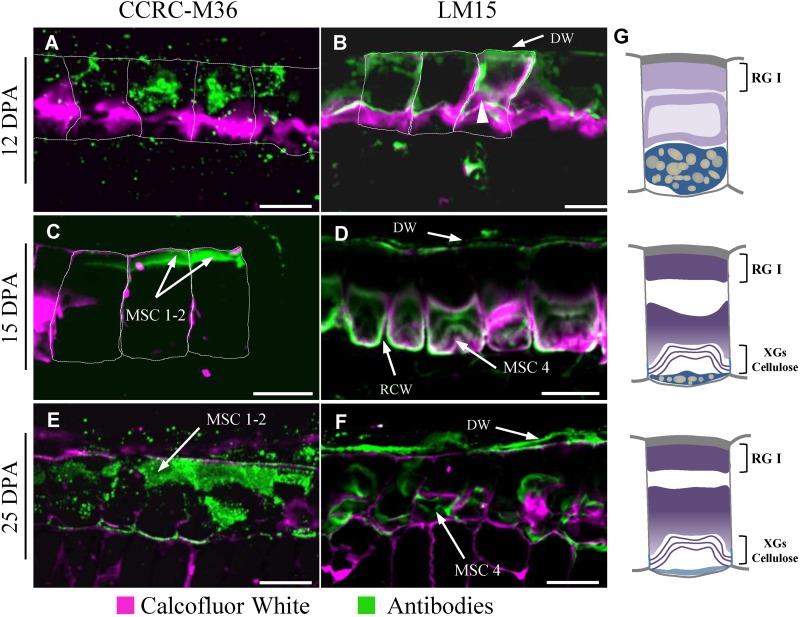
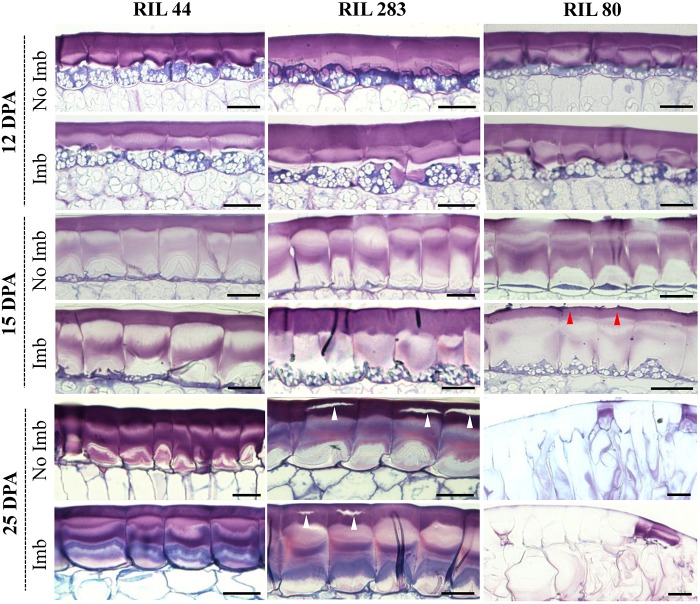
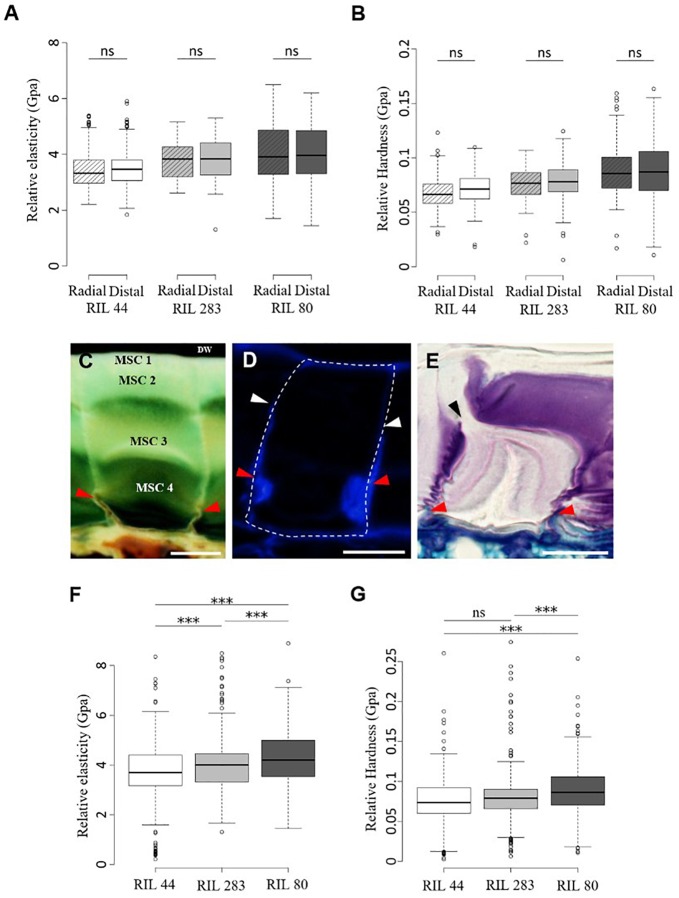
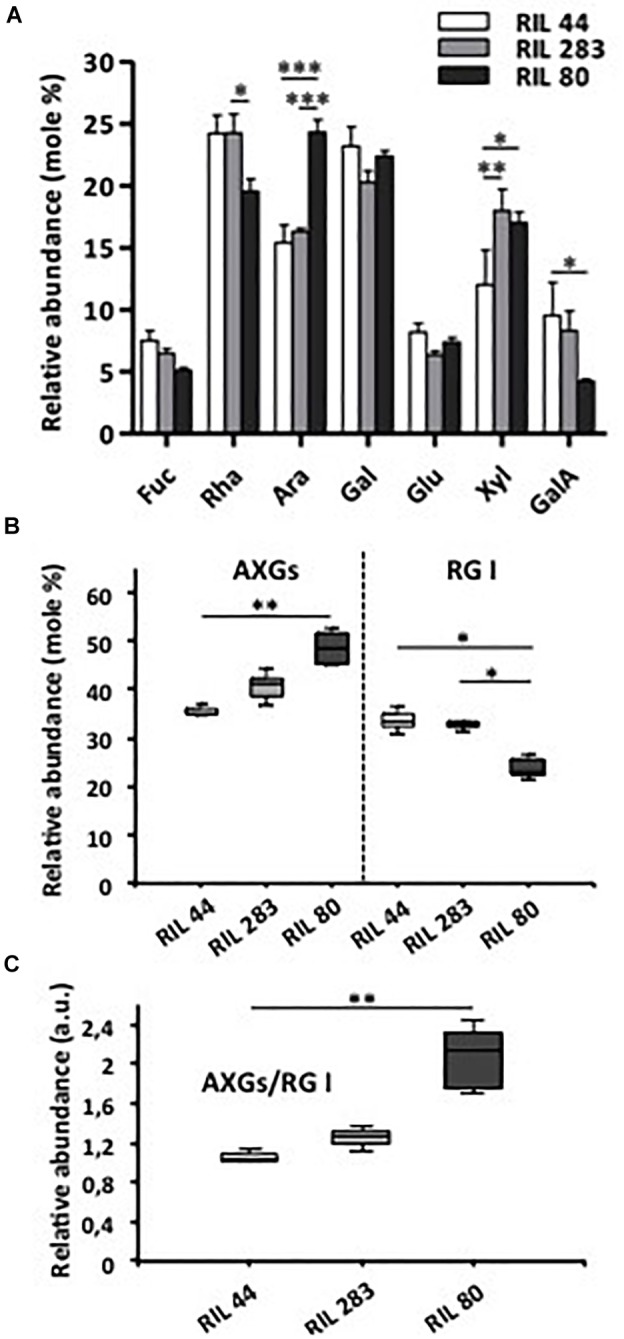
The external seed coat cell layer of certain species is specialized in the production and extrusion of a polysaccharide matrix called mucilage. Variations in the content of the released mucilage have been mainly associated with genetically regulated physiological modifications. Understanding the mucilage extrusion process in crop species is of importance to gain deeper insight into the complex cell wall biosynthesis and dynamics. In this study, we took advantage of the varying polysaccharide composition and the size of the flax mucilage secretory cells (MSCs) to study mucilage composition and extrusion in this species of agricultural interest. We demonstrate herein that flax MSCs are structured in four superimposed layers and that rhamnogalacturonans I (RG I) are firstly synthesized, in the upper face, preceding arabinoxylan and glucan synthesis in MSC lower layers. Our results also reveal that the flax mucilage release originates from inside MSC, between the upper and deeper layers, the latter collaborating to trigger polysaccharide expansion, radial cell wall breaking and mucilage extrusion in a peeling fashion. Here, we provide evidence that the layer organization and polysaccharide composition of the MSCs regulate the mucilage release efficiency like a peeling mechanism. Finally, we propose that flax MSCs may represent an excellent model for further investigations of mucilage biosynthesis and its release.
某些物种的外部种皮细胞层专门用于生产和挤出一种名为黏液的多糖基质。释放出的黏液含量变化主要与基因调控的生理修饰有关。了解作物物种中的黏液挤出过程对于更深入地洞察复杂的细胞壁生物合成和动态变化具有重要意义。在本研究中,我们利用亚麻黏液分泌细胞(MSC)中多糖组成的差异和细胞大小来研究这种具有农业价值的物种中的黏液组成和挤出过程。我们在此证明,亚麻MSC由四个叠加层构成,鼠李糖半乳糖醛酸聚糖I(RG I)首先在上表面合成,先于MSC下层中阿拉伯木聚糖和葡聚糖的合成。我们的结果还表明,亚麻黏液的释放源自MSC内部,在上层和深层之间,后者协同以剥离的方式引发多糖膨胀、径向细胞壁破裂和黏液挤出。在此,我们提供证据表明,MSC的层组织和多糖组成像一种剥离机制一样调节黏液释放效率。最后,我们提出亚麻MSC可能是进一步研究黏液生物合成及其释放的优秀模型。