Xiao Wei, Liang Yao, Que Yi, Li Jingjing, Peng Ruiqing, Xu Bushu, Wen Xizhi, Zhao Jingjing, Guan Yuanxiang, Zhang Xing
Melanoma and Sarcoma Medical Oncology Unit, Sun Yat-sen University Cancer Center, Guangzhou 510060, China.
State Key Laboratory of Oncology in South China; Collaborative Innovation Center for Cancer Medicine, Sun Yat-sen University Cancer Center; Guangzhou 510060, China.
J Cancer. 2019 Jun 9;10(15):3517-3525. doi: 10.7150/jca.28734. eCollection 2019.
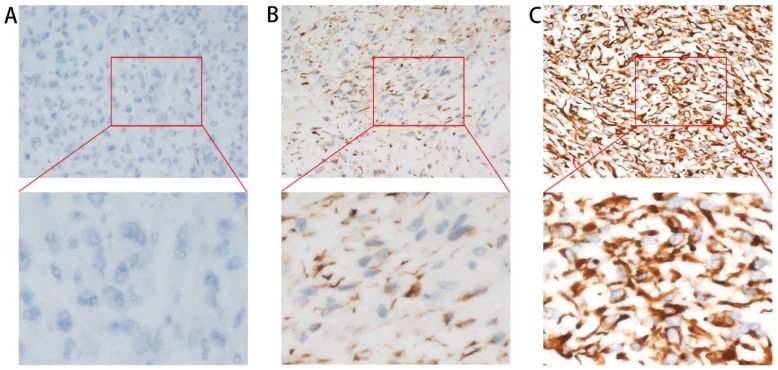
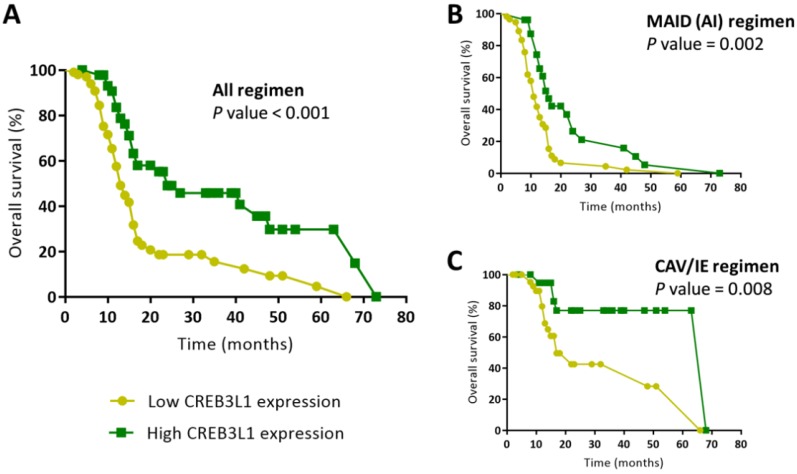
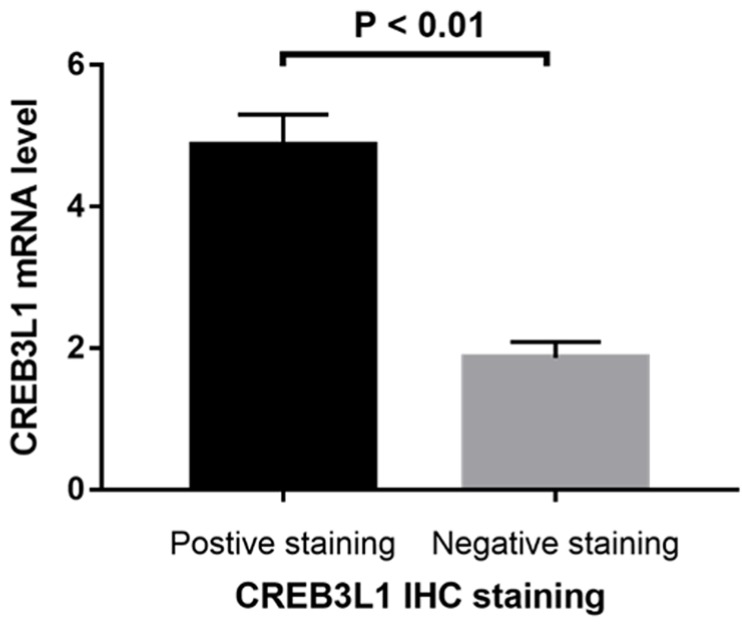
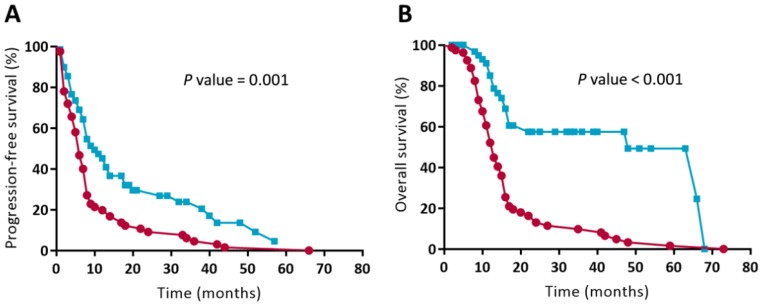
: Palliative chemotherapy is currently the first-line treatment for advanced soft tissue sarcoma. The purpose of this study was to compare the efficacies of the MAID (AI) and CAV/IE alternating regimens in advanced soft-tissue sarcoma patients. Since resistances to ADM-based chemotherapy and toxicity from doxorubicin are frequently observed in clinical practice, we investigated the association between CREB3L1 expression and survival in advanced soft-tissue sarcomas patients treated with doxorubicin-based palliative chemotherapy. : The cohort under investigation comprised 152 patients who underwent doxorubicin-based first-line palliative chemotherapy for advanced soft-tissue sarcoma at our institution between January 2010 and April 2017. Immunohistochemical analysis and the reverse transcription polymerase chain reaction were used to determine the expression of CREB3L1 in soft-tissue sarcoma specimens prior to first-line palliative chemotherapy. Univariate and multivariate analyses were performed on chemotherapy regimens and CREB3L1 expression levels. The relationship between CREB3L1 expression and survival was also analyzed. : The CAV/IE alternating regimen yielded favorable outcomes for response and survival in patients compared with those who received MAID (AI) treatment. The most common toxicity of grades 3 and 4 was leukopenia (58.5 % in the MAID (AI) regimen; 37.1 % in the CAV/IE regimen). The incidence of febrile neutropenia after CAV/IE treatment (7.1 %) was lower than after MAID (AI) treatment (13.4 %). Grade 3 neuralgia was observed in 1.2 % of patients receiving the MAID regimen versus 8.6 % in patients receiving the CAV/IE regimen. High CREB3L1 expression was observed in 48 of 152 patients (31.6 %). Overall survival was significantly higher for CREB3L1 high-expression patients than for CREB3L1 low-expression patients, especially for those also treated with the MAID (AI) regimen. The CREB3L1 expression level was identified as an independent prognostic factor for survival by multivariate analysis. : Our study suggests that the CAV/IE alternating regimen may be associated with a better response and more favorable survival than the MAID (AI) regimen in advanced soft-tissue sarcoma patients. Furthermore, the CREB3L1 expression level may predict the efficacy and survival of doxorubicin-based palliative chemotherapy for advanced soft-tissue sarcoma.
姑息性化疗目前是晚期软组织肉瘤的一线治疗方法。本研究的目的是比较MAID(AI)和CAV/IE交替方案在晚期软组织肉瘤患者中的疗效。由于在临床实践中经常观察到对基于阿霉素的化疗的耐药性和阿霉素的毒性,我们研究了接受基于阿霉素的姑息性化疗的晚期软组织肉瘤患者中CREB3L1表达与生存之间的关联。:研究队列包括2010年1月至2017年4月期间在我们机构接受基于阿霉素的一线姑息性化疗的152例晚期软组织肉瘤患者。在一线姑息性化疗之前,使用免疫组织化学分析和逆转录聚合酶链反应来确定软组织肉瘤标本中CREB3L1的表达。对化疗方案和CREB3L1表达水平进行单因素和多因素分析。还分析了CREB3L1表达与生存之间的关系。:与接受MAID(AI)治疗的患者相比,CAV/IE交替方案在患者的反应和生存方面产生了良好的结果。3级和4级最常见的毒性是白细胞减少(MAID(AI)方案中为58.5%;CAV/IE方案中为37.1%)。CAV/IE治疗后发热性中性粒细胞减少的发生率(7.1%)低于MAID(AI)治疗后(13.4%)。接受MAID方案的患者中有1.2%观察到3级神经痛,而接受CAV/IE方案的患者中为8.6%。152例患者中有48例(31.6%)观察到高CREB3L1表达。CREB3L1高表达患者的总生存率明显高于CREB3L1低表达患者,尤其是那些也接受MAID(AI)方案治疗的患者。通过多因素分析,CREB3L1表达水平被确定为生存的独立预后因素。:我们的研究表明,在晚期软组织肉瘤患者中,CAV/IE交替方案可能比MAID(AI)方案具有更好的反应和更有利的生存。此外,CREB3L1表达水平可能预测基于阿霉素的晚期软组织肉瘤姑息性化疗的疗效和生存。