von Arx Martina, Cheval Boris, Sieber Stefan, Orsholits Dan, Widmer Eric, Kliegel Matthias, Guessous Idris, Kelly-Irving Michelle, Courvoisier Delphine S, Boisgontier Matthieu P, Cullati Stéphane
Swiss NCCR "LIVES - Overcoming Vulnerability: Life Course Perspectives", University of Geneva, Switzerland.
Department of General Internal Medicine, Rehabilitation and Geriatrics, University of Geneva, Switzerland.
SSM Popul Health. 2019 Jun 17;8:100434. doi: 10.1016/j.ssmph.2019.100434. eCollection 2019 Aug.
Childhood misfortune is associated with late-life depressive symptoms, but it remains an open question whether adult socioeconomic and relational reserves could reduce the association between childhood misfortune and late-life depressive symptoms.
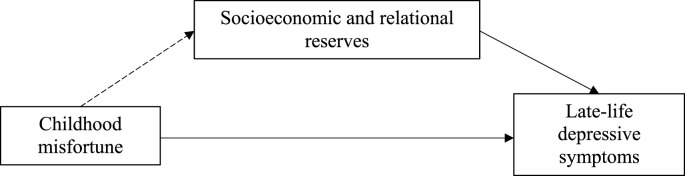
Using the Survey of Health, Ageing and Retirement in Europe (SHARE), data from 8'357 individuals (35'260 observations) aged 50-96 years and living in 11 European countries were used to examine associations between three indicators of childhood misfortune (adverse childhood events, poor childhood health, and childhood socioeconomic circumstances) and late-life depressive symptoms. Subsequently, we tested whether these associations were mediated by education, occupational position, the ability to make ends meet, and potential or perceived relational reserves; that is family members or significant others who can provide help in case of need, respectively. Analyses were stratified by gender and adjusted for confounding and control variables.
Adult socioeconomic reserves partly mediated the associations between adverse childhood events, poor childhood health and late-life depressive symptoms. The associations with the third indicator of childhood misfortune (childhood socioeconomic circumstances) were fully mediated by adult socioeconomic reserves in men, and partly mediated in women. None of the associations were mediated by relational reserves. However, perceived relational reserves were associated with fewer late-life depressive symptoms.
Childhood socioeconomic disadvantage can be mitigated more easily over the life course than adverse childhood events and poor childhood health, especially in men. Perceived relational reserves work primarily as a protective force against late-life depressive symptoms and may be particularly important in the context of the cumulative effect of childhood adversities.
童年不幸与晚年抑郁症状相关,但成人的社会经济和人际关系储备是否能减少童年不幸与晚年抑郁症状之间的关联仍是一个悬而未决的问题。
利用欧洲健康、老龄化和退休调查(SHARE),对11个欧洲国家的8357名年龄在50 - 96岁的个体(35260次观察)的数据进行分析,以研究童年不幸的三个指标(童年不良事件、童年健康状况差和童年社会经济状况)与晚年抑郁症状之间的关联。随后,我们测试了这些关联是否由教育、职业地位、收支平衡能力以及潜在或感知到的人际关系储备(即分别指在需要时能够提供帮助的家庭成员或重要他人)介导。分析按性别分层,并对混杂因素和控制变量进行了调整。
成人的社会经济储备部分介导了童年不良事件、童年健康状况差与晚年抑郁症状之间的关联。与童年不幸的第三个指标(童年社会经济状况)的关联在男性中完全由成人社会经济储备介导,在女性中部分由其介导。没有任何关联是由人际关系储备介导的。然而,感知到的人际关系储备与较少的晚年抑郁症状相关。
与童年不良事件和童年健康状况差相比,童年社会经济劣势在整个生命过程中更容易得到缓解,尤其是在男性中。感知到的人际关系储备主要作为一种抵御晚年抑郁症状的保护力量,在童年逆境的累积效应背景下可能尤为重要。