Peterson Jill, Brunie Aurelie, Diop Ibrahima, Diop Seynabou, Stanback John, Chin-Quee Dawn S
FHI 360, Washington, DC, 20009, USA.
Agence pour la Promotion des Activités de Population-Sénégal (APAPS), Dakar, Senegal.
Gates Open Res. 2019 May 15;2:29. doi: 10.12688/gatesopenres.12825.3. eCollection 2018.
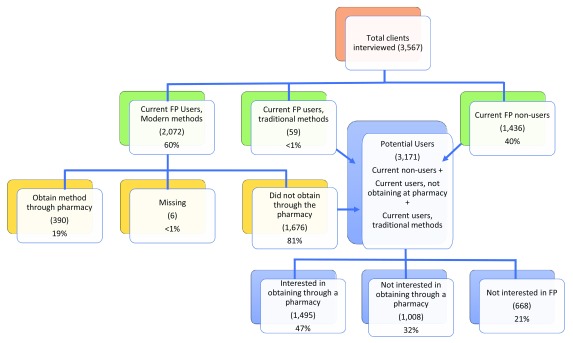
This research assessed the potential for expanding access to family planning through private sector pharmacies in Senegal, by examining the quality of the services provided through private sector pharmacies, and pharmacy staff and client interest in private sector pharmacy-based family planning services. This was a cross-sectional, descriptive study conducted in eight urban districts in and around Dakar and two urban districts outside of Dakar employing an audit of 225 pharmacies, a survey with 486 private sector pharmacy staff and a survey with 3,567 women exiting private sector pharmacies. Most (54%) pharmacies reported offering method-specific counseling to clients. Family planning commodities were available in all pharmacies, and 72% had a private space available to offer counseling. Three quarters (76%) did not have any counseling materials available. 49% of pharmacists and 47% of assistant pharmacists reported receiving training on family planning during their professional studies. Half had received counseling training. Few pharmacists met pre-determined criteria to be considered highly knowledgeable of the oral contraceptive pill (OCP) and injectable contraceptive provision (0.6% and 1.1%). Overall, 60% of women surveyed were current family planning users and 11% procured their method through a private sector pharmacy. Among non-users of family planning, and current users who did not obtain their method through a pharmacy, 47% said they would be interested in procuring a method through a private sector pharmacy. There is both actual and latent demand for accessing family planning through Senegal's urban, private sector pharmacies. With proper training, pharmacy staff could better provide effective counseling and provision of OCPs and injectables, and lifting the requirement for a prescription could help support gains in contraceptive prevalence.
本研究通过考察塞内加尔私营药店提供的服务质量、药店工作人员以及客户对基于私营药店的计划生育服务的兴趣,评估了通过私营药店扩大计划生育服务可及性的潜力。这是一项横断面描述性研究,在达喀尔及其周边的八个城市地区以及达喀尔以外的两个城市地区开展,对225家药店进行了审计,对486名私营药店工作人员进行了调查,并对3567名离开私营药店的女性进行了调查。大多数(54%)药店报告称会为客户提供特定方法的咨询。所有药店均有计划生育用品,72%有可供咨询的私密空间。四分之三(76%)没有任何咨询材料。49%的药剂师和47%的助理药剂师报告称在专业学习期间接受过计划生育培训。一半人接受过咨询培训。很少有药剂师达到预先确定的标准,被认为对口服避孕药(OCP)和注射用避孕药具非常了解(分别为0.6%和1.1%)。总体而言,接受调查的女性中有60%是目前的计划生育使用者,11%通过私营药店获取其使用的避孕方法。在非计划生育使用者以及未通过药店获取避孕方法的现有使用者中,47%表示有兴趣通过私营药店获取避孕方法。通过塞内加尔城市的私营药店获取计划生育服务既有实际需求,也有潜在需求。通过适当培训,药店工作人员可以更好地提供有效的咨询,并提供口服避孕药和注射用避孕药具,取消处方要求有助于提高避孕普及率。