Department of Biology, Faculty of Chemistry, National Autonomous University of Mexico (UNAM), Mexico City 04510, Mexico.
Medicina (Kaunas). 2019 Jul 10;55(7):360. doi: 10.3390/medicina55070360.
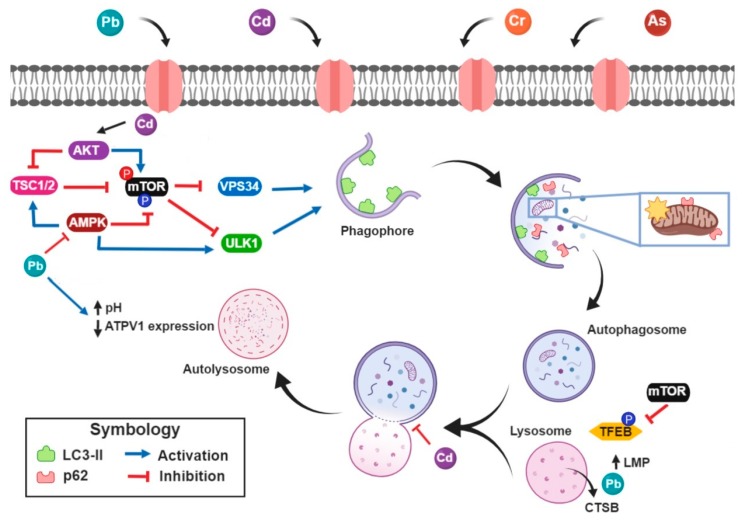
Curcumin is a hydrophobic polyphenol compound extracted from the rhizome of turmeric. The protective effect of curcumin on kidney damage in multiple experimental models has been widely described. Its protective effect is mainly associated with its antioxidant and anti-inflammatory properties, as well as with mitochondrial function maintenance. On the other hand, occupational or environmental exposure to heavy metals is a serious public health problem. For a long time, heavy metals-induced nephrotoxicity was mainly associated with reactive oxygen species overproduction and loss of endogenous antioxidant activity. However, recent studies have shown that in addition to oxidative stress, heavy metals also suppress the autophagy flux, enhancing cell damage. Thus, natural compounds with the ability to modulate and restore autophagy flux represent a promising new therapeutic strategy. Furthermore, it has been reported in other renal damage models that curcumin's nephroprotective effects are related to its ability to regulate autophagic flow. The data indicate that curcumin modulates autophagy by classic signaling pathways (suppression of protein kinase B (Akt)/mammalian target of rapamycin (mTOR) and/or by stimulation of adenosine monophosphate-activated protein kinase (AMPK) and extracellular signal-dependent kinase (ERK) pathways). Moreover, it allows lysosomal function preservation, which is crucial for the later stage of autophagy. However, future studies of autophagy modulation by curcumin in heavy metals-induced autophagy flux impairment are still needed.
姜黄素是一种从姜黄根茎中提取的疏水性多酚化合物。姜黄素对多种实验模型肾损伤的保护作用已被广泛描述。其保护作用主要与其抗氧化和抗炎特性以及维持线粒体功能有关。另一方面,职业或环境暴露于重金属是一个严重的公共卫生问题。长期以来,重金属诱导的肾毒性主要与活性氧过度产生和内源性抗氧化活性丧失有关。然而,最近的研究表明,除了氧化应激外,重金属还会抑制自噬流,从而增强细胞损伤。因此,具有调节和恢复自噬流能力的天然化合物代表了一种有前途的新治疗策略。此外,在其他肾损伤模型中已经报道,姜黄素的肾保护作用与其调节自噬流的能力有关。这些数据表明,姜黄素通过经典信号通路(抑制蛋白激酶 B(Akt)/雷帕霉素靶蛋白(mTOR)和/或通过刺激腺苷单磷酸激活蛋白激酶(AMPK)和细胞外信号依赖性激酶(ERK)途径)来调节自噬。此外,它还允许溶酶体功能的保存,这对自噬的后期阶段至关重要。然而,仍需要进一步研究姜黄素对重金属诱导的自噬流障碍的自噬调节作用。