a UCIBIO, REQUIMTE, Laboratory of Biochemistry, Department of Biological Sciences, Faculty of Pharmacy , University of Porto , Porto , Portugal.
b CESPU, Institute of Research and Advanced Training in Health Sciences and Technologies (IINFACTS) , Gandra-Paredes , Portugal.
Ren Fail. 2019 Nov;41(1):662-672. doi: 10.1080/0886022X.2019.1635893.
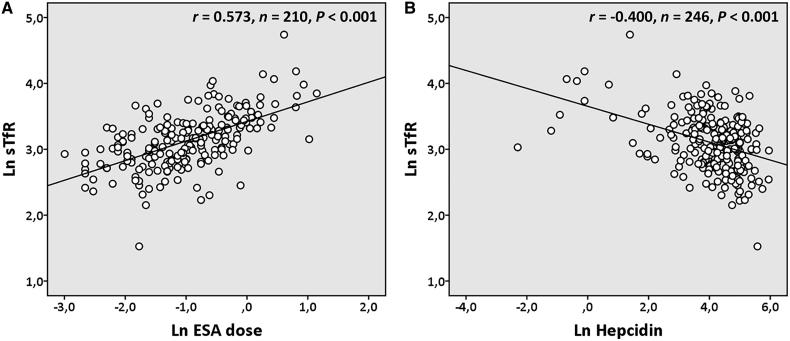
Soluble transferrin receptor (sTfR) is a biomarker of erythropoiesis, which is often impaired in dialysis patients. The aim of our study was to evaluate sTfR levels in chronically dialyzed patients and assess potential determinants of its levels. We performed a cross-sectional study by evaluating 246 end-stage renal disease patients undergoing dialysis and 32 healthy controls. Circulating levels of interleukin (IL)-6, C-reactive protein (CRP), tumor necrosis factor (TNF)-α, hepcidin, sTfR, growth differentiation factor 15 (GDF15), and traditional iron metabolism markers were measured, as well as hemogram parameters. Clinical data was obtained from all patients. Compared to controls, patients presented similar values of sTfR, reticulocytes and reticulocyte production index (RPI), and significantly higher levels of IL-6, CRP, ferritin, hepcidin, TNF-α, and GDF15. Iron, transferrin, hemoglobin levels, erythrocyte count, mean cell hemoglobin (MCH), and mean cell hemoglobin concentration (MCHC) values were significantly lower in dialysis group. Within patients, sTfR values were higher in diabetic patients and were positively and significantly correlated with reticulocytes and erythrocytes, RPI, and therapeutic doses of erythropoiesis stimulating agents (ESA) and intravenous iron; and inversely and significantly correlated with circulating iron, ferritin, transferrin saturation, hepcidin, MCH, and MCHC. In multiple linear regression analysis, ESA dose, RPI, serum iron, diabetes, and hepcidin levels were independently associated with sTfR levels in dialysis patients and, thus, with erythropoiesis. Our data suggest that, besides RPI and ESA dose, diabetes and hepcidin are closely related to erythropoiesis in dialysis patients. The influence of diabetes on sTfR levels deserves further investigation.
可溶性转铁蛋白受体(sTfR)是红细胞生成的生物标志物,在透析患者中常受到损害。我们的研究目的是评估慢性透析患者的 sTfR 水平,并评估其水平的潜在决定因素。
我们通过评估 246 名接受透析的终末期肾病患者和 32 名健康对照进行了横断面研究。测量了循环白细胞介素(IL)-6、C 反应蛋白(CRP)、肿瘤坏死因子(TNF)-α、铁调素、sTfR、生长分化因子 15(GDF15)和传统铁代谢标志物以及血液学参数。从所有患者中获得临床数据。
与对照组相比,患者的 sTfR、网织红细胞和网织红细胞生成指数(RPI)值相似,而 IL-6、CRP、铁蛋白、铁调素、TNF-α和 GDF15 水平明显更高。铁、转铁蛋白、血红蛋白水平、红细胞计数、平均红细胞血红蛋白(MCH)和平均红细胞血红蛋白浓度(MCHC)在透析组中显著降低。在患者中,糖尿病患者的 sTfR 值更高,并且与网织红细胞和红细胞、RPI 以及促红细胞生成刺激剂(ESA)和静脉铁的治疗剂量呈正相关;与循环铁、铁蛋白、转铁蛋白饱和度、铁调素、MCH 和 MCHC 呈负相关。多元线性回归分析显示,ESA 剂量、RPI、血清铁、糖尿病和铁调素水平与透析患者的 sTfR 水平独立相关,因此与红细胞生成相关。
我们的数据表明,除了 RPI 和 ESA 剂量外,糖尿病和铁调素与透析患者的红细胞生成密切相关。糖尿病对 sTfR 水平的影响值得进一步研究。