Zhong Zhong, Luo Dan, Luo Ning, Li Bin, Fu Dongying, Fan Li, Li Zhijian, Chen Wei, Mao Haiping
Department of Nephrology, The First Affiliated Hospital, Sun Yat-sen University, Guangzhou, China.
Key Laboratory of Nephrology, National Health Commission and Guangdong Province, Guangzhou, China.
Front Med (Lausanne). 2021 Jun 17;8:684548. doi: 10.3389/fmed.2021.684548. eCollection 2021.
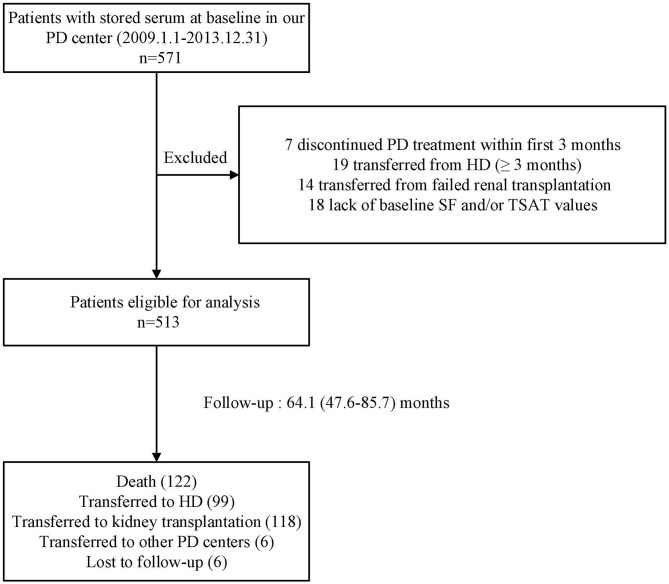
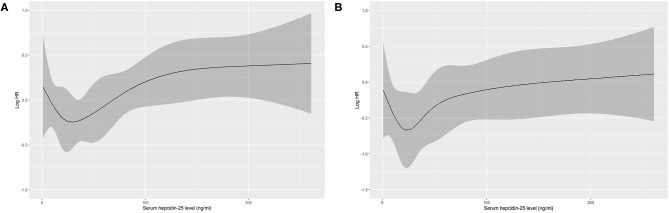
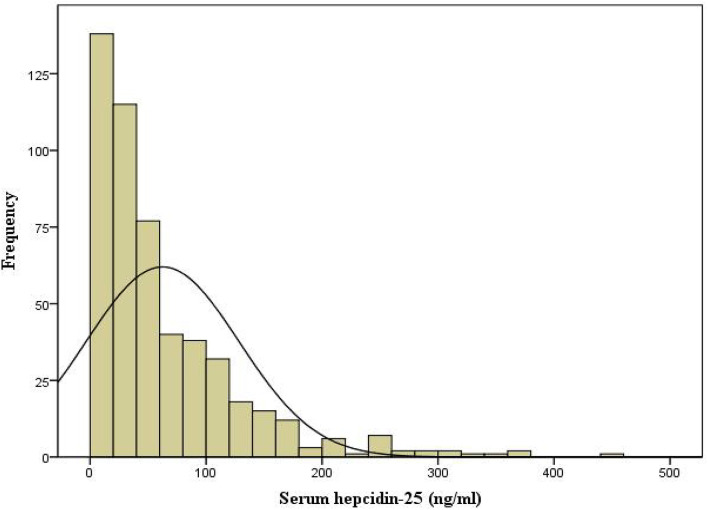
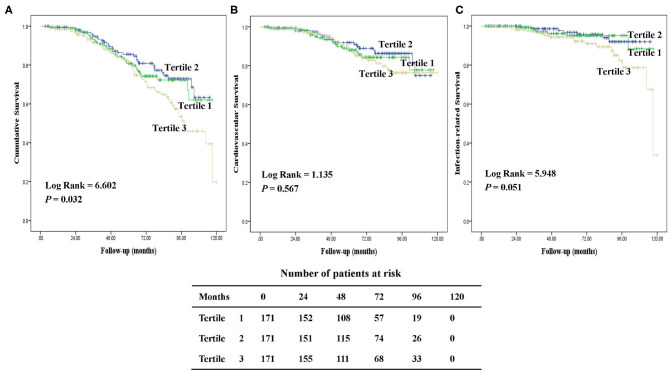
Increased serum hepcidin-25 level is associated with excess mortality in hemodialysis patients. However, there is a dearth of published information about its predictive effect for survival in patients on peritoneal dialysis (PD). The purpose of this study is to evaluate the association of serum hepcidin-25 with the risk of mortality in PD patients. Serum hepcidin-25 level was measured using an enzyme-linked immunosorbent assay in a prospective cohort study of PD patients with stored serum samples at baseline. Multivariate linear regression model was used to determine clinical characteristics associated with serum hepcidin-25 concentration. We evaluated the relationship between serum hepcidin-25 and all-cause mortality using a Cox proportional hazards model and the relationship between hepcidin-25 and cardiovascular (CV) and infection-related deaths using competing-risks regression models. In total, 513 PD patients were included in this study. The median serum hepcidin-25 level was 40.9 (17.9-85.9) ng/mL. Body mass index and serum ferritin were positively correlated with serum hepcidin-25 levels. During a median follow-up period of 64.1 months, 122 (24%) patients died, including 61 (50%) CV deaths and 32 (26%) infection-related deaths. In multivariable analysis, patients with the highest tertile of serum hepcidin-25 had a greater risk of all-cause [adjusted hazard ratio (aHR) 1.85, 95% confidence interval (95%CI), 1.14 to 3.00, = 0.013] and infection-related mortality (adjusted subdistribution hazard ratio [aSHR], 2.61; 95%CI, 1.01 to 6.76, = 0.049) when compared with those in the second tertile. However, no significant relationship was observed between serum hepcidin-25 and CV mortality. Higher baseline serum hepcidin-25 level was associated with increased risk for all-cause and infection-related mortality in PD patients.
血清铁调素-25水平升高与血液透析患者的过高死亡率相关。然而,关于其对腹膜透析(PD)患者生存的预测作用,公开信息匮乏。本研究的目的是评估血清铁调素-25与PD患者死亡风险之间的关联。在一项对基线时保存有血清样本的PD患者的前瞻性队列研究中,采用酶联免疫吸附测定法测量血清铁调素-25水平。使用多变量线性回归模型确定与血清铁调素-25浓度相关的临床特征。我们使用Cox比例风险模型评估血清铁调素-25与全因死亡率之间的关系,并使用竞争风险回归模型评估铁调素-25与心血管(CV)及感染相关死亡之间的关系。本研究共纳入513例PD患者。血清铁调素-25水平的中位数为40.9(17.9 - 85.9)ng/mL。体重指数和血清铁蛋白与血清铁调素-25水平呈正相关。在中位随访期64.1个月期间,122例(24%)患者死亡,其中61例(50%)死于CV疾病,32例(26%)死于感染相关原因。在多变量分析中,与处于第二三分位数的患者相比,血清铁调素-25处于最高三分位数的患者全因死亡风险更高[调整后风险比(aHR)1.85,95%置信区间(95%CI)为1.14至3.00, = 0.013],感染相关死亡风险也更高(调整后亚分布风险比[aSHR]为2.61;95%CI为1.01至6.76, = 0.049)。然而,未观察到血清铁调素-25与CV死亡率之间存在显著关系。较高的基线血清铁调素-25水平与PD患者全因及感染相关死亡风险增加相关。