Department of Clinical Sciences of Companion Animals, Faculty of Veterinary Medicine, Utrecht University, Utrecht, the Netherlands.
Vet Comp Oncol. 2019 Dec;17(4):545-552. doi: 10.1111/vco.12521. Epub 2019 Aug 4.
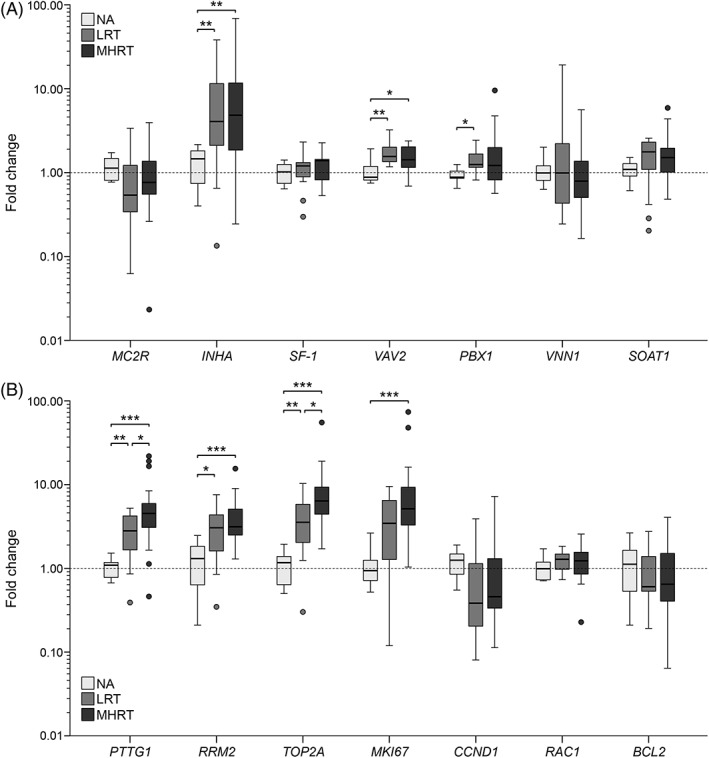
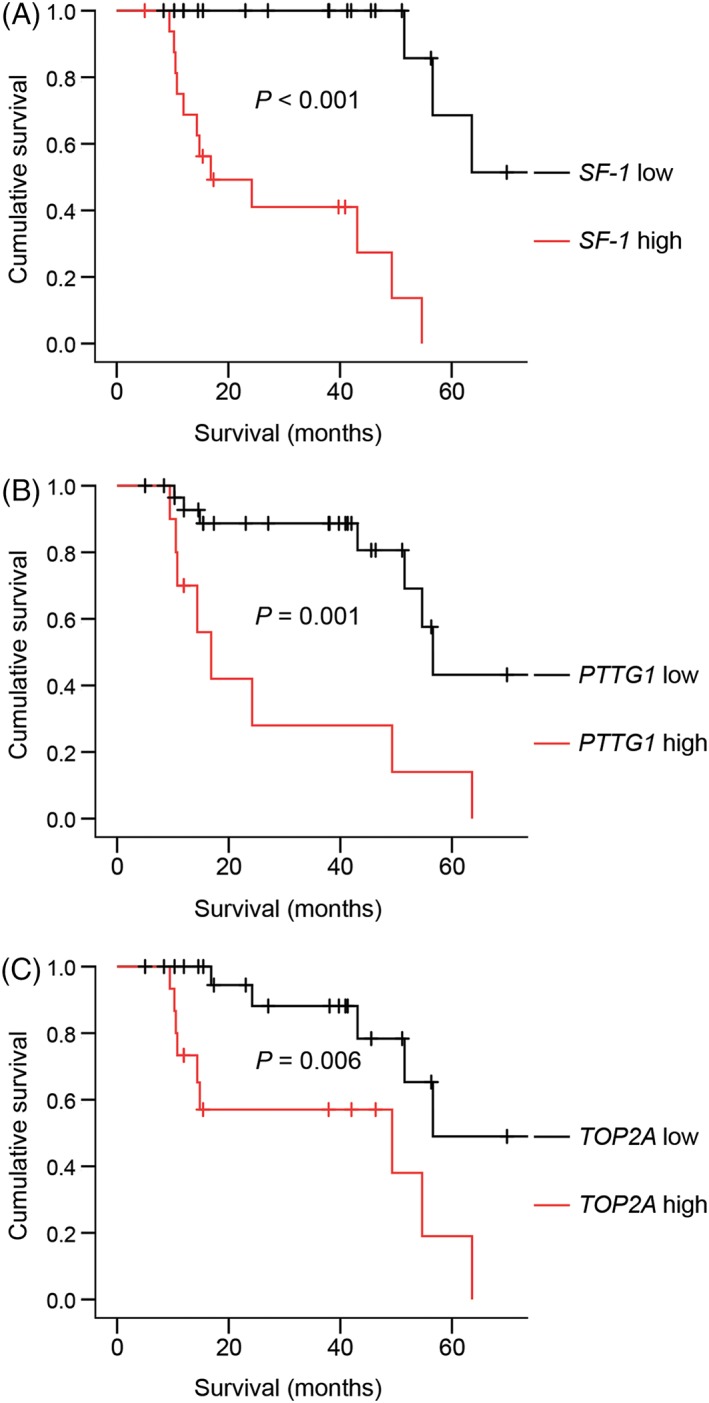
Hypercortisolism is caused by a cortisol-secreting adrenocortical tumour (ACT) in approximately 15%-20% of cases in dogs. Little is known about which molecular markers are associated with malignant behaviour of canine ACTs. The objective of this study was to identify molecular markers of prognosis, which could be useful to refine prognostic prediction and to identify potential treatment targets. Cortisol-secreting ACTs were included from 40 dogs, of which follow-up information was available. The ACTs were classified as low risk of recurrence tumours (LRT; n = 14) or moderate-high risk of recurrence tumours (MHRT; n = 26), based on the novel histopathological Utrecht score. Normal adrenals (NAs) were included from 11 healthy dogs as reference material. The mRNA expression of 14 candidate genes was analysed in the 40 ACTs and in 11 NAs with quantitative RT-PCR. The genes' expression levels were statistically compared between NAs, LRTs and MHRTs. Univariate and multivariate analyses were performed to determine the association of the genes' expression levels with survival. Seven genes were differentially expressed between NAs and ACTs, of which pituitary tumour-transforming gene-1 (PTTG1) and topoisomerase II alpha (TOP2A) were also differentially expressed between LRTs and MHRTs. In survival analyses, high expression levels of Steroidogenic factor-1 (SF-1), PTTG1 and TOP2A were significantly associated with poor survival. In conclusion, we have identified several genes that are part of the molecular signature of malignancy in canine ACTs. These findings can be used to refine prognostic prediction, but also offer insights for future studies on druggable targets.
皮质醇增多症是由大约 15%-20%犬的皮质醇分泌性肾上腺皮质肿瘤(ACT)引起的。目前对于哪些分子标志物与犬 ACT 的恶性行为相关知之甚少。本研究的目的是确定预后的分子标志物,这可能有助于完善预后预测,并确定潜在的治疗靶点。纳入了 40 只具有随访信息的皮质醇分泌性 ACT 犬。根据新的组织病理学乌得勒支评分,将这些 ACT 分为低复发风险肿瘤(LRT;n=14)或中高复发风险肿瘤(MHRT;n=26)。从 11 只健康犬的正常肾上腺(NA)中纳入作为参考材料。使用定量 RT-PCR 分析 40 个 ACT 和 11 个 NA 中的 14 个候选基因的 mRNA 表达。统计比较了 NA、LRT 和 MHRT 之间的基因表达水平。进行单变量和多变量分析以确定基因表达水平与生存的关联。在 NA 和 ACT 之间有 7 个基因表达差异,其中垂体肿瘤转化基因-1(PTTG1)和拓扑异构酶 II alpha(TOP2A)在 LRT 和 MHRT 之间也有差异表达。在生存分析中,Steroidogenic factor-1(SF-1)、PTTG1 和 TOP2A 的高表达水平与预后不良显著相关。总之,我们已经确定了几个基因,它们是犬 ACT 恶性特征的分子特征的一部分。这些发现可用于完善预后预测,也为未来研究可治疗靶点提供了思路。