
靶向癌基因可损害对BRAF抑制剂达拉非尼敏感或获得性耐药的黑色素瘤细胞的增殖和侵袭能力。
Targeting the oncogene impairs proliferation and invasiveness of melanoma cells sensitive or with acquired resistance to the BRAF inhibitor dabrafenib.
作者信息
Caporali Simona, Alvino Ester, Lacal Pedro Miguel, Ruffini Federica, Levati Lauretta, Bonmassar Laura, Scoppola Alessandro, Marchetti Paolo, Mastroeni Simona, Antonini Cappellini Gian Carlo, D'Atri Stefania
机构信息
Laboratory of Molecular Oncology, Istituto Dermopatico dell'Immacolata-IRCCS, Rome, Italy.
Institute of Translational Pharmacology, National Council of Research, Rome, Italy.
出版信息
Oncotarget. 2017 Dec 9;8(69):113472-113493. doi: 10.18632/oncotarget.23052. eCollection 2017 Dec 26.
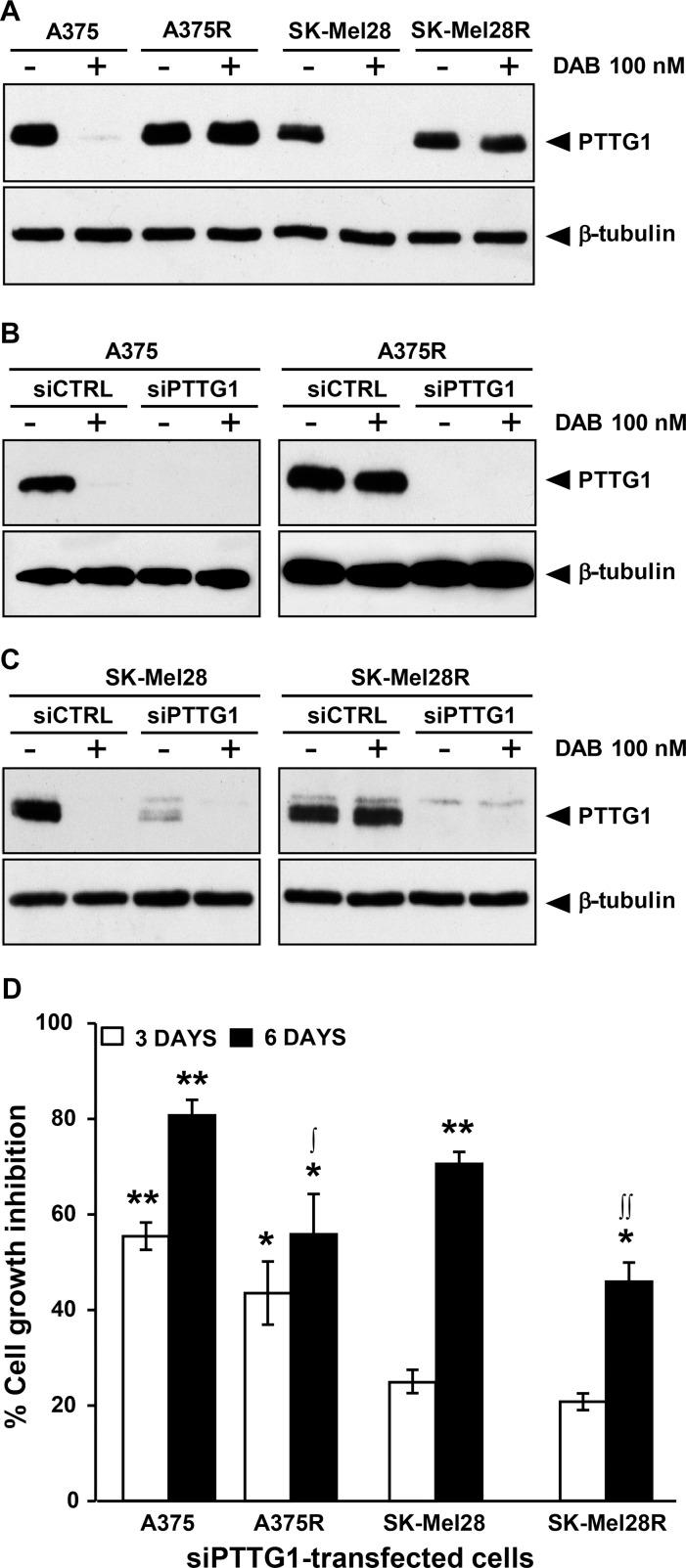
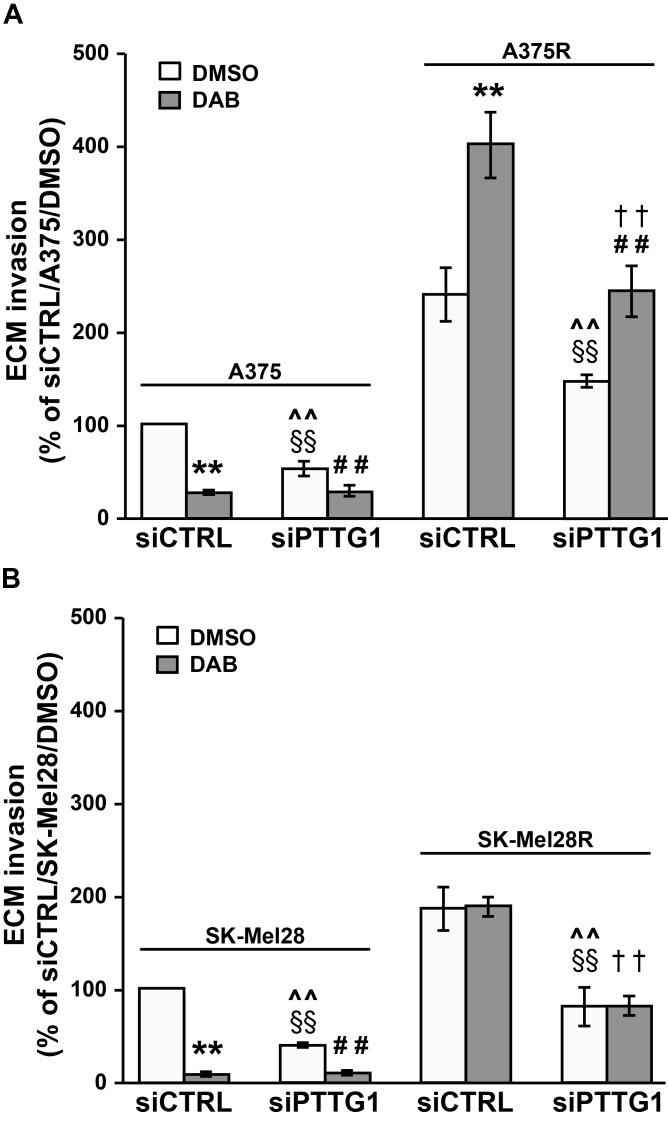
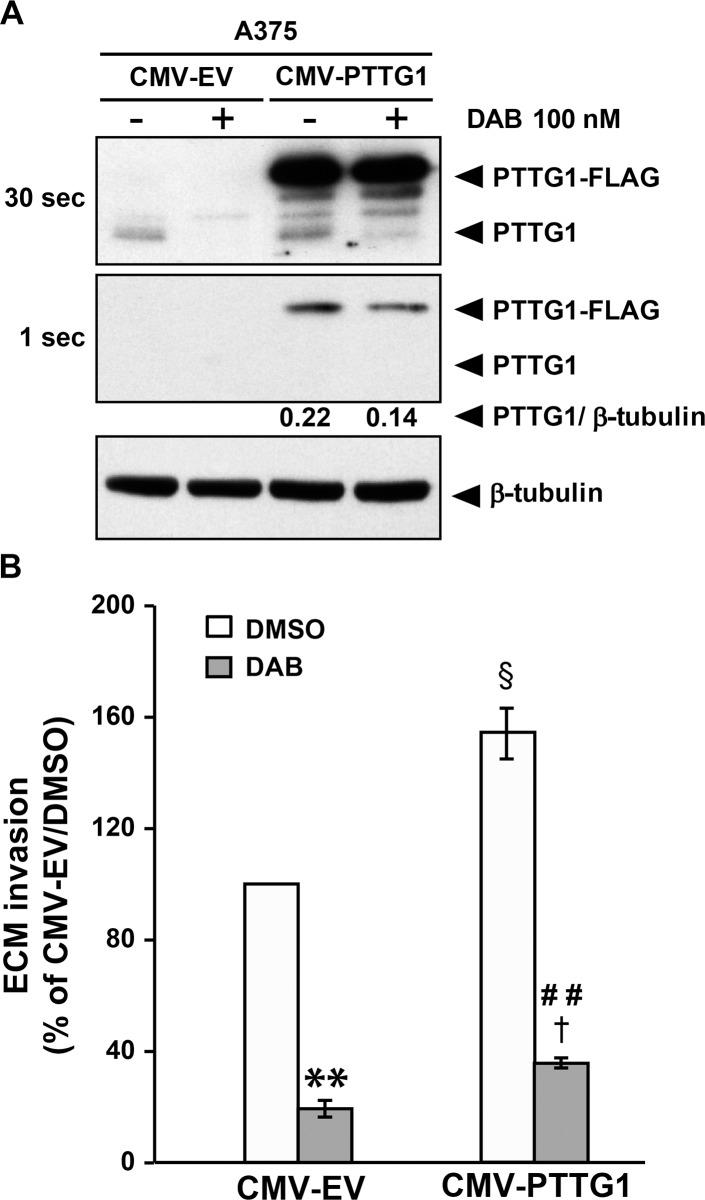
The () is implicated in tumor growth, metastasis and drug resistance. Here, we investigated the involvement of in melanoma cell proliferation, invasiveness and response to the BRAF inhibitor (BRAFi) dabrafenib. We also preliminary assessed the potential value of circulating PTTG1 protein to monitor melanoma patient response to BRAFi or to dabrafenib plus trametinib. Dabrafenib-resistant cell lines (A375R and SK-Mel28R) were more invasive than their drug-sensitive counterparts (A375 and SK-Mel28), but expressed comparable PTTG1 levels. Dabrafenib abrogated PTTG1 expression and impaired invasion of the extracellular matrix (ECM) in A375 and SK-Mel28 cells. In contrast, it affected neither PTTG1 expression in A375R and SK-Mel28R cells, nor ECM invasion in the latter cells, while further stimulated A375R cell invasiveness. Assessment of proliferation and ECM invasion in control and -silenced A375 and SK-Mel28 cells, exposed or not to dabrafenib, demonstrated that the inhibitory effects of this drug were, at least in part, dependent on its ability to down-regulate PTTG1 expression. -silencing also impaired proliferation and invasiveness of A375R and SK-Mel28R cells, and counteracted dabrafenib-induced stimulation of ECM invasion in A375R cells. Further experiments performed in A375R cells indicated that -silencing impaired cell invasiveness through inhibition of MMP-9 and that PTTG1 expression and ECM invasion could be also reduced by the CDK4/6 inhibitor LEE011. PTTG1 targeting might, therefore, represent a useful strategy to impair proliferation and metastasis of melanomas resistant to BRAFi. Circulating PTTG1 also appeared to deserve further investigation as biomarker to monitor patient response to targeted therapy.
()与肿瘤生长、转移及耐药性有关。在此,我们研究了()在黑色素瘤细胞增殖、侵袭以及对BRAF抑制剂(BRAFi)达拉非尼反应中的作用。我们还初步评估了循环中PTTG1蛋白在监测黑色素瘤患者对BRAFi或达拉非尼联合曲美替尼反应方面的潜在价值。达拉非尼耐药细胞系(A375R和SK-Mel28R)比其药物敏感对应细胞系(A375和SK-Mel28)更具侵袭性,但PTTG1表达水平相当。达拉非尼消除了A375和SK-Mel28细胞中PTTG1的表达,并损害了细胞对细胞外基质(ECM)的侵袭。相比之下,它既不影响A375R和SK-Mel28R细胞中PTTG1的表达,也不影响后者细胞对ECM的侵袭,同时还进一步刺激了A375R细胞的侵袭性。对未处理及沉默()的A375和SK-Mel28细胞(无论是否暴露于达拉非尼)的增殖和ECM侵袭进行评估,结果表明该药物的抑制作用至少部分取决于其下调PTTG1表达的能力。沉默()也损害了A375R和SK-Mel28R细胞的增殖和侵袭性,并抵消了达拉非尼诱导的A375R细胞对ECM侵袭的刺激作用。在A375R细胞中进行的进一步实验表明,沉默()通过抑制基质金属蛋白酶-9(MMP-9)损害细胞侵袭性,并且细胞周期蛋白依赖性激酶4/6(CDK4/6)抑制剂LEE011也可降低PTTG1表达和ECM侵袭。因此,靶向PTTG1可能是一种有用的策略,可削弱对BRAFi耐药的黑色素瘤的增殖和转移。循环中的PTTG1作为监测患者对靶向治疗反应的生物标志物似乎也值得进一步研究。





 Zotero 插件