Diabetes and Cardiovascular Center, University of Missouri School of Medicine, Columbia, MO 65212, USA; Research Service, Harry S Truman Memorial Veterans Hospital, 800 Hospital Dr, Columbia, MO 65201, USA; Dalton Cardiovascular Research Center, University of Missouri, Columbia, MO 65212, USA; Department of Medical Pharmacology and Physiology, University of Missouri School of Medicine, Columbia, MO 65212, USA.
Diabetes and Cardiovascular Center, University of Missouri School of Medicine, Columbia, MO 65212, USA; Research Service, Harry S Truman Memorial Veterans Hospital, 800 Hospital Dr, Columbia, MO 65201, USA.
Metabolism. 2019 Oct;99:57-66. doi: 10.1016/j.metabol.2019.153946. Epub 2019 Jul 11.
Mineralocorticoid receptor activation of the epithelial sodium channel in endothelial cells (ECs) (EnNaC) is accompanied by aldosterone induced endothelial stiffening and impaired nitric oxide (NO)-mediated arterial relaxation. Recent data support enhanced activity of the alpha subunit of EnNaC (αEnNaC) mediates this aldosterone induced endothelial stiffening and associated endothelial NO synthase (eNOS) activation. There is mounting evidence that diet induced obesity diminishes expression and activation of AMP-activated protein kinase α (AMPKα), sirtuin 1 (Sirt1), which would be expected to lead to impaired downstream eNOS activation. Thereby, we posited that enhanced EnNaC activation contributes to diet induced obesity related increases in stiffness of the endothelium and diminished NO mediated vascular relaxation by increasing oxidative stress and related inhibition of AMPKα, Sirt1, and associated eNOS inactivation.
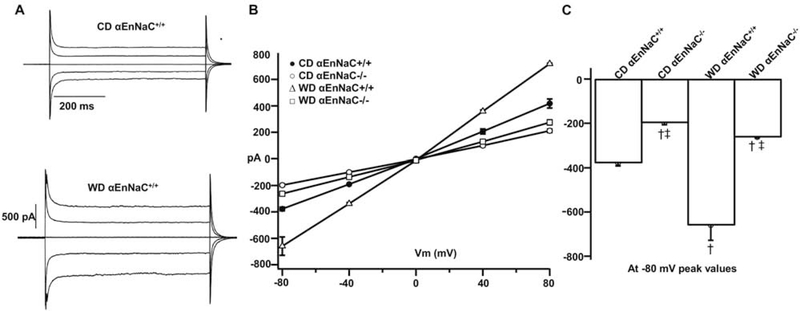
MATERIALS/METHODS: Sixteen to twenty week-old αEnNaC knockout (αEnNaC) and wild type littermate (EnNaC) female mice were fed a mouse chow or an obesogenic western diet (WD) containing excess fat (46%) and fructose (17.5%) for 16 weeks. Sodium currents of ECs, endothelial stiffness and NO mediated aortic relaxation were examined along with indices of aortic oxidative stress, vascular remodeling and fibrosis.
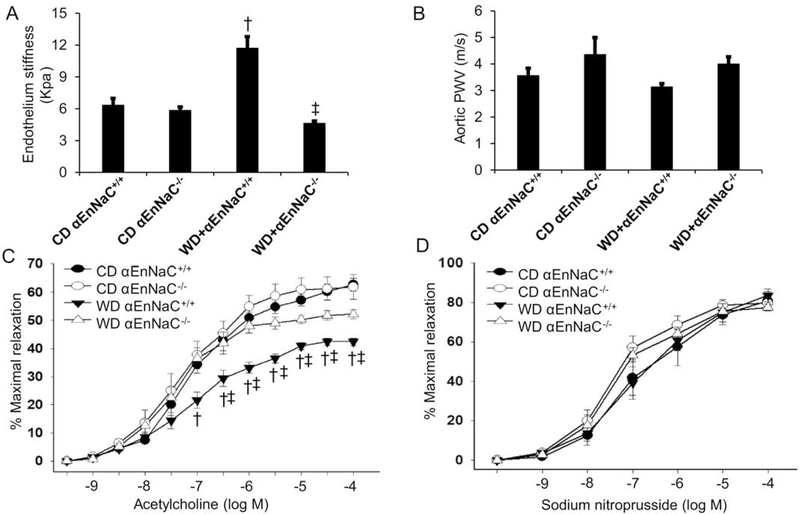
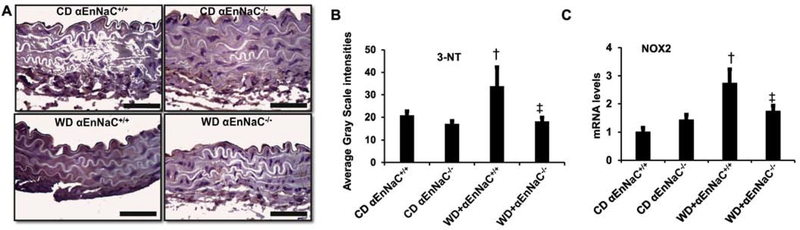
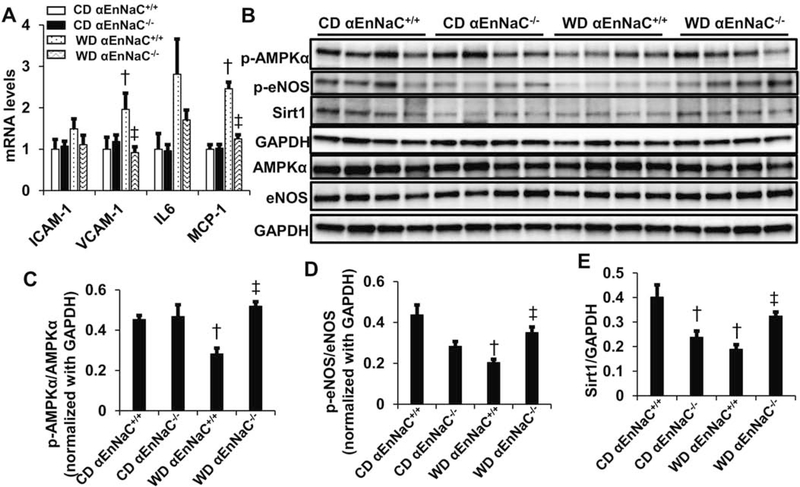
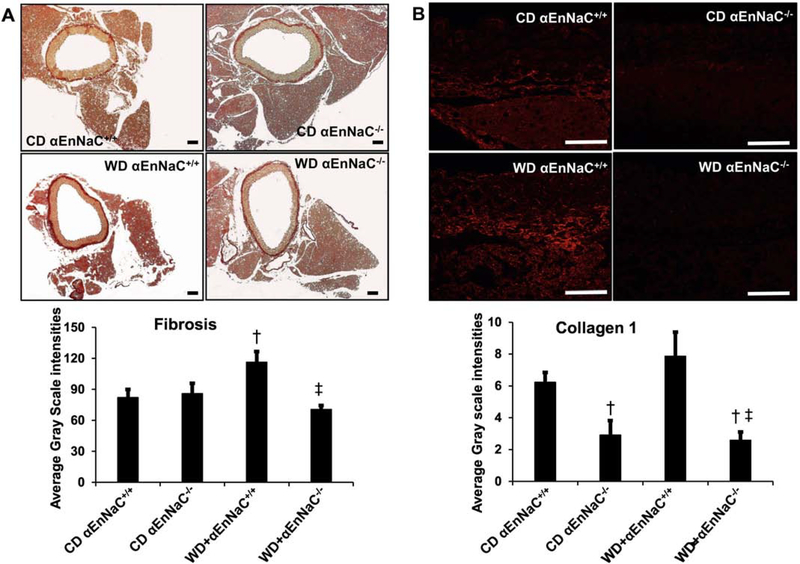
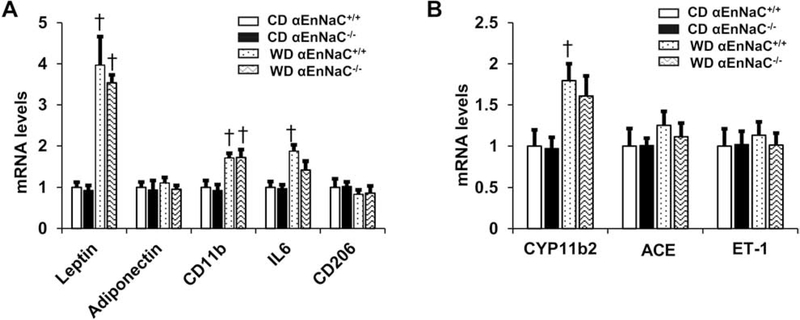
Enhanced EnNaC activation-mediated WD-induced increases in sodium currents in isolated lung ECs, increased endothelial stiffness and impaired aortic endothelium-dependent relaxation to acetylcholine (10-10 mol/L). These abnormalities occurred in conjunction with WD-mediated aortic tissue oxidative stress, inflammation, and decreased activation of AMPKα, Sirt1, and downstream eNOS were substantially mitigated in αEnNaC mice. Importantly, αEnNaC prevented WD induced increases in endothelial stiffness and related impairment of endothelium-dependent relaxation as well as aortic fibrosis and remodeling. However, EnNaC signaling was not involved in diet-induced abnormal expression of adipokines and CYP11b2 in abdominal aortic perivascular adipose tissue.
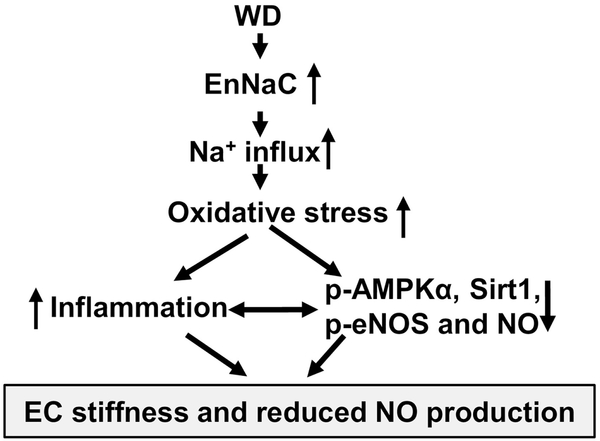
These data suggest that endothelial specific EnNaC activation mediates WD-induced endothelial stiffness, impaired eNOS activation, aortic fibrosis and remodeling through increased aortic oxidative stress and increased inflammation related to a reduction of AMPKα and Sirt 1 mediated eNOS phosphorylation/activation and NO production.
醛固酮诱导的内皮细胞 (EC) 上皮钠通道 (EnNaC) 中的盐皮质激素受体激活伴随着内皮僵硬和一氧化氮 (NO) 介导的动脉舒张功能受损。最近的数据支持 EnNaC 的α亚基 (αEnNaC) 的活性增强介导了这种醛固酮诱导的内皮僵硬和相关的内皮一氧化氮合酶 (eNOS) 激活。越来越多的证据表明,饮食诱导的肥胖会降低 AMP 激活的蛋白激酶 α (AMPKα) 和沉默调节蛋白 1 (Sirt1) 的表达和激活,这预计会导致下游 eNOS 激活受损。因此,我们假设增强的 EnNaC 激活通过增加氧化应激和相关的 AMPKα、Sirt1 抑制以及相关的 eNOS 失活,导致与饮食诱导的肥胖相关的内皮僵硬增加和 NO 介导的血管舒张功能受损。
材料/方法:16 至 20 周龄的αEnNaC 敲除 (αEnNaC) 和野生型同窝仔 (EnNaC) 雌性小鼠分别喂食标准鼠粮或含有过量脂肪 (46%) 和果糖 (17.5%) 的西式饮食 16 周。检测 EC 钠电流、内皮硬度和乙酰胆碱 (10-10mol/L) 介导的主动脉舒张反应,并检测主动脉氧化应激、血管重塑和纤维化的指标。
增强的 EnNaC 激活介导的西式饮食诱导的肺 EC 钠电流增加,内皮僵硬增加,乙酰胆碱 (10-10mol/L) 介导的主动脉内皮依赖性舒张受损。这些异常与西式饮食诱导的主动脉组织氧化应激、炎症以及 AMPKα、Sirt1 和下游 eNOS 的激活减少有关,在 αEnNaC 小鼠中这些异常明显减轻。重要的是,αEnNaC 可防止西式饮食诱导的内皮僵硬增加以及相关的内皮依赖性舒张受损、主动脉纤维化和重塑。然而,EnNaC 信号传导不参与饮食诱导的腹主动脉血管周围脂肪组织中脂肪因子和 CYP11b2 的异常表达。
这些数据表明,内皮特异性 EnNaC 激活通过增加主动脉氧化应激和炎症,导致 AMPKα 和 Sirt1 介导的 eNOS 磷酸化/激活和 NO 产生减少,介导西式饮食诱导的内皮僵硬、eNOS 激活受损、主动脉纤维化和重塑。