Department of Medicine, Division of Infectious Diseases, University of California Los Angeles, 10920 Wilshire Blvd. Suite 350 Room 40, Los Angeles, CA, 90024, USA.
Department of Epidemiology, Fielding School of Public Health, University of California Los Angeles, Los Angeles, USA.
BMC Infect Dis. 2019 Jul 15;19(1):626. doi: 10.1186/s12879-019-4223-9.
In the United States Hepatitis C virus (HCV) viral clearance is estimated to range between 20 and 30%. The objective of this study was to estimate the frequency of HCV clearance and identify correlates of viral clearance among patients newly identified as HCV antibody positive in a large urban health system in Los Angeles, California.
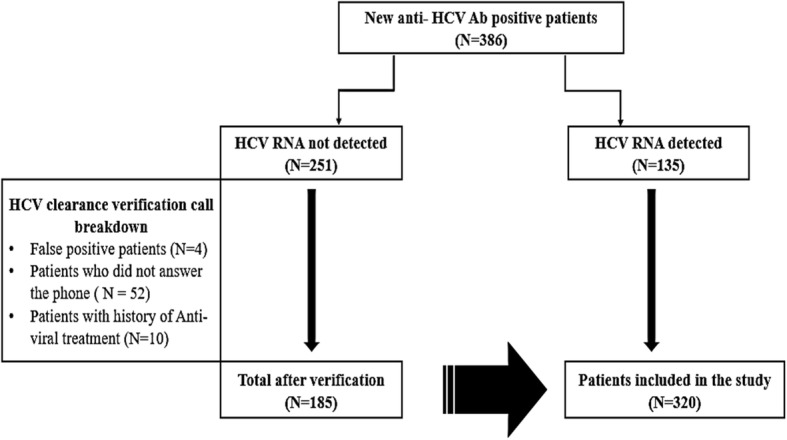
We identified patients between November 2015 and September 2017 as part of a newly implemented HCV screening and linkage-to-care program at University of California Los Angeles (UCLA) Health System. All patients were eligible for screening, though there were additional efforts to screen patients born between 1945 and 1965. We reviewed Medical records to categorize anti-HCV antibody positive patients as having spontaneously cleared HCV infection (HCV RNA not detected) or not (HCV RNA detected). We excluded those with a prior history of anti-HCV positivity or history of HCV treatment. We compared differences between those with and without detectable HCV RNA using chi-square test, Fisher's exact test, and t-test as appropriate. We assessed factors associated with HCV clearance using logistic regression analysis.
Among the 320 patients included in this study, 56% were male. Baby boomers (52-72 years of age) comprised the single largest age group (62%). We found spontaneous HCV clearance in 58% (n = 185). HCV viral clearance was slightly higher among women as compared to men (63% vs. 53%; p value = 0.07) and varied by race/ethnicity: clearance among Blacks/African Americans was 37% vs. 58% among whites (p value = 0.02). After adjusting for age, race/ethnicity, and sex we found that those diagnosed with chronic kidney disease had a tendency of decreased HCV viral clearance (adjusted OR = 0.34; 95% CI 0.14-1.03).
Of those patients newly identified as anti-HCV positive, 58% had cleared HCV virus, while the rest showed evidence of active infection. In addition, we found that clearance varied by race/ethnicity and clinical characteristics.
在美国,丙型肝炎病毒 (HCV) 的清除率估计在 20%到 30%之间。本研究的目的是估计在加利福尼亚州洛杉矶市的一个大型城市卫生系统中新发现的 HCV 抗体阳性患者中 HCV 清除的频率,并确定其与病毒清除相关的因素。
我们于 2015 年 11 月至 2017 年 9 月间,作为加利福尼亚大学洛杉矶分校(UCLA)卫生系统新实施的 HCV 筛查和治疗计划的一部分,对患者进行了识别。所有患者都有资格进行筛查,但还需要额外的努力来筛查出生于 1945 年至 1965 年之间的患者。我们查阅了病历,将抗 HCV 抗体阳性患者分为 HCV 感染自发清除(未检测到 HCV RNA)或未清除(检测到 HCV RNA)。我们排除了那些之前有抗 HCV 阳性或 HCV 治疗史的患者。我们使用卡方检验、Fisher 确切检验和 t 检验比较了有和无可检测 HCV RNA 的患者之间的差异。我们使用逻辑回归分析评估了与 HCV 清除相关的因素。
在本研究的 320 名患者中,56%为男性。婴儿潮一代(52-72 岁)构成了最大的单一年龄组(62%)。我们发现 58%(n=185)患者自发清除了 HCV。与男性相比,女性的 HCV 病毒清除率略高(63%与 53%;p 值=0.07),且因种族/民族而异:黑人/非裔美国人的清除率为 37%,白人的清除率为 58%(p 值=0.02)。在调整年龄、种族/民族和性别后,我们发现患有慢性肾病的患者 HCV 病毒清除率有下降趋势(调整后的 OR=0.34;95%CI 0.14-1.03)。
在新发现的抗 HCV 阳性患者中,有 58%的患者清除了 HCV 病毒,而其余患者则显示出活跃感染的证据。此外,我们发现清除率因种族/民族和临床特征而异。