Centre for Population Health Sciences, Lee Kong Chian School of Medicine, Nanyang Technological University, Clinical Sciences Building, Level 18, 11 Mandalay Road, Singapore, 308232, Singapore.
NTU Institute for Health Technologies (HealthTech NTU), Interdisciplinary Disciplinary School, Nanyang Technological University, Singapore, Singapore.
BMC Med. 2019 Jul 17;17(1):127. doi: 10.1186/s12916-019-1362-1.
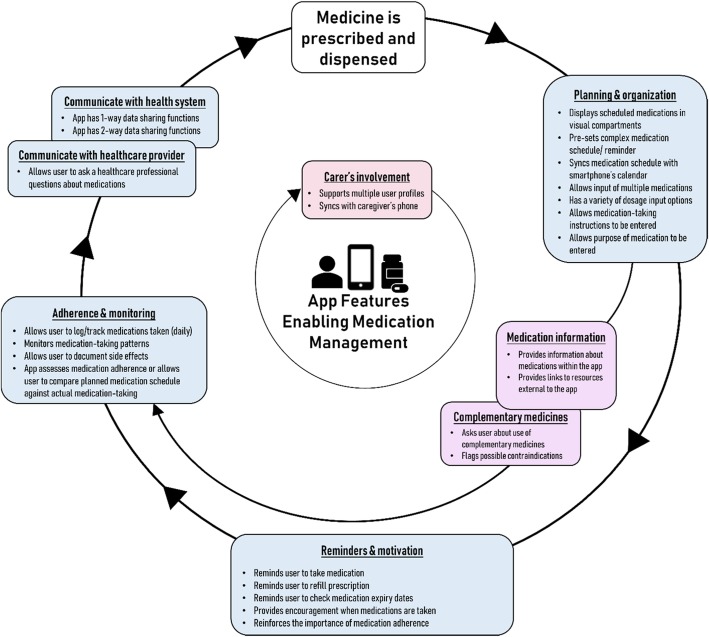
Smartphone apps are becoming increasingly popular for supporting diabetes self-management. A key aspect of diabetes self-management is appropriate medication-taking. This study aims to systematically assess and characterise the medication management features in diabetes self-management apps and their congruence with best-practice evidence-based criteria.
The Google Play and Apple app stores were searched in June 2018 using diabetes-related terms in the English language. Apps with both medication and blood glucose management features were downloaded and evaluated against assessment criteria derived from international medication management and diabetes guidelines.
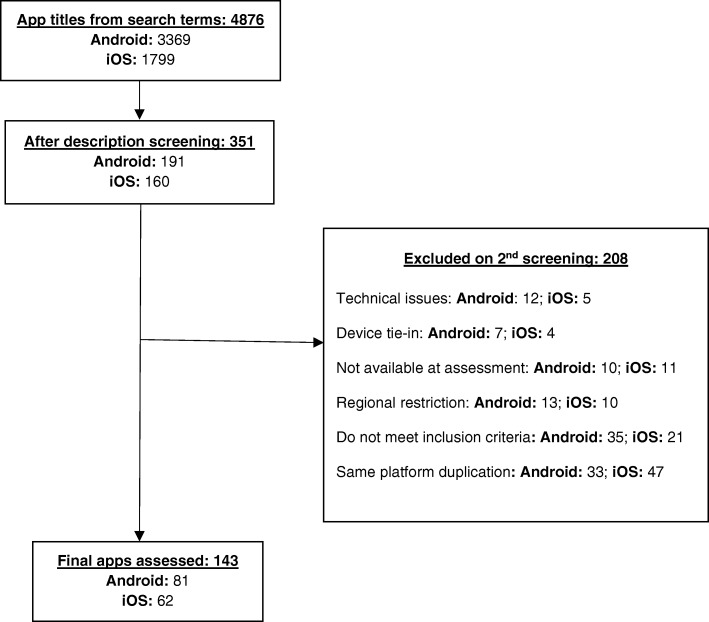
Our search yielded 3369 Android and 1799 iOS potentially relevant apps; of which, 143 apps (81 Android, 62 iOS) met inclusion criteria and were downloaded and assessed. Over half 58.0% (83/143) of the apps had a medication reminder feature; 16.8% (24/143) had a feature to review medication adherence; 39.9% (57/143) allowed entry of medication-taking instructions; 5.6% (8/143) provided information about medication; and 4.2% (6/143) displayed motivational messages to encourage medication-taking. Only two apps prompted users on the use of complementary medicine. Issues such as limited medication logging capacity, faulty reminder features, unclear medication adherence assessment, and visually distracting excessive advertising were observed during app assessments.
A large proportion of diabetes self-management apps lacked features for enhancing medication adherence and safety. More emphasis should be given to the design of medication management features in diabetes apps to improve their alignment to evidence-based best practice.
智能手机应用程序在支持糖尿病自我管理方面变得越来越流行。糖尿病自我管理的一个关键方面是适当的用药。本研究旨在系统评估和描述糖尿病自我管理应用程序中的药物管理功能,并评估其与基于最佳实践证据的标准的一致性。
2018 年 6 月,使用英语中与糖尿病相关的术语在 Google Play 和 Apple 应用商店中进行搜索。下载具有药物和血糖管理功能的应用程序,并根据国际药物管理和糖尿病指南制定的评估标准对其进行评估。
我们的搜索产生了 3369 个安卓应用程序和 1799 个 iOS 应用程序;其中,143 个应用程序(81 个安卓,62 个 iOS)符合纳入标准,并被下载和评估。超过一半的应用程序 58.0%(83/143)具有药物提醒功能;16.8%(24/143)具有评估药物依从性的功能;39.9%(57/143)允许输入药物服用说明;5.6%(8/143)提供药物信息;4.2%(6/143)显示鼓励服药的激励信息。只有两个应用程序提示用户使用补充药物。在应用程序评估过程中观察到一些问题,例如有限的药物记录容量、错误的提醒功能、不明确的药物依从性评估以及视觉上分散注意力的过多广告。
很大一部分糖尿病自我管理应用程序缺乏增强药物依从性和安全性的功能。应更加重视糖尿病应用程序中药物管理功能的设计,以提高其与基于最佳实践证据的标准的一致性。