Car Josip, Tan Woan Shin, Huang Zhilian, Sloot Peter, Franklin Bryony Dean
Centre for Population Health Sciences, Lee Kong Chian School of Medicine, Nanyang Technological University, 3 Fusionopolis Link, #06-13, Nexus@One-North, South tower, Singapore, 138543, Singapore.
Global eHealth Unit, Department of Primary Care and Public Health, School of Public Health, Imperial College, London, UK.
BMC Med. 2017 Apr 5;15(1):73. doi: 10.1186/s12916-017-0838-0.
Globally, healthcare systems face major challenges with medicines management and medication adherence. Medication adherence determines medication effectiveness and can be the single most effective intervention for improving health outcomes. In anticipation of growth in eHealth interventions worldwide, we explore the role of eHealth in the patients' medicines management journey in primary care, focusing on personalisation and intelligent monitoring for greater adherence.
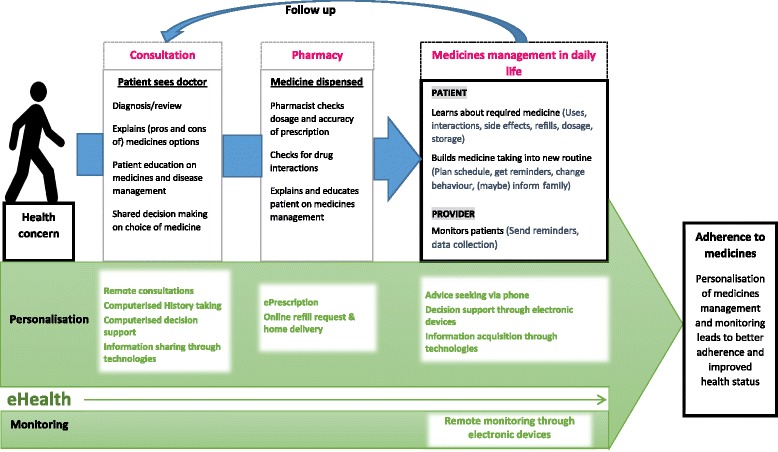
eHealth offers opportunities to transform every step of the patient's medicines management journey. From booking appointments, consultation with a healthcare professional, decision-making, medication dispensing, carer support, information acquisition and monitoring, to learning about medicines and their management in daily life. It has the potential to support personalisation and monitoring and thus lead to better adherence. For some of these dimensions, such as supporting decision-making and providing reminders and prompts, evidence is stronger, but for many others more rigorous research is urgently needed.
Given the potential benefits and barriers to eHealth in medicines management, a fine balance needs to be established between evidence-based integration of technologies and constructive experimentation that could lead to a game-changing breakthrough. A concerted, transdisciplinary approach adapted to different contexts, including low- and middle-income contries is required to realise the benefits of eHealth at scale.
在全球范围内,医疗保健系统在药品管理和药物依从性方面面临重大挑战。药物依从性决定药物疗效,并且可能是改善健康结果的最有效的单一干预措施。鉴于全球电子健康干预措施的增长预期,我们探讨电子健康在初级保健中患者药品管理过程中的作用,重点关注个性化和智能监测以提高依从性。
电子健康为改变患者药品管理过程的每一步提供了机会。从预约、与医疗保健专业人员咨询、决策、配药、护理支持、信息获取和监测,到了解药品及其在日常生活中的管理。它有潜力支持个性化和监测,从而提高依从性。对于其中一些方面,如支持决策和提供提醒与提示,证据更强,但对于许多其他方面,迫切需要更严格的研究。
鉴于电子健康在药品管理中的潜在益处和障碍,需要在基于证据的技术整合与可能带来变革性突破的建设性实验之间建立良好平衡。需要采取协调一致的跨学科方法,以适应不同背景,包括低收入和中等收入国家,以大规模实现电子健康的益处。