Ramírez-Moya Julia, Santisteban Pilar
Instituto de Investigaciones Biomédicas "Alberto Sols", Consejo Superior Investigaciones Científicas and Universidad Autónoma de Madrid (CSIC-UAM), Madrid, Spain.
Centro de Investigación Biomédica en Red de Cáncer (CIBERONC), Instituto de Salud Carlos III (ISCIII), Madrid, Spain.
Front Endocrinol (Lausanne). 2019 Jul 2;10:430. doi: 10.3389/fendo.2019.00430. eCollection 2019.
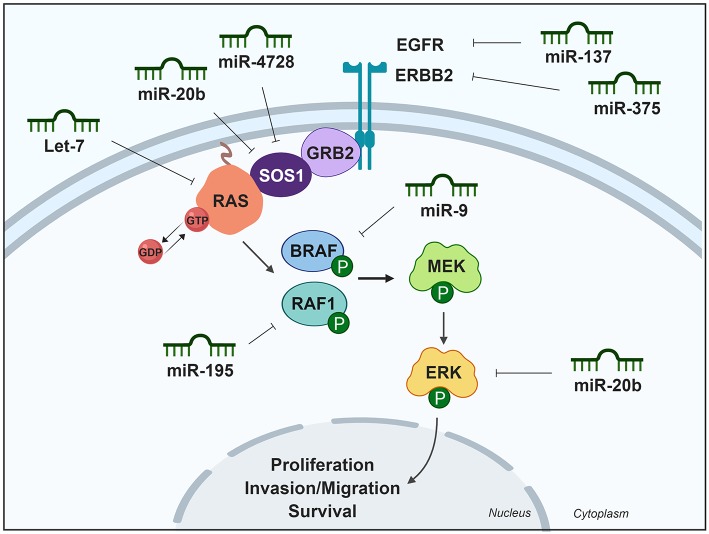
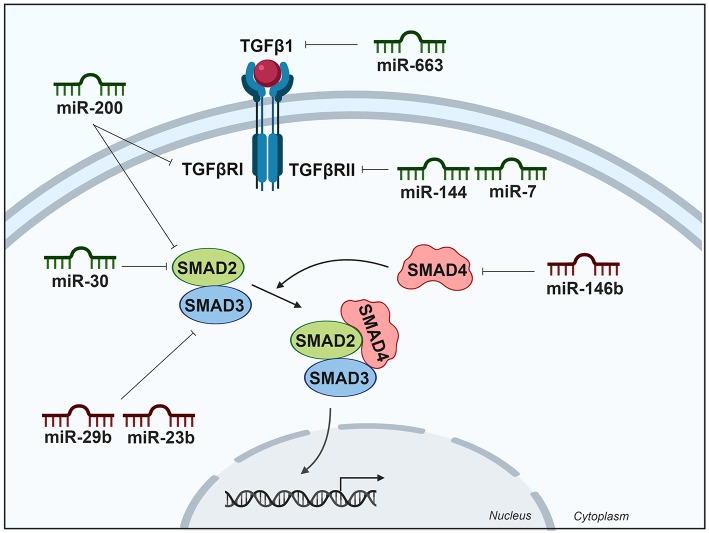
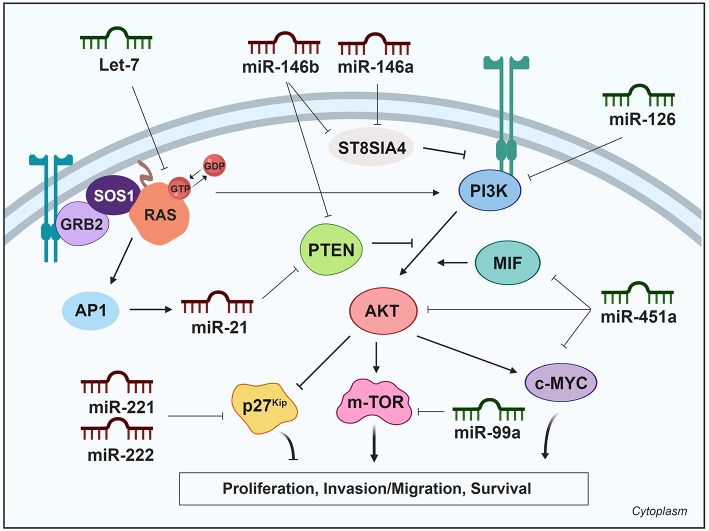
In the last two decades, great strides have been made in the study of microRNAs in development and in diseases such as cancer, as reflected in the exponential increase in the number of reviews on this topic including those on undifferentiated and well-differentiated thyroid cancer. Nevertheless, few reviews have focused on understanding the functional significance of the most up- or down-regulated miRNAs in thyroid cancer for the main signaling pathways hyperactivated in this tumor type. The aim of this review is to discuss the major miRNAs targeting proteins of the MAPK, PI3K, and TGFβ pathways, to define their mechanisms of action through the 3'UTR regions of their target genes, and to describe how they affect thyroid tumorigenesis through their actions on cell proliferation, migration, and invasion. Given the importance of miRNAs in cancer as diagnostic, prognostic and therapeutic candidates, a better understanding of this cross-talk might shed new light on the biomedical treatment of thyroid cancer.
在过去二十年中,微小RNA在发育以及癌症等疾病研究方面取得了巨大进展,这体现在关于该主题的综述数量呈指数级增长,其中包括未分化和高分化甲状腺癌的相关综述。然而,很少有综述聚焦于了解甲状腺癌中上调或下调最明显的微小RNA对该肿瘤类型中过度激活的主要信号通路的功能意义。本综述的目的是讨论靶向丝裂原活化蛋白激酶(MAPK)、磷脂酰肌醇-3激酶(PI3K)和转化生长因子β(TGFβ)通路蛋白的主要微小RNA,通过其靶基因的3'非翻译区(3'UTR)确定它们的作用机制,并描述它们如何通过对细胞增殖、迁移和侵袭的作用影响甲状腺肿瘤发生。鉴于微小RNA在癌症中作为诊断、预后和治疗候选物的重要性,更好地理解这种相互作用可能为甲状腺癌的生物医学治疗提供新的思路。