Alshabeeb Mohammad A, Deneer Vera H M, Khan Amjad, Asselbergs Folkert W
Medical Genomics Research Department, King Abdullah International Medical Research Center, Riyadh, Saudi Arabia.
King Saud Bin Abdulaziz University for Health Sciences, Riyadh, Saudi Arabia.
Front Genet. 2019 Jul 2;10:567. doi: 10.3389/fgene.2019.00567. eCollection 2019.
The Dutch Pharmacogenetics Working Group (DPWG) indicated a list of actionable genotypes that affect patients' response to more 50 drugs; these drugs which show variable effects based on patients' genetic traits were named as pharmacogenetics (PGX) drugs. Preemptive genetic testing before using these drugs may protect certain patients from serious adverse reactions and could help in avoiding treatment failures. The objectives of this study include identifying the rate of PGX drug usage among Dutch population, estimating the level of users who carry the actionable genotypes and determining the main genes involved in drug's effect variability.
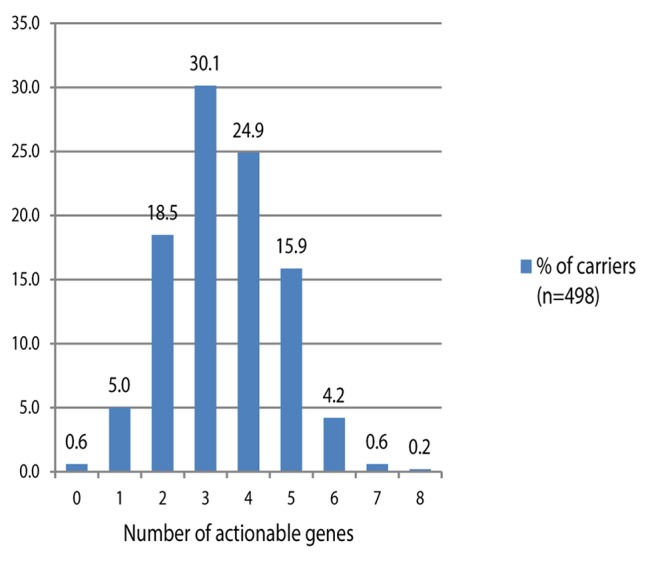
Usage of PGX drugs over 2011-2017 by the insured population (an average of 11.4 million) in outpatient clinics in Netherlands was obtained from the publically available GIP databank. The data of 45 drugs were analyzed and their interactions with selected pharmacogenes were estimated. Frequency of actionable genotypes of 249 Dutch parents was obtained from the public database: Genome of Netherlands (GoNL), to identify the pattern of genetic characteristics of Dutch population.
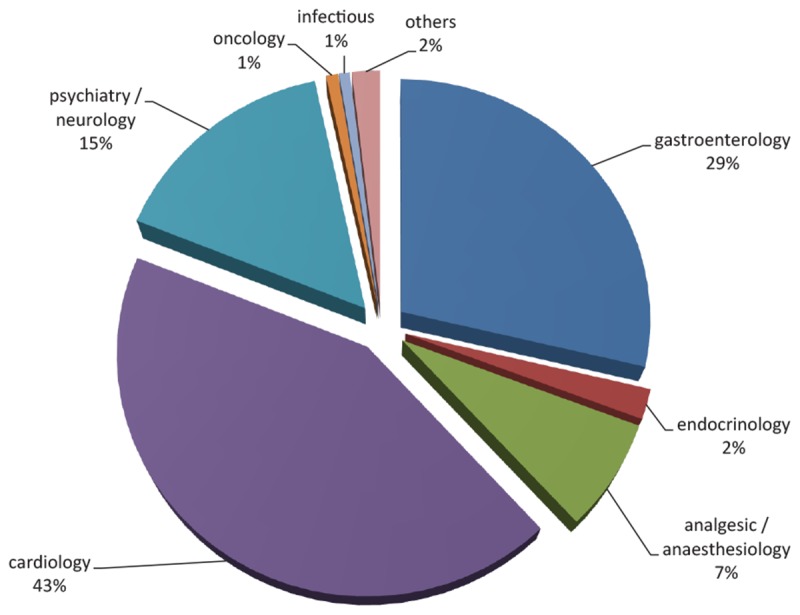
Over a 7 year period, 51.3 million exposures of patients to PGX drugs were reported with an average of 5.3 exposures per each drug user. One quarterof the exposures (12.4 million) are predicted to be experienced by individuals with actionable genotypes (risky exposures). Up to 60% of the risky exposures (around 7.5 million) were related to drugs metabolized by CYP2D6. SLCO1B1, and CYP2C19 were also identified among the top genes affecting response of drugs users (involved in about 22 and 12.4% of the risky exposures, respectively). Cardiovascular medications were the top prescribed PGX drug class (43%), followed by gastroenterology (29%) and psychiatry/neurology medications (15%). Women use more PGX drugs than men (55.8 vs. 44.2%, respectively) with the majority (84%) of users in both sexes are above 45 years.
PGX drugs are commonly used in Netherlands. Preemptive panel testing for CYP2D6, SLCO1B1, and CYP2C19 only could be useful to predict 95% of vulnerable patients' exposures to PGX drugs. Future studies to assess the economic impact of preemptive panel testing on patients of older age are suggested.
荷兰药物基因组学工作组(DPWG)列出了一系列可影响患者对50多种药物反应的可操作基因型;这些基于患者遗传特征显示出不同效果的药物被称为药物基因组学(PGX)药物。在使用这些药物之前进行前瞻性基因检测可能会保护某些患者免受严重不良反应的影响,并有助于避免治疗失败。本研究的目的包括确定荷兰人群中PGX药物的使用比例,估计携带可操作基因型的使用者水平,并确定参与药物效果变异性的主要基因。
从公开可用的GIP数据库中获取2011 - 2017年荷兰门诊诊所参保人群(平均1140万)使用PGX药物的情况。分析了45种药物的数据,并估计了它们与选定药物基因的相互作用。从公共数据库“荷兰基因组(GoNL)”中获取了249名荷兰父母的可操作基因型频率,以确定荷兰人群的遗传特征模式。
在7年期间,报告了患者对PGX药物的5130万次暴露,每位药物使用者平均暴露5.3次。预计四分之一的暴露(1240万次)将由具有可操作基因型的个体经历(风险暴露)。高达60%的风险暴露(约750万次)与CYP2D6代谢的药物有关。SLCO1B1和CYP2C19也被确定为影响药物使用者反应的主要基因(分别涉及约22%和12.4%的风险暴露)。心血管药物是处方量最大的PGX药物类别(43%),其次是胃肠病学药物(29%)和精神病学/神经学药物(15%)。女性使用的PGX药物比男性多(分别为55.8%和44.2%),两性中大多数使用者(84%)年龄在45岁以上。
PGX药物在荷兰被广泛使用。仅对CYP2D6、SLCO1B1和CYP2C19进行前瞻性基因检测可能有助于预测95%易受影响患者对PGX药物的暴露情况。建议未来开展研究评估前瞻性基因检测对老年患者的经济影响。