Division of Clinical Pharmacology and Toxicology, Department of Paediatrics, The Hospital for Sick Children, University of Toronto, Toronto, Ontario, Canada.
Program in Translational Medicine, The Hospital for Sick Children, Toronto, Ontario, Canada.
JAMA Netw Open. 2021 May 3;4(5):e2110446. doi: 10.1001/jamanetworkopen.2021.10446.
Pharmacogenomic (PGx) testing provides preemptive pharmacotherapeutic guidance regarding the lack of therapeutic benefit or adverse drug reactions of PGx targeted drugs. Pharmacogenomic information is of particular value among children with complex medical conditions who receive multiple medications and are at higher risk of developing adverse drug reactions.
To assess the implementation outcomes of a PGx testing program comprising both a point-of-care model that examined targeted drugs and a preemptive model informed by whole-genome sequencing that evaluated a broad range of drugs for potential therapy among children in a pediatric tertiary care setting.
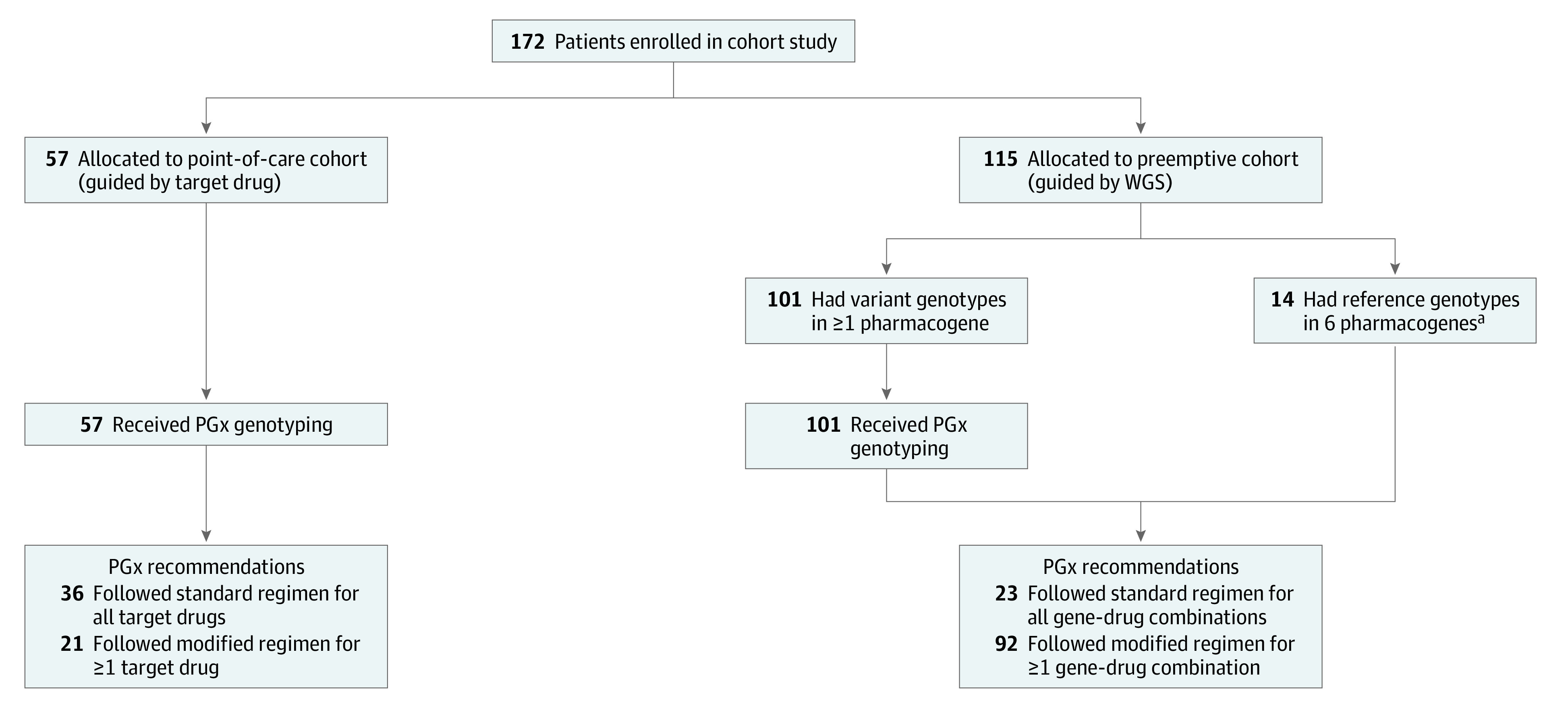
DESIGN, SETTING, AND PARTICIPANTS: This cohort study was conducted at The Hospital for Sick Children in Toronto, Ontario, from January 2017 to September 2020. Pharmacogenomic analyses were performed among 172 children who were categorized into 2 groups: a point-of-care cohort and a preemptive cohort. The point-of-care cohort comprised 57 patients referred to the consultation clinic for planned therapy with PGx targeted drugs and/or for adverse drug reactions, including lack of therapeutic benefit, after the receipt of current or past medications. The preemptive cohort comprised 115 patients who received exploratory whole-genome sequencing-guided PGx testing for their heart conditions from the cardiac genome clinic at the Ted Rogers Centre for Heart Research.
Patients received PGx analysis of whole-genome sequencing data and/or multiplex genotyping of 6 pharmacogenes (CYP2C19, CYP2C9, CYP2D6, CYP3A5, VKORC1, and TPMT) that have established PGx clinical guidelines.
The number of patients for whom PGx test results warranted deviation from standard dosing regimens.
A total of 172 children (mean [SD] age, 8.5 [5.6] years; 108 boys [62.8%]) were enrolled in the study. In the point-of-care cohort, a median of 2 target genes (range, 1-5 genes) were investigated per individual, with CYP2C19 being the most frequently examined; genotypes in 21 of 57 children (36.8%) were incompatible with standard treatment regimens. As expected from population allelic frequencies, among the 115 children in the whole-genome sequencing-guided preemptive cohort, 92 children (80.0%) were recommended to receive nonstandard treatment regimens for potential drug therapies based on their 6-gene pharmacogenetic profile.
In this cohort study, among both the point-of-care and preemptive cohorts, the multiplex PGx testing program provided dosing recommendations that deviated from standard regimens at an overall rate that was similar to the population frequencies of relevant variants.
药物基因组学(PGx)检测提供了针对 PGx 靶向药物缺乏治疗效果或药物不良反应的预防性药物治疗指导。对于接受多种药物治疗且发生药物不良反应风险较高的患有复杂疾病的儿童,PGx 信息尤其有价值。
评估一个 PGx 检测计划的实施结果,该计划包括一个即时护理模型,该模型检查靶向药物,以及一个基于全基因组测序的预防性模型,该模型评估了儿科三级护理环境中广泛的潜在治疗药物。
设计、设置和参与者:这项队列研究于 2017 年 1 月至 2020 年 9 月在安大略省多伦多的 SickKids 医院进行。对 172 名儿童进行了 PGx 分析,这些儿童分为 2 组:即时护理队列和预防性队列。即时护理队列包括 57 名因计划接受 PGx 靶向药物治疗和/或在接受当前或过去药物治疗后出现缺乏治疗效果或药物不良反应而转介至咨询诊所的患者。预防性队列包括 115 名因心脏疾病在泰德·罗杰斯心脏研究中心的心脏基因组诊所接受探索性全基因组测序指导的 PGx 检测的患者。
患者接受了全基因组测序数据和/或 6 个药物基因(CYP2C19、CYP2C9、CYP2D6、CYP3A5、VKORC1 和 TPMT)的多重基因分型的 PGx 分析,这些基因已建立了 PGx 临床指南。
PGx 检测结果需要偏离标准剂量方案的患者人数。
共纳入 172 名儿童(平均[标准差]年龄,8.5[5.6]岁;108 名男孩[62.8%])。在即时护理队列中,每个患者平均调查了 2 个目标基因(范围,1-5 个基因),最常检查的是 CYP2C19;57 名儿童中有 21 名(36.8%)的基因型与标准治疗方案不兼容。根据人群等位基因频率,在全基因组测序指导的预防性队列中的 115 名儿童中,92 名(80.0%)根据他们的 6 个基因药物遗传学特征,建议接受潜在药物治疗的非标准治疗方案。
在这项队列研究中,即时护理和预防性队列中的多基因 PGx 检测计划提供了与标准方案不同的剂量建议,其总体偏离率与相关变异的人群频率相似。