Schmelzle Sebastian, Blüthgen Nico
Department of Biology, Ecological Networks, Technische Universität Darmstadt, Schnittspahnstr. 3, 64287 Darmstadt, Germany.
Front Zool. 2019 Jul 4;16:24. doi: 10.1186/s12983-019-0325-x. eCollection 2019.
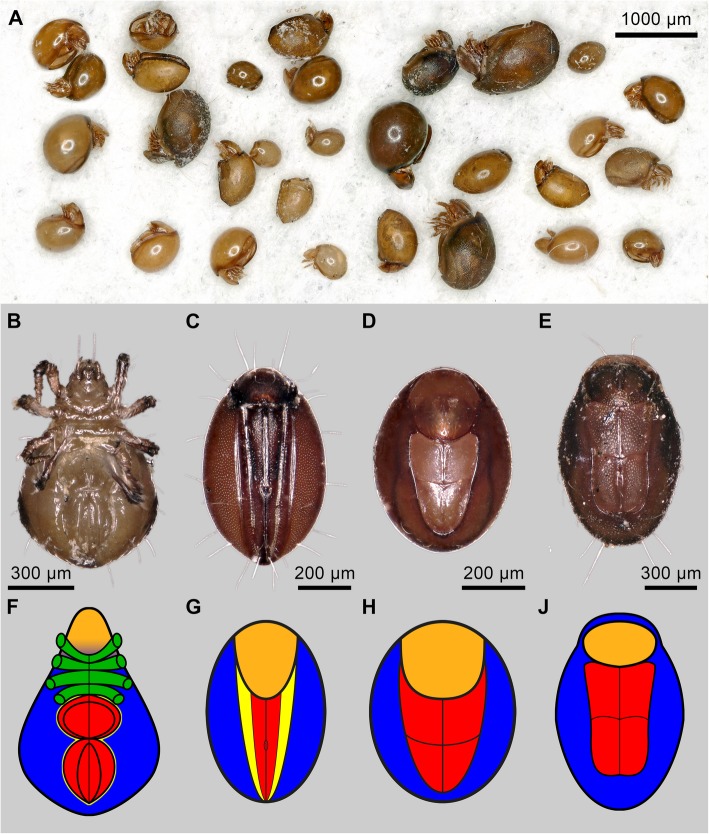
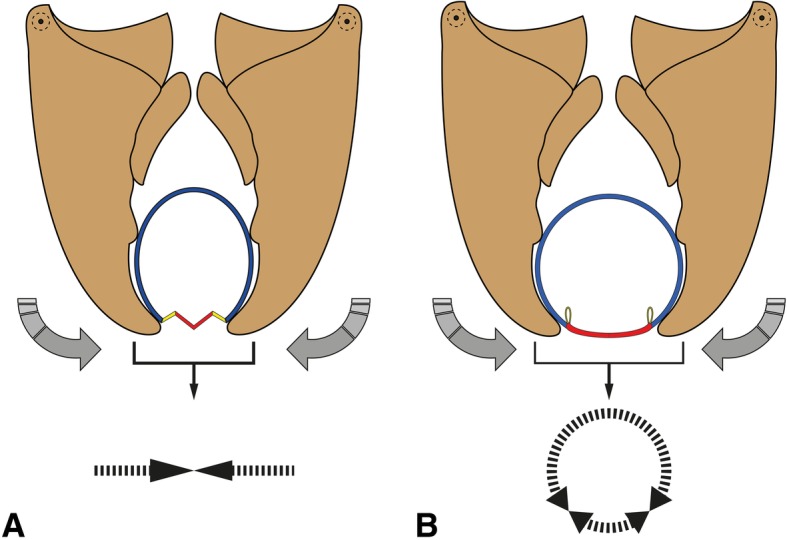
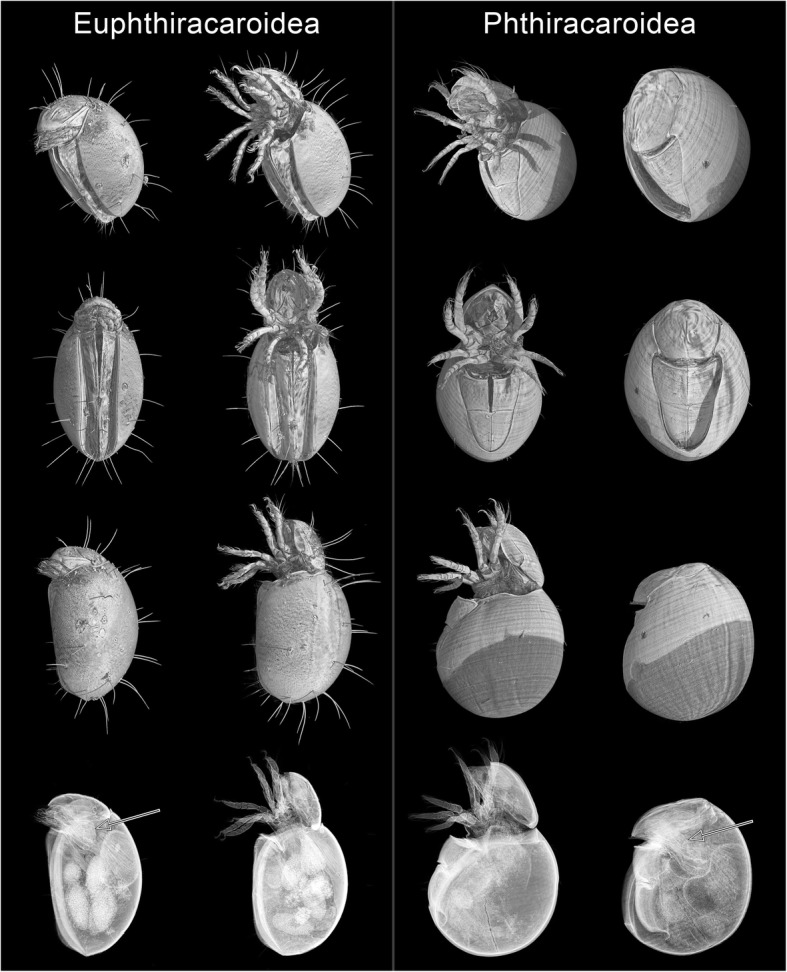
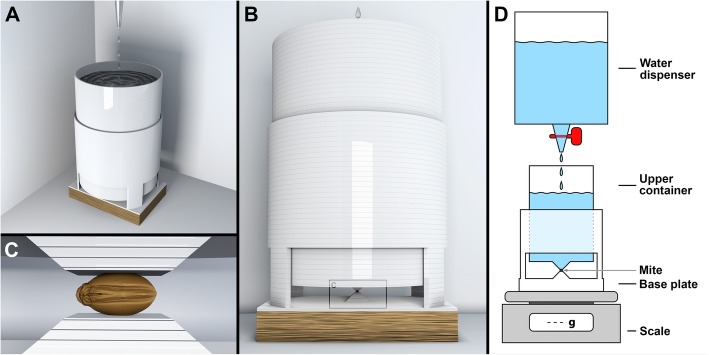
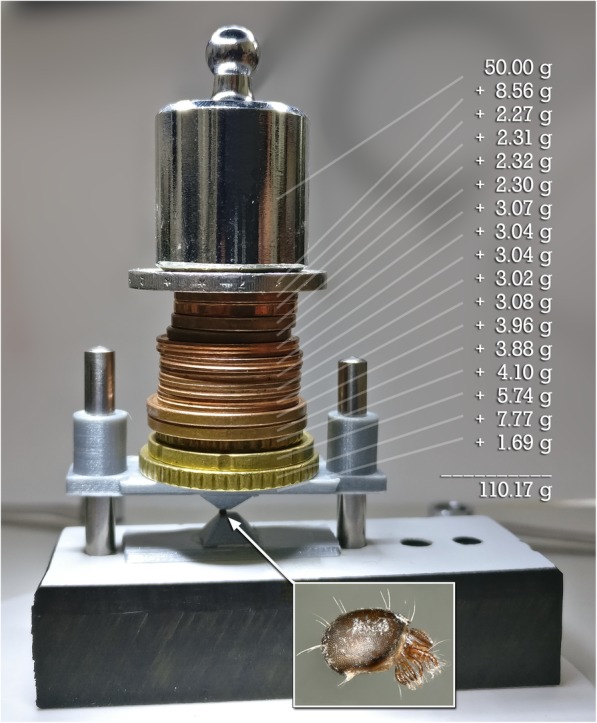
Mechanical defenses are very common and diverse in prey species, for example in oribatid mites. Here, the probably most complex form of morphological defense is known as ptychoidy, that enables the animals to completely retract the appendages into a secondary cavity and encapsulate themselves. The two groups of ptychoid mites constituting the Ptyctima, i.e. Euphthiracaroidea and Phthiracaroidea, have a hardened cuticle and are well protected against similar sized predators. Euphthiracaroidea additionally feature predator-repelling secretions. Since both taxa evolved within the glandulate group of Oribatida, the question remains why Phthiracaroidea lost this additional protection. In earlier predation bioassays, chemically disarmed specimens of Euphthiracaroidea were cracked by the staphylinid beetle , whereas equally sized specimens of Phthiracaroidea survived. We thus hypothesized that Phthiracaroidea can withstand significantly more force than Euphthiracaroidea and that the specific body form in each group is key in understanding the loss of chemical defense in Phthiracaroidea. To measure force resistance, we adapted the principle of machines applying compressive forces for very small animals and tested the two ptyctimous taxa as well as the soft-bodied mite .
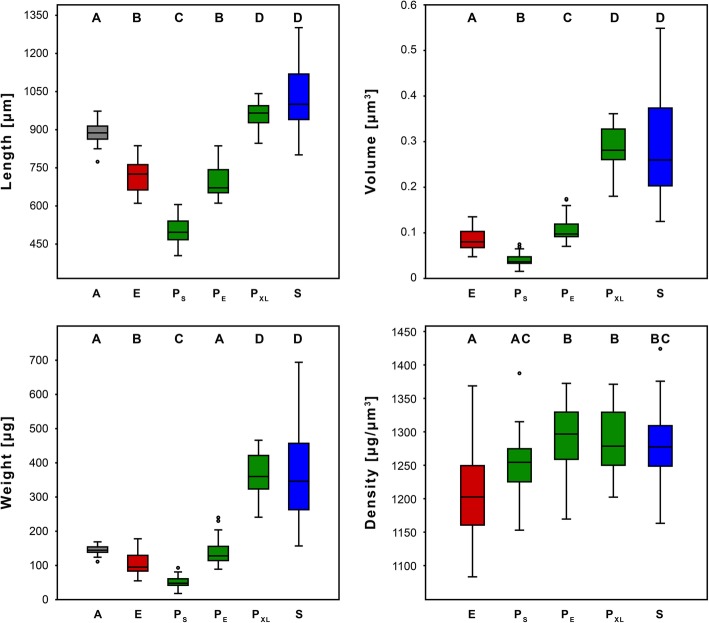
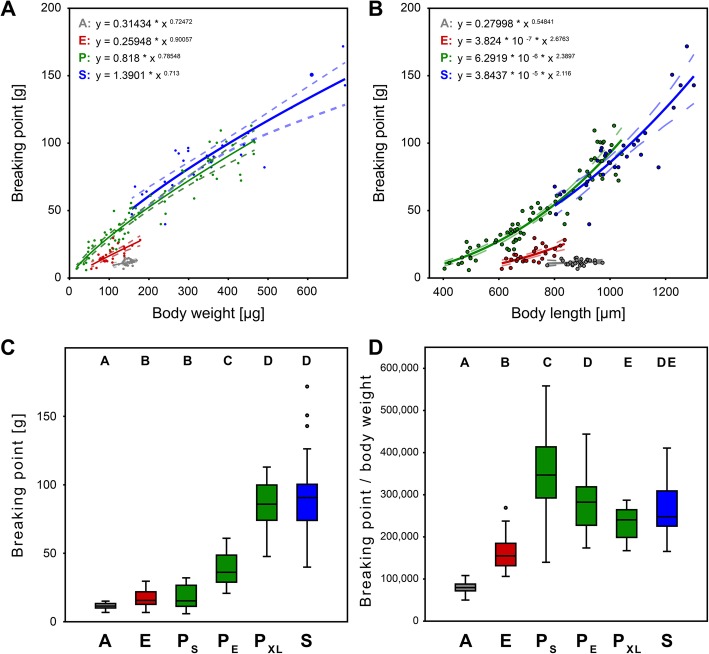
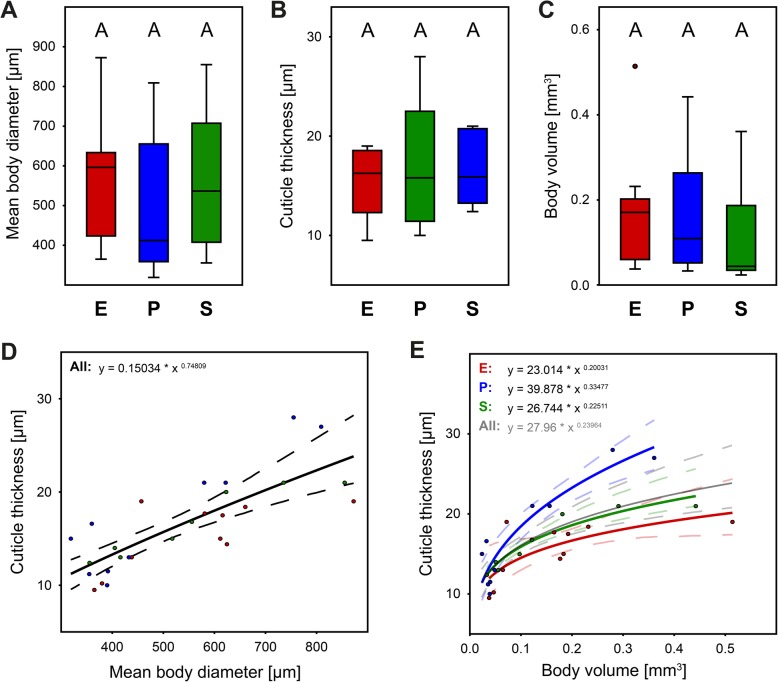
Some Phthiracaroidea individuals sustained about 560,000 times their body weight. Their mean resistance was about three times higher, and their mean breaking point in relation to body weight nearly two times higher than Euphthiracaroidea individuals. The breaking point increased with body weight and differed significantly between the two taxa. Across taxa, the absolute force resistance increased sublinearly (with a 0.781 power term) with the animal's body weight. Force resistance of was inferior in all tests (about half that of Euphthiracaroidea after accounting for body weight). As an important determinant of mechanical resistance in ptychoid mites, the individuals' cuticle thickness increased sublinearly with body diameter and body mass as well and did not differ significantly between the taxa.
We showed the feasibility of the force resistance measurement method, and our results were consistent with the hypothesis that Phthiracaroidea compensated its lack of chemical secretions by a heavier mechanical resistance based on a different body form and associated build-up of hemolymph pressure (defensive trade-off).
机械防御在猎物物种中非常常见且多样,例如在甲螨中。在这里,形态防御可能最复杂的形式被称为褶叠状态,这使动物能够将附肢完全缩回次生腔内并包裹自身。构成褶叠甲螨类的两组褶叠甲螨,即真缝甲螨总科和缝甲螨总科,具有坚硬的角质层,能很好地抵御体型相近的捕食者。真缝甲螨总科还具有驱避捕食者的分泌物。由于这两个分类单元都在有腺甲螨类群中进化,问题仍然存在,即为什么缝甲螨总科失去了这种额外的保护。在早期的捕食生物测定中,化学失活的真缝甲螨总科标本被隐翅虫咬碎,而同样大小的缝甲螨总科标本却存活了下来。因此,我们推测缝甲螨总科比真缝甲螨总科能承受更大的力,并且每组特定的身体形态是理解缝甲螨总科化学防御丧失的关键。为了测量抗受力,我们采用了适用于非常小的动物的施加压缩力的机器原理,并测试了这两个褶叠甲螨类分类单元以及软体螨。
一些缝甲螨总科个体能承受约560,000倍于其体重的力。它们的平均抗受力约高3倍,相对于体重的平均断裂点几乎比真缝甲螨总科个体高2倍。断裂点随体重增加,且两个分类单元之间差异显著。在不同分类单元中,绝对抗受力随动物体重呈亚线性增加(幂次项为0.781)。在所有测试中,软体螨的抗受力都较差(考虑体重后约为真缝甲螨总科的一半)。作为褶叠甲螨机械抗性的一个重要决定因素,个体的角质层厚度也随身体直径和体重呈亚线性增加,且在分类单元之间没有显著差异。
我们证明了抗受力测量方法的可行性,并且我们的结果与以下假设一致,即缝甲螨总科通过基于不同身体形态和相关血淋巴压力积累的更强机械抗性来弥补其化学分泌物的缺乏(防御权衡)。