Carmo Érica Assunção, Nery Adriana Alves, Nascimento Sobrinho Carlito Lopes, Casotti Cezar Augusto
MSc. Nurse and Doctoral Student, Postgraduate Program on Nursing and Health, Universidade Estadual do Sudoeste da Bahia (UESB), Jequié (BA), Brazil.
PhD. Nurse and Professor, Department of Health II and Postgraduate Program on Nursing and Health, Universidade Estadual do Sudoeste da Bahia (UESB), Jequié (BA), Brazil.
Sao Paulo Med J. 2019 Jul 15;137(2):162-168. doi: 10.1590/1516-3180.2018.0388070219.
Scorpion accidents have gained great visibility around the world because of the high frequency and severity with which they occur, and have become a global medical-sanitary problem.
The aim of this study was to describe the sociodemographic, clinical and epidemiological profile of scorpionism in the municipality of Jequié, Bahia, Brazil, from 2007 to 2015.
Retrospective epidemiological study in the municipality of Jequié, Bahia, Brazil.
This study was based on data collected from the epidemiological investigation notification forms of the injury information system.
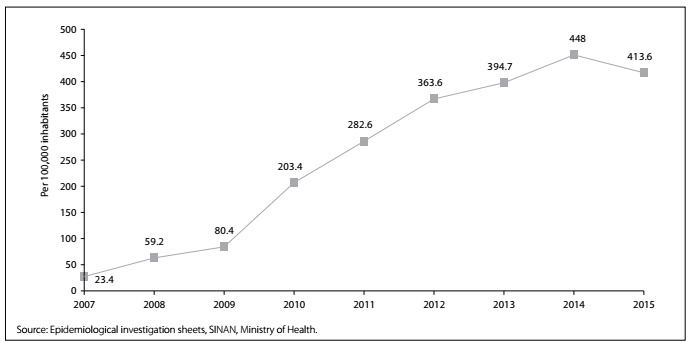
There was an increase in the coefficient of incidence of scorpion accidents in Jequié from 23.4/100,000 in 2007 to 413.6/100,000 in 2015. There were 3565 cases: 54.9% were female, 58.8% were aged 20-59 years, 63.5% had brown skin color and 48.6% had incomplete primary education. Most accidents occurred in urban areas (93.1%). Homes were the main place of occurrence (84.5%) and upper limbs were the commonest sting sites (53.0%). Regarding clinical aspects, 66.4% of the cases received hospital assistance within one hour after the bite, 84.1% presented mild severity, 97.1% had local manifestations and 10.2% had systemic symptoms. Serum therapy was administered in 17.3% of the cases, and 99.9% evolved to cure.
There was an increase in the incidence of scorpion accidents in the municipality, which demonstrates the need for investment in actions that reduce the morbidity and mortality caused by these accidents, such as educational campaigns and improvements in socioeconomic and health conditions.
蝎子蜇伤事故因其发生频率高且严重程度大,在全球范围内受到高度关注,并已成为一个全球性的医疗卫生问题。
本研究旨在描述2007年至2015年巴西巴伊亚州热基耶市蝎子蜇伤的社会人口学、临床和流行病学特征。
在巴西巴伊亚州热基耶市进行的回顾性流行病学研究。
本研究基于从伤害信息系统的流行病学调查通知表中收集的数据。
热基耶市蝎子蜇伤事故的发病率从2007年的23.4/10万增加到2015年的413.6/10万。共有3565例病例:54.9%为女性;58.8%年龄在20至59岁之间;63.5%肤色为棕色;48.6%接受的初等教育不完整。大多数事故发生在城市地区(93.1%)。家庭是主要发生地点(84.5%),上肢是最常见的蜇伤部位(53.0%)。在临床方面,66.4%的病例在被蜇伤后一小时内接受了医院救治,84.1%症状较轻,97.1%有局部表现,10.2%有全身症状。17.3%的病例接受了血清治疗,99.9%康复。
该市蝎子蜇伤事故发病率上升,这表明需要投资开展相关行动,以降低这些事故造成的发病率和死亡率,如开展教育活动以及改善社会经济和健康状况。