Department of Basic and Clinical Neuroscience, King's College London, Maurice Wohl Clinical Neuroscience Institute, London, UK.
Department of Neurology, King's College Hospital, London, UK.
J Neurol Neurosurg Psychiatry. 2019 Oct;90(10):1165-1170. doi: 10.1136/jnnp-2018-320288. Epub 2019 Jul 17.
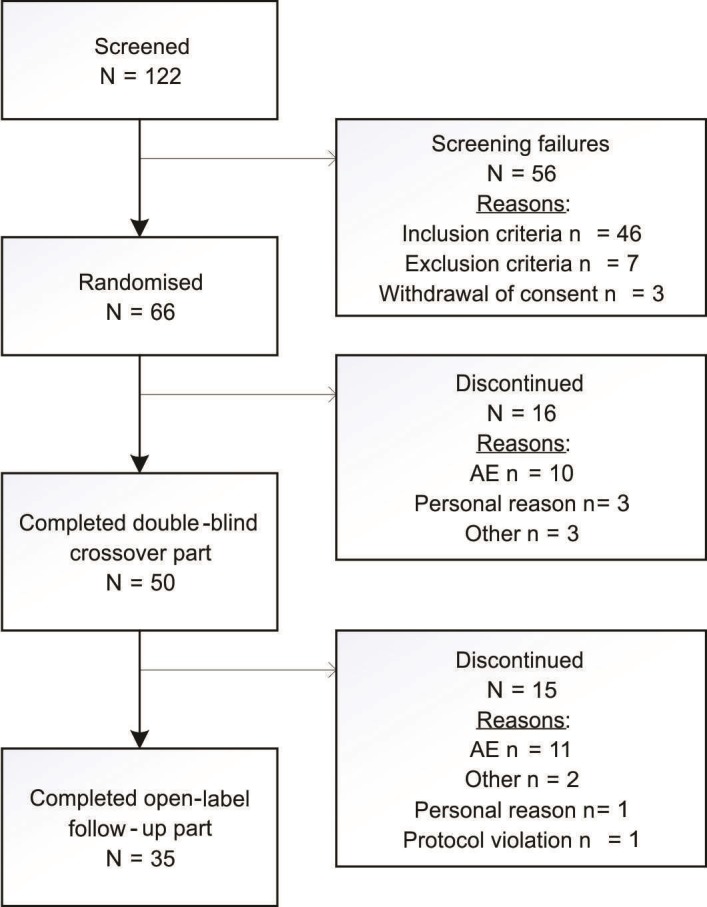
To evaluate the efficacy and safety of oral levosimendan in patients with amyotrophic lateral sclerosis (ALS). This phase II, randomised, double-blind, placebo-controlled, crossover, three-period study with 6 months open-label follow-up enrolled adults with ALS and sitting slow vital capacity (SVC) 60%-90 % of predicted from 11 sites in four countries.
Patients received levosimendan 1 mg daily, 1 mg two times a day or placebo during three 14-day crossover periods and levosimendan 1-2 mg daily during open-label follow-up. Primary endpoint was sitting SVC; secondary endpoints included supine SVC, ALS Functional Rating Scale-Revised (ALSFRS-R), tolerability and safety.
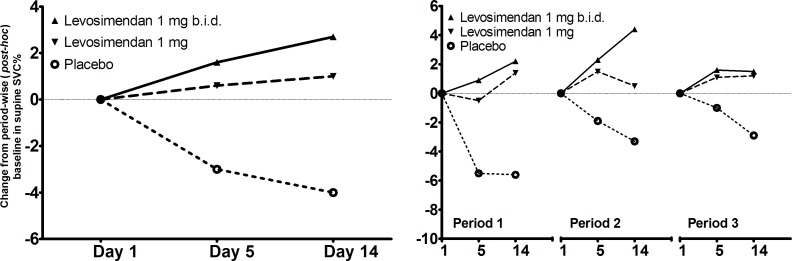
Of 66 patients randomised, 59 contributed to the double-blind results and 50 entered open-label follow-up. Sitting SVC was not significantly different between the treatments. In post hoc analysis using period-wise baselines, supine SVC favoured levosimendan over placebo, estimated mean differences from baseline being -3.62% on placebo, +0.77% on levosimendan 1 mg daily (p=0.018) and +2.38% on 1 mg two times a day (p=0.001). Headache occurred in 16.7% of patients during levosimendan 1 mg daily (p=0.030), 28.6% during 1 mg two times a day (p=0.002) and 3.3% during placebo. The respective frequencies for increased heart rate were 5.1% (p=0.337), 18.5% (p=0.018) and 1.7%. No significant differences between the treatments were seen for other adverse events.
Levosimendan did not achieve the primary endpoint of improving sitting SVC in ALS. Headache and increased heart rate were increased on levosimendan, although it was otherwise well tolerated. A phase III study to evaluate the longer term effects of oral levosimendan in ALS is ongoing.
评估左西孟旦口服制剂在肌萎缩侧索硬化症(ALS)患者中的疗效和安全性。这项在 4 个国家的 11 个地点进行的 II 期、随机、双盲、安慰剂对照、交叉、三周期研究,随访 6 个月,纳入了成年人 ALS 和坐式肺活量(SVC)预测值的 60%-90%。
患者在 3 个 14 天的交叉期内分别接受左西孟旦 1mg/天、1mg/次,2 次/天或安慰剂治疗,然后进入开放性随访期,接受左西孟旦 1-2mg/天治疗。主要终点是坐式 SVC;次要终点包括仰卧 SVC、肌萎缩侧索硬化功能评定量表修订版(ALSFRS-R)、耐受性和安全性。
在 66 名随机分组的患者中,59 名患者完成了双盲结果,50 名患者进入开放性随访。治疗组之间的坐式 SVC 无显著差异。在按周期基线的事后分析中,仰卧 SVC 显示左西孟旦优于安慰剂,从基线的估计平均差异分别为安慰剂组-3.62%、左西孟旦 1mg/天组+0.77%(p=0.018)和左西孟旦 1mg/次,2 次/天组+2.38%(p=0.001)。在左西孟旦 1mg/天组中,头痛发生率为 16.7%(p=0.030),1mg/次,2 次/天组为 28.6%(p=0.002),安慰剂组为 3.3%。心率增加的相应频率分别为 5.1%(p=0.337)、18.5%(p=0.018)和 1.7%。治疗组之间其他不良反应无显著差异。
左西孟旦未能达到改善 ALS 患者坐式 SVC 的主要终点。尽管左西孟旦耐受性良好,但头痛和心率增加。一项评估口服左西孟旦在 ALS 中长期疗效的 III 期研究正在进行中。