From the Departments of Laboratory Medicine and Pathology (A.Z., T.K., V.L., S.P., A.M.), Neurology (A.Z., Y.G., A.H., V.L., C.F.L., S.P., A.M.), and Immunology (V.L.), Mayo Clinic, Rochester, MN.
Neurology. 2019 Aug 20;93(8):e815-e822. doi: 10.1212/WNL.0000000000007971. Epub 2019 Jul 17.
To describe a novel antibody biomarker of neurologic paraneoplastic autoimmunity specific for phosphodiesterase 10A (PDE10A), a striatum-enriched phosphodiesterase, and to characterize the clinical phenotype of patients with PDE10A immunoglobulin G (IgG).
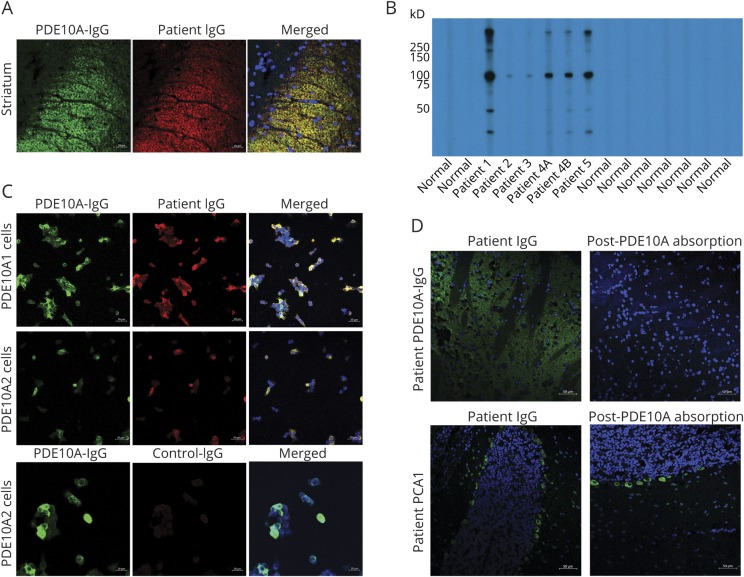
We describe 7 patients with autoantibodies specific for PDE10A identified in the Mayo Clinic Neuroimmunology Laboratory. Patient specimens (sera, 7; CSF, 4) produced identical basal ganglia-predominant synaptic staining of murine brain tissue by indirect immunofluorescence. The autoantigen was identified by immunoprecipitation and mass spectrometry as PDE10A, and confirmed by antigen-specific recombinant Western blot and cell-based assays, and immune absorption experiments.
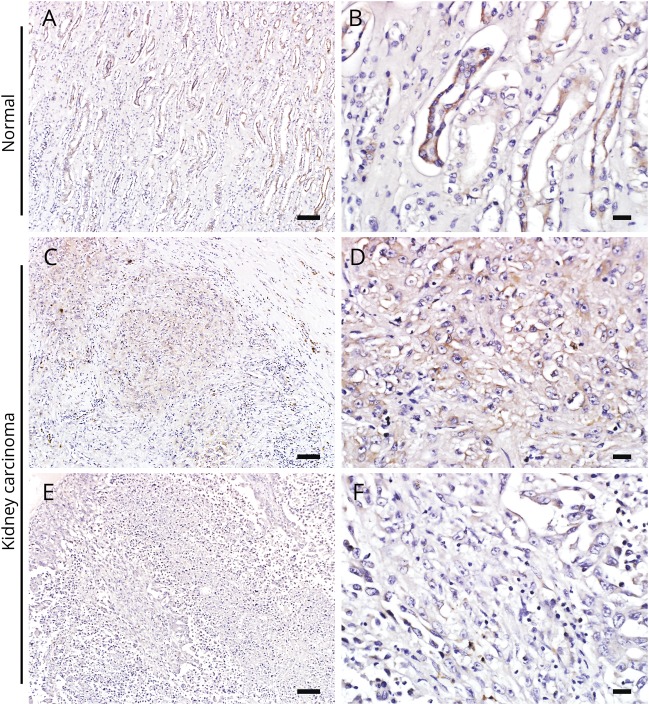
The median patient age was 70 years (range 66-76); 4 were men. Four patients with clinical information available had movement disorders (hyperkinetic in 3 [chorea, ballismus, dystonia] and parkinsonism in 1). All patients but one had cancer (lung [adenocarcinoma 1, squamous cell carcinoma 1, poorly differentiated mesenchymal carcinoma 1], renal adenocarcinoma 2, and pancreatic adenocarcinoma 1). Two of the 7 patients developed hyperkinetic movement disorders during treatment with immune checkpoint inhibitors (nivolumab and pembrolizumab), though none of 26 cancer control patients treated with immune checkpoint inhibitors harbored PDE10A IgG in their serum. MRIs from those 2 patients with hyperkinetic movement disorders demonstrated fluid-attenuated inversion recovery/T2 basal ganglia hyperintensities, and their CSF harbored unique oligoclonal bands. One of those 2 patients had substantial improvement after corticosteroids. One patient's renal adenocarcinoma expressed PDE10A by immunohistochemistry.
PDE10A IgG defines a novel rare neurologic autoimmune syndrome and expands the spectrum of diagnosable paraneoplastic CNS disorders. The intracellular location of PDE10A suggests a T-cell-mediated pathology targeting cells displaying MHC1-bound PDE10A peptides.
描述一种新型神经副肿瘤自身免疫抗体生物标志物,该标志物针对富含纹状体的磷酸二酯酶 10A(PDE10A),并对 PDE10A 免疫球蛋白 G(IgG)患者的临床表型进行特征描述。
我们描述了在梅奥诊所神经免疫实验室鉴定出的 7 例针对 PDE10A 的自身抗体患者。通过间接免疫荧光法,患者标本(血清 7 例;CSF 4 例)对鼠脑组织产生了相同的基底节为主的突触染色。通过免疫沉淀和质谱鉴定自身抗原为 PDE10A,并通过抗原特异性重组 Western blot 和基于细胞的测定以及免疫吸收实验进行了确认。
中位患者年龄为 70 岁(范围 66-76 岁);4 例为男性。有临床信息的 4 例患者出现运动障碍(3 例为多动[舞蹈症、舞蹈手足徐动症、肌张力障碍],1 例为帕金森病)。除 1 例患者外,所有患者均患有癌症(肺 [腺癌 1 例、鳞状细胞癌 1 例、低分化间充质癌 1 例]、肾腺癌 2 例、胰腺腺癌 1 例)。在接受免疫检查点抑制剂(nivolumab 和 pembrolizumab)治疗的 7 例患者中,有 2 例出现了多动性运动障碍,而在接受免疫检查点抑制剂治疗的 26 例癌症对照组患者中,没有 1 例血清中存在 PDE10A IgG。这 2 例出现多动性运动障碍的患者的 MRI 显示了液体衰减反转恢复/T2 基底节高信号,其 CSF 中存在独特的寡克隆带。其中 1 例患者在接受皮质类固醇治疗后有明显改善。1 例患者的肾腺癌通过免疫组织化学表达 PDE10A。
PDE10A IgG 定义了一种新型罕见的神经自身免疫综合征,并扩大了可诊断的副肿瘤性中枢神经系统疾病谱。PDE10A 的细胞内位置提示存在针对表达 MHC1 结合的 PDE10A 肽的细胞的 T 细胞介导的病理学。