Department of Chemistry, University of Utah, Salt Lake City, UT, USA.
Nature. 2019 Jul;571(7765):343-348. doi: 10.1038/s41586-019-1384-z. Epub 2019 Jul 17.
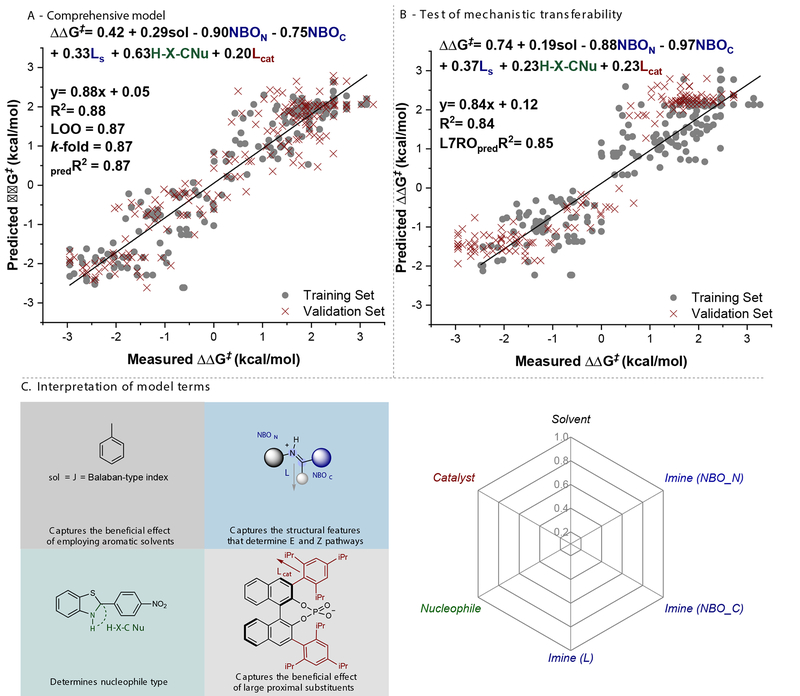
When faced with unfamiliar reaction space, synthetic chemists typically apply the reported conditions (reagents, catalyst, solvent and additives) of a successful reaction to a desired, closely related reaction using a new substrate type. Unfortunately, this approach often fails owing to subtle differences in reaction requirements. Consequently, an important goal in synthetic chemistry is the ability to transfer chemical observations quantitatively from one reaction to another. Here we present a holistic, data-driven workflow for deriving statistical models of one set of reactions that can be used to predict out-of-sample reactions. As a validating case study, we combined published enantioselectivity datasets that employ 1,1'-bi-2-naphthol (BINOL)-derived chiral phosphoric acids for a range of nucleophilic addition reactions to imines and developed statistical models. These models reveal the general interactions that impart asymmetric induction and allow the quantitative transfer of this information to new reaction components. This technique creates opportunities for translating comprehensive reaction analysis to diverse chemical space, streamlining both catalyst and reaction development.
当面对不熟悉的反应空间时,合成化学家通常会将成功反应的报告条件(试剂、催化剂、溶剂和添加剂)应用于使用新型底物类型的所需的、密切相关的反应。不幸的是,由于反应要求的细微差异,这种方法常常失败。因此,在合成化学中,一个重要的目标是能够将化学观察结果从一个反应定量地转移到另一个反应。在这里,我们提出了一种整体的、数据驱动的工作流程,用于推导一组反应的统计模型,这些模型可用于预测样本外反应。作为一个验证性案例研究,我们结合了发表的对映选择性数据集,这些数据集使用 1,1'-双-2-萘酚(BINOL)衍生的手性磷酸用于一系列亲核加成反应到亚胺,并开发了统计模型。这些模型揭示了赋予不对称诱导的一般相互作用,并允许将此信息定量转移到新的反应成分。该技术为将全面的反应分析转化为多样化的化学空间创造了机会,从而简化了催化剂和反应的开发。