Goldberg Emma J, Schmidt Cameron A, Green T D, Karnekar R, Yamaguchi D J, Spangenberg E E, McClung Joseph M
Department of Physiology, Brody School of Medicine, East Carolina University, Greenville, NC, United States.
East Carolina Diabetes and Obesity Institute, East Carolina Heart Institute, Brody School of Medicine, East Carolina University, Greenville, NC, United States.
Front Physiol. 2019 Jun 28;10:804. doi: 10.3389/fphys.2019.00804. eCollection 2019.
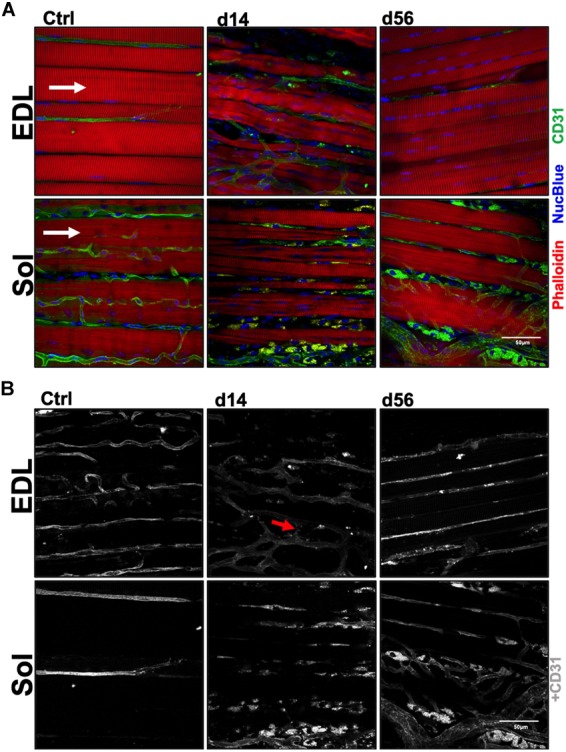
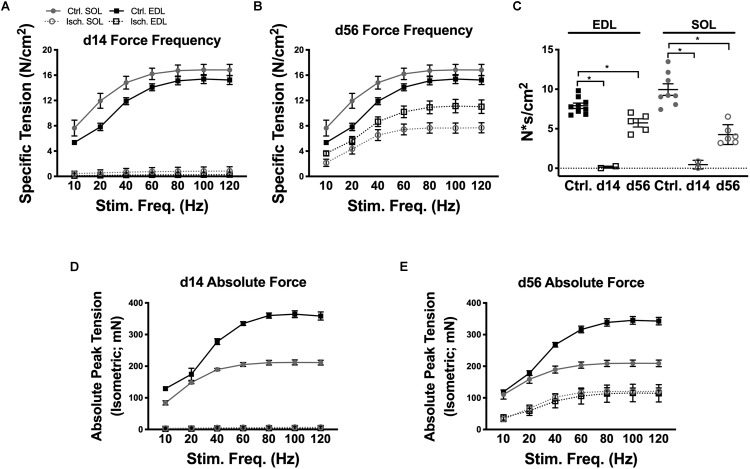
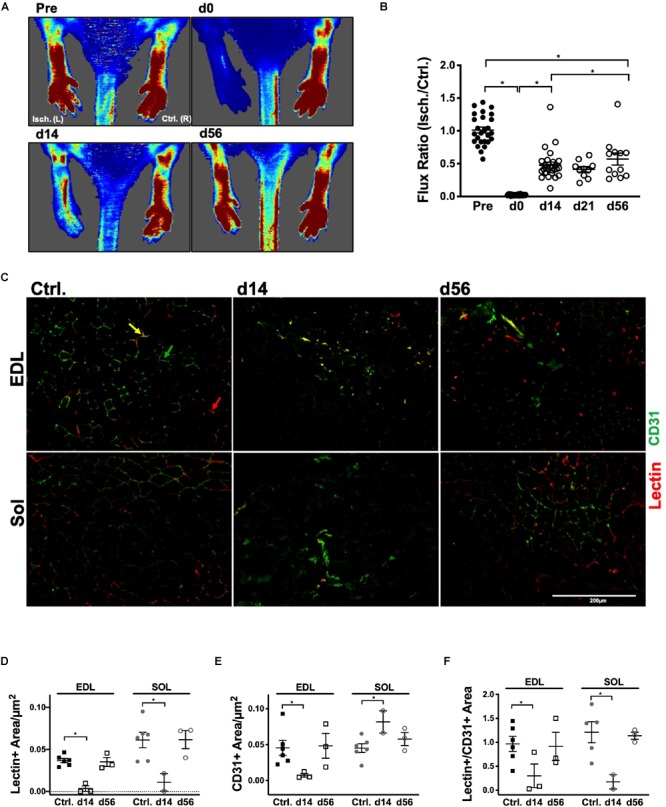
During incomplete skeletal muscle recovery from ischemia, such as that occurs with critical limb ischemia, the temporal relationship between recovery of muscle capillary perfusion and contractile function is poorly defined. We examined this relationship in BALB/cJ mice ( = 24) following unilateral hindlimb ischemia (HLI), which pre-clinically mimics the myopathy observed in critical limb ischemia patients. Specifically, we examined this relationship in two phenotypically distinct muscles (i.e., "oxidative" soleus - Sol and "glycolytic" extensor digitorum longus - EDL) 14- or 56-days after HLI. Although overall limb blood flow (LDPI) reached its' recovery peak (48% of control) by HLI d14, the capillary networks in both the Sol and EDL (whole mount confocal imaging) were disrupted and competent muscle capillary perfusion (perfused lectinμm/muscle μm) remained reduced. Interestingly, both Sol and EDL muscles recovered their distinct capillary structures and perfusion (Con Sol; 0.056 ± 0.02 lectinμm/muscle μm, and Con EDL; 0.039 ± 0.005 lectinμm/muscle μm) by HLI d56 (Sol; 0.062 ± 0.011 lectinμm/muscle μm and EDL; 0.0035 ± 0.005 lectinμm/muscle μm), despite no further improvement in limb blood flow (LDPI). Both muscles suffered severe myopathy, indicated by loss of dystrophin positive immunostaining and the absence of stimulation induced isometric force production at HLI d14. Dystrophin immunofluorescence returned at HLI d56, although neither myofiber CSA (μm) nor isometric force production (58 and 28% sustained deficits, Sol and EDL, respectively) recovered completely in either muscle. In summary, we reveal that the temporal relationship between the restoration of muscle capillary perfusion and functional ischemic skeletal muscle regeneration favors competent muscle capillary perfusion recovery in BALB/c mice in a phenotypically non-distinct manner.
在骨骼肌从缺血状态进行不完全恢复的过程中,比如在严重肢体缺血时发生的情况,肌肉毛细血管灌注恢复与收缩功能之间的时间关系尚不清楚。我们在单侧后肢缺血(HLI)后的BALB/cJ小鼠(n = 24)中研究了这种关系,该模型在临床前模拟了严重肢体缺血患者中观察到的肌病。具体而言,我们在HLI后14天或56天,在两种表型不同的肌肉(即“氧化型”比目鱼肌 - Sol和“糖酵解型”趾长伸肌 - EDL)中研究了这种关系。尽管到HLI第14天时,整体肢体血流(激光散斑血流成像)达到其恢复峰值(对照的48%),但Sol和EDL中的毛细血管网络(整装共聚焦成像)均遭到破坏,有效的肌肉毛细血管灌注(灌注凝集素μm/肌肉μm)仍然降低。有趣的是,到HLI第56天时,Sol和EDL肌肉均恢复了其独特的毛细血管结构和灌注(对照Sol;0.056±0.02凝集素μm/肌肉μm,对照EDL;0.039±0.005凝集素μm/肌肉μm)(Sol;0.062±0.011凝集素μm/肌肉μm,EDL;0.0035±0.005凝集素μm/肌肉μm),尽管肢体血流(激光散斑血流成像)没有进一步改善。在HLI第14天时,两种肌肉均出现严重肌病,表现为抗肌萎缩蛋白阳性免疫染色缺失以及刺激诱导的等长力产生消失。抗肌萎缩蛋白免疫荧光在HLI第56天时恢复,尽管两种肌肉中的肌纤维横截面积(μm)和等长力产生(分别持续存在58%和28%的缺陷,Sol和EDL)均未完全恢复。总之,我们揭示了肌肉毛细血管灌注恢复与功能性缺血性骨骼肌再生之间的时间关系有利于BALB/c小鼠中有效的肌肉毛细血管灌注恢复,且在表型上无明显差异。