Calandri Emanuela, Graziano Federica, Testa Silvia, Cattelino Elena, Begotti Tatiana
Department of Psychology, University of Turin, Turin, Italy.
Department of Human and Social Sciences, University of Aosta Valley, Aosta, Italy.
Front Psychol. 2019 Jun 28;10:1447. doi: 10.3389/fpsyg.2019.01447. eCollection 2019.
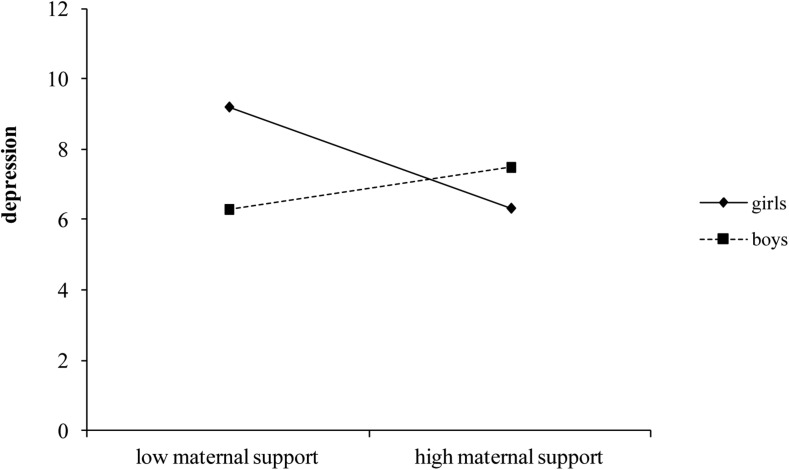
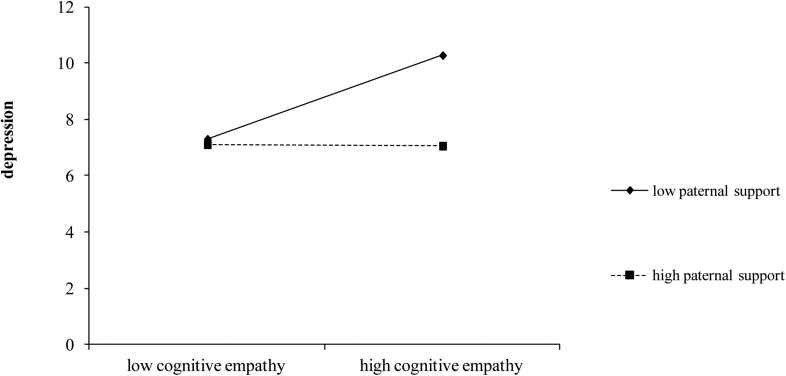
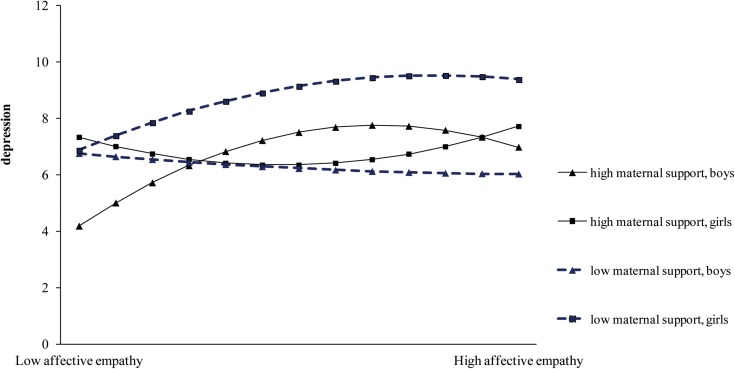
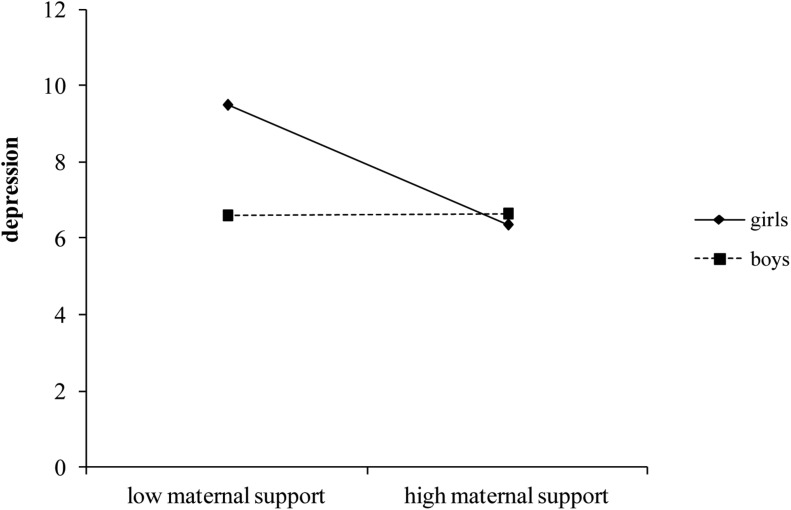
Early adolescence is a period of development of emotional competence, but also of increasing vulnerability for the onset of depressive symptoms. While literature underscored that empathy promotes social relationships and psychological well-being over the life course, the possible role of high empathy levels as a risk factor for depression has been under investigated, especially among early adolescents. Moreover, although parenting practices are known to influence both empathy and depression in adolescence, few studies investigated if parenting moderates the relationship between empathy and depression. Therefore, the aims of the study were: (1) to investigate the relationships between affective and cognitive empathy and depression; (2) to investigate the moderating role of perceived paternal and maternal support on the associations between affective and cognitive empathy and depression; (3) to examine if the relationships among affective and cognitive empathy, maternal and paternal support and depression vary as a function of early adolescents' gender. The study involved 386 Italian students aged between 12 and 14 ( age = 13, = 0.3, 47.9% girls) who completed an anonymous self-report questionnaire, including measures of cognitive and affective empathy, paternal and maternal support and depression. Results showed that with a mean level of affective and cognitive empathy, higher maternal support was related to lower depression for girls, whereas higher paternal support was related to lower depression for both boys and girls. Both maternal and paternal support moderated the relation between empathy and depression. In particular, maternal support moderated the non-linear relation between affective empathy and depression and the relation was further moderated by early adolescents' gender: boys with low affective empathy reported lower depression in a context of high maternal support. Paternal support moderated the linear relation between cognitive empathy and depression, independently of early adolescents' gender: boys and girls with high cognitive empathy reported higher depression in a context of low paternal support. The results of the study suggested that high empathy might be a risk factor for depression during early adolescence and mothers and fathers have a differential moderating role in relation to the affective and cognitive dimensions of empathy, also in relation to early adolescents' gender.
青春期早期是情绪能力发展的时期,但也是抑郁症状发作易感性增加的时期。虽然文献强调共情在人的一生中能促进社会关系和心理健康,但高共情水平作为抑郁症风险因素的潜在作用一直未得到充分研究,尤其是在青春期早期人群中。此外,尽管已知养育方式会影响青少年的共情和抑郁,但很少有研究探讨养育方式是否会调节共情与抑郁之间的关系。因此,本研究的目的是:(1)调查情感共情和认知共情与抑郁之间的关系;(2)调查感知到的父母支持对情感共情和认知共情与抑郁之间关联的调节作用;(3)检验情感共情和认知共情、父母支持与抑郁之间的关系是否因青春期早期青少年的性别而异。该研究涉及386名年龄在12至14岁之间的意大利学生(平均年龄 = 13岁,标准差 = 0.3,47.9%为女生),他们完成了一份匿名的自我报告问卷,包括认知和情感共情、父母支持以及抑郁的测量。结果显示,在情感共情和认知共情的平均水平下,较高的母亲支持与女孩较低的抑郁相关,而较高的父亲支持与男孩和女孩较低的抑郁相关。母亲和父亲的支持都调节了共情与抑郁之间的关系。具体而言,母亲支持调节了情感共情与抑郁之间的非线性关系,且这种关系进一步受到青春期早期青少年性别的调节:情感共情水平低的男孩在母亲支持高的情况下报告的抑郁较低。父亲支持调节了认知共情与抑郁之间的线性关系,与青春期早期青少年的性别无关:认知共情水平高的男孩和女孩在父亲支持低的情况下报告的抑郁较高。研究结果表明,高共情可能是青春期早期抑郁的一个风险因素,母亲和父亲在共情的情感和认知维度方面具有不同的调节作用,这也与青春期早期青少年的性别有关。