Chai Li-Juan, Lu Zhen-Ming, Zhang Xiao-Juan, Ma Jian, Xu Peng-Xiang, Qian Wei, Xiao Chen, Wang Song-Tao, Shen Cai-Hong, Shi Jin-Song, Zheng-Hong Xu
National Engineering Laboratory for Cereal Fermentation Technology, Jiangnan University, Wuxi, China.
Jiangsu Engineering Research Center for Bioactive Products Processing Technology, Jiangnan University, Wuxi, China.
Front Microbiol. 2019 Jun 21;10:1397. doi: 10.3389/fmicb.2019.01397. eCollection 2019.
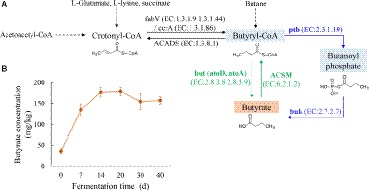
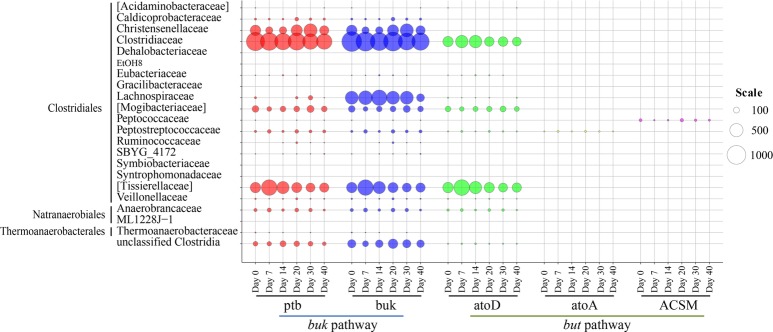
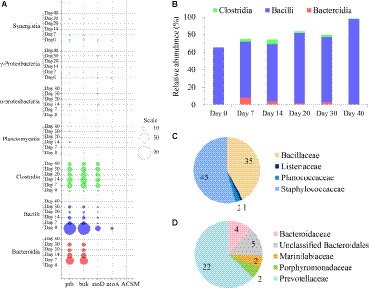
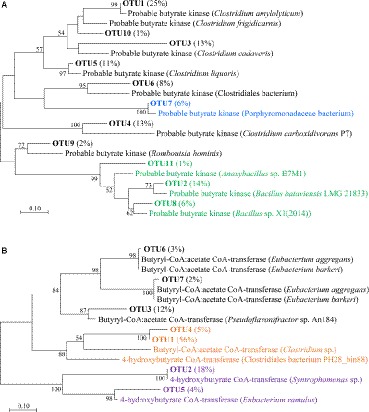
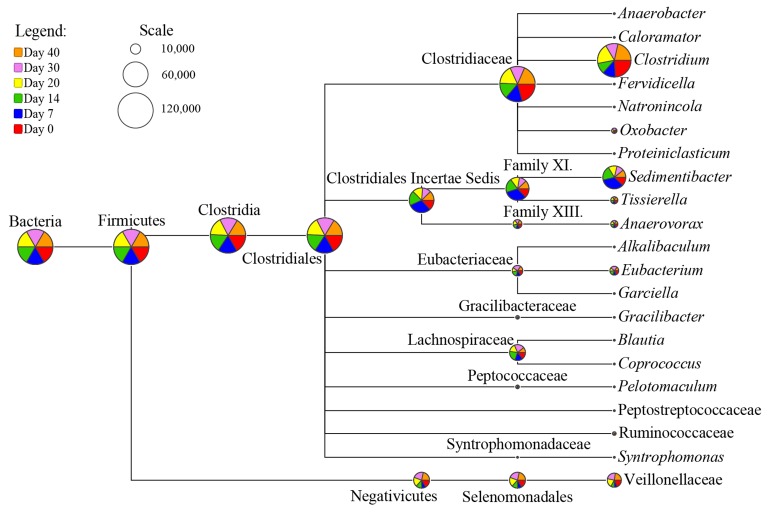
Butyrate, one of the key aroma compounds in Luzhou-flavor , is synthesized through two alternative pathways: butyrate kinase () and butyryl-CoA: acetate CoA-transferase (). A lack of knowledge of butyrate-producing microorganisms hinders our ability to understand the flavor formation mechanism of . Here, temporal dynamics of microbial metabolic profiling in fermented grains (FG) was explored PICRUSt based on 16S rRNA gene sequences. We found Bacilli and Bacteroidia were the major potential butyrate producers in pathway at the beginning of fermentation, while later Clostridia dominated the two pathways. Clone library analysis also revealed that Clostridia (~73% OTUs) was predominant in pathway throughout fermentation, followed by Bacilli and Bacteroidia, and pathway was merely possessed by Clostridia. Afterward, Clostridia-specific 16S rRNA gene sequencing demonstrated might be the major butyrate-producing genus in two pathways, which was subsequently evaluated using culture approach. Seventeen species were isolated from FG based on 16S rRNA gene sequence-guided medium prediction method. Profiles of short-chain fatty acids and and genes in these species demonstrated phylogenetic and functional diversities of butyrate-producing in FG. These findings add to illustrate the diversity of potential butyrate producers during brewing and provide a workflow for targeting functional microbes in complex microbial community.
丁酸是泸州老窖香型白酒中的关键香气成分之一,其合成途径有两条:丁酸激酶途径和丁酰辅酶A:乙酸辅酶A转移酶途径。由于对产丁酸微生物缺乏了解,阻碍了我们对泸州老窖香型白酒风味形成机制的理解。在此,基于16S rRNA基因序列,利用PICRUSt对发酵糟醅(FG)中微生物代谢谱的时间动态进行了探索。我们发现,芽孢杆菌和拟杆菌是发酵初期丁酸激酶途径中主要的潜在产丁酸菌,而后期梭菌在这两条途径中占主导地位。克隆文库分析还显示,在整个发酵过程中,梭菌(约73%的操作分类单元)在丁酸激酶途径中占主导地位,其次是芽孢杆菌和拟杆菌,且丁酰辅酶A:乙酸辅酶A转移酶途径仅由梭菌拥有。随后,通过梭菌特异性16S rRNA基因测序表明,梭菌可能是这两条途径中主要的产丁酸菌属,并随后采用培养方法进行了评估。基于16S rRNA基因序列引导的培养基预测方法,从发酵糟醅中分离出17株梭菌属菌株。这些菌株中短链脂肪酸以及丁酸激酶和丁酰辅酶A:乙酸辅酶A转移酶基因的图谱表明了发酵糟醅中产丁酸梭菌属的系统发育和功能多样性。这些发现进一步说明了酿造过程中潜在产丁酸菌的多样性,并为在复杂微生物群落中靶向功能微生物提供了一个工作流程。