Department of Immunology, School of Medicine, Complutense University of Madrid, Madrid, Spain.
Inmunotek SL, Madrid, Spain.
Front Immunol. 2019 Jun 28;10:1434. doi: 10.3389/fimmu.2019.01434. eCollection 2019.
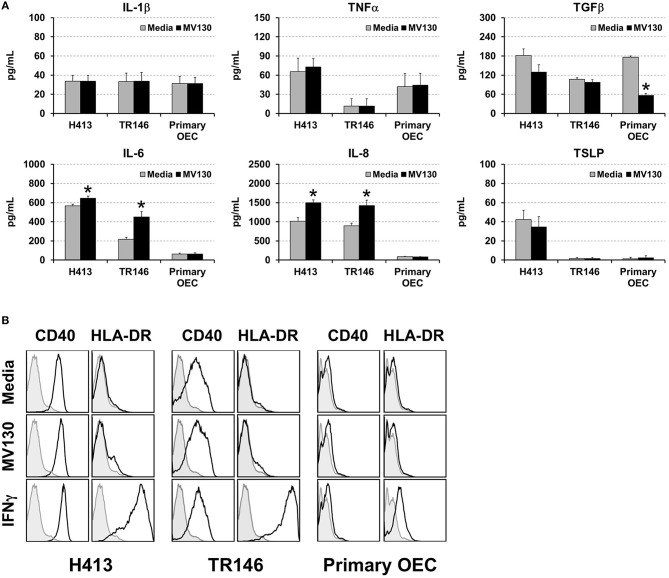
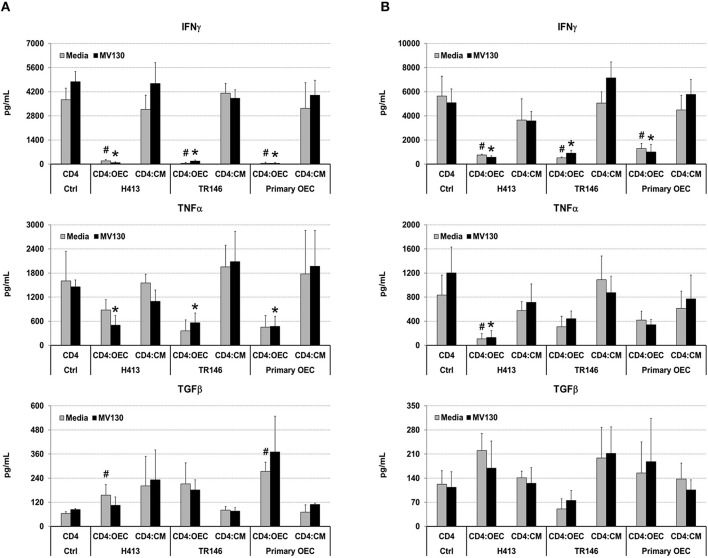
The oral mucosa is a first line of defense against pathogenic organisms and yet tolerates food antigens and resident bacteria. Mucosal epithelial cells are emerging as important regulators of innate and adaptive immune responses. However, the contribution of oral epithelial cells (OECs) determining oral immunity is understudied. Here, we evaluated the ability of H413 and TR146 cells, two OEC lines derived from human oral squamous cell carcinomas, and primary OECs to modulate immune responses to a cocktail of Gram and Gram bacteria known as MV130. OECs expressed CD40 constitutively and class II major histocompatibility complex (MHC II) molecules when stimulated with IFNγ, but not CD80 or CD86. Dendritic cells (DCs) treated with bacteria in co-culture with OECs did not fully mature, as judged by the expression of MHC II, CD80 and CD86, and barely released IL-12 and TNFα, compared to control DCs. Furthermore, in the presence of OECs, DCs were unable to stimulate allogenic naive CD4 T cells to produce IFNγ and TNFα. Similarly, OECs in culture with total CD4 T cells or Th1 cells stimulated with anti-CD3 and anti-CD28 antibodies abrogated CD25 and CD69 expression, T cell proliferation and the release of IFNγ and TNFα. The inhibition on T cell activation by OECs was cell-contact dependent, TGFβ independent and largely irreversible. Overall, this behavior of OECs is likely key to avoid immune system over-reaction against resident bacteria.
口腔黏膜是抵御病原体的第一道防线,但它能耐受食物抗原和常驻细菌。黏膜上皮细胞作为固有和适应性免疫反应的重要调节因子而崭露头角。然而,口腔上皮细胞(OECs)对口腔免疫的贡献尚未得到充分研究。在这里,我们评估了 H413 和 TR146 细胞(两种源自人口腔鳞状细胞癌的 OEC 系)和原代 OEC 调节对称为 MV130 的革兰氏阳性和革兰氏阴性混合菌 cocktail 免疫反应的能力。OECs 在受到 IFNγ刺激时会持续表达 CD40 和 II 类主要组织相容性复合物(MHC II)分子,但不会表达 CD80 或 CD86。在与 OEC 共培养中用细菌处理的树突状细胞(DC)没有完全成熟,这从 MHC II、CD80 和 CD86 的表达以及 IL-12 和 TNFα 的释放量上可以判断,与对照 DC 相比。此外,在 OEC 存在的情况下,DC 无法刺激同种异体幼稚 CD4 T 细胞产生 IFNγ和 TNFα。同样,在与总 CD4 T 细胞或用抗 CD3 和抗 CD28 抗体刺激的 Th1 细胞共培养的 OEC 中,CD25 和 CD69 的表达、T 细胞增殖和 IFNγ和 TNFα的释放被阻断。OEC 对 T 细胞激活的抑制作用是细胞接触依赖性的,不依赖 TGFβ,且在很大程度上是不可逆的。总体而言,OEC 的这种行为可能是避免免疫系统对常驻细菌过度反应的关键。