Chen Jun, Hao Peng, Zheng Tao, Zhang Yong
Department of Urology, Wuhan Fourth Hospital, Puai Hospital, Tongji Medical College, Huazhong University of Science and Technology, Hubei, Wuhan 430033, P.R. China.
Exp Ther Med. 2019 Aug;18(2):1005-1012. doi: 10.3892/etm.2019.7682. Epub 2019 Jun 18.
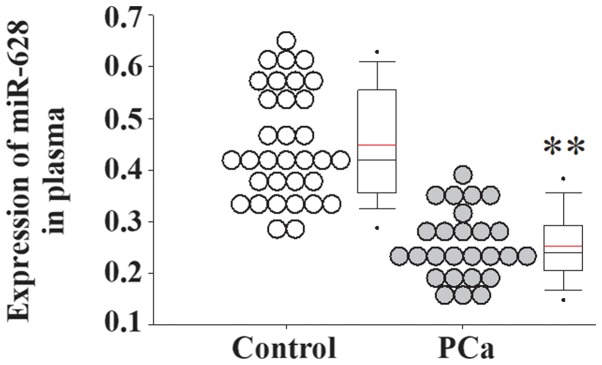
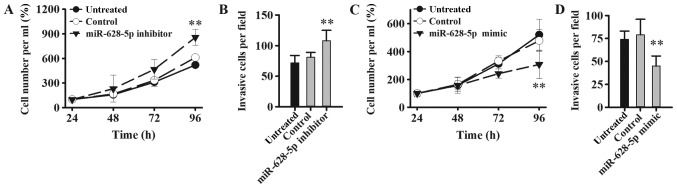
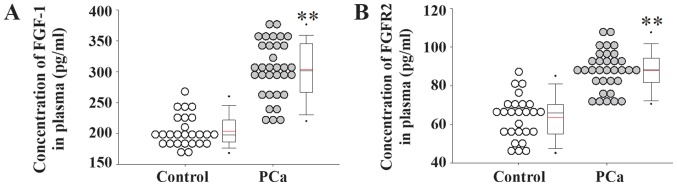
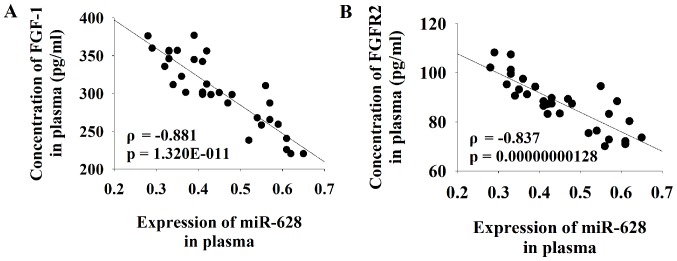
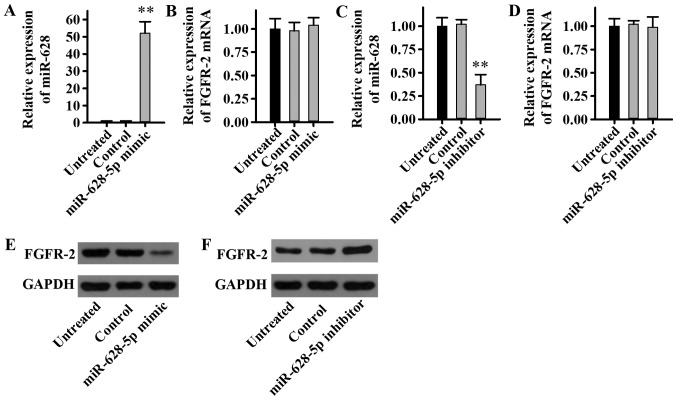
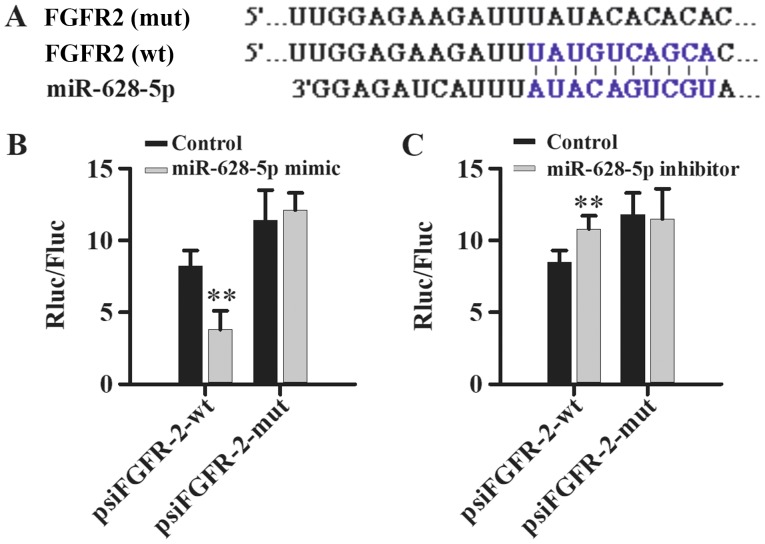
Recently, microRNA (miR)-628 was identified as a potential biomarker for several types of cancer, including prostate cancer (PCa). The aim of the present study was to investigate miR-628 expression and its underlying mechanism in PCa cell proliferation and invasion and the fibroblast growth factor receptor 2 (FGFR2) signaling pathway. The serum expression levels of miR-628, prostate-specific antigen, fibroblast growth factor 1, and FGFR2 were examined in patients with PCa. The relative expression levels of miR-628 and FGFR2 were determined by reverse transcription-quantitative polymerase chain reaction in PCa cells following transfection with miR-628-5p mimic or inhibitor. In addition, the protein expression level of FGFR2 was examined by western blot analysis following transfection with miR-628-5p mimic or inhibitor. Following bioinformatics analysis, dual-luciferase reporter assay was used to confirm the direct interaction between miR-628 and FGFR2. The current study demonstrated that the protein expression level of FGFR2 decreased following transfection with miR-628-5p mimic and increased following transfection with miR-628-5p inhibitor. Similarly, the proliferation and invasion of PCa cells were significantly enhanced following transfection with miR-628-5p inhibitor. By contrast, the proliferation and invasion of PCa cells were significantly inhibited following transfection with miR-628 mimic. Therefore, downregulating the expression level of miR-628 may increase the expression level of FGF in PCa, thereby promoting tumor proliferation and invasion. In conclusion, the FGF signaling pathway may be involved in promoting PCa cell proliferation and invasion. miR-628 may be a potential therapeutic target for patients with PCa.
最近,微小RNA(miR)-628被确定为包括前列腺癌(PCa)在内的多种癌症的潜在生物标志物。本研究的目的是探讨miR-628在PCa细胞增殖、侵袭以及成纤维细胞生长因子受体2(FGFR2)信号通路中的表达及其潜在机制。检测了PCa患者血清中miR-628、前列腺特异性抗原、成纤维细胞生长因子1和FGFR2的表达水平。在用miR-628-5p模拟物或抑制剂转染后的PCa细胞中,通过逆转录-定量聚合酶链反应测定miR-628和FGFR2的相对表达水平。此外,在用miR-628-5p模拟物或抑制剂转染后,通过蛋白质印迹分析检测FGFR2的蛋白表达水平。经过生物信息学分析后,采用双荧光素酶报告基因测定法来证实miR-628与FGFR2之间的直接相互作用。当前研究表明,用miR-628-5p模拟物转染后FGFR2的蛋白表达水平降低,而用miR-628-5p抑制剂转染后则升高。同样,用miR-628-5p抑制剂转染后PCa细胞的增殖和侵袭显著增强。相比之下,用miR-628模拟物转染后PCa细胞的增殖和侵袭受到显著抑制。因此,下调miR-628的表达水平可能会增加PCa中FGF的表达水平,从而促进肿瘤增殖和侵袭。总之,FGF信号通路可能参与促进PCa细胞的增殖和侵袭。miR-628可能是PCa患者的潜在治疗靶点。