Barnett Adrian G, Moher David
School of Public Health and Social Work & Institute of Health and Biomedical Innovation, Queensland University of Technology, Brisbane, QLD, 4059, Australia.
Centre for Journalology, Ottawa Hospital Research Institute, Ottawa, Ontario, ON K1H 8L6, Canada.
F1000Res. 2019 Apr 29;8:583. doi: 10.12688/f1000research.18453.2. eCollection 2019.
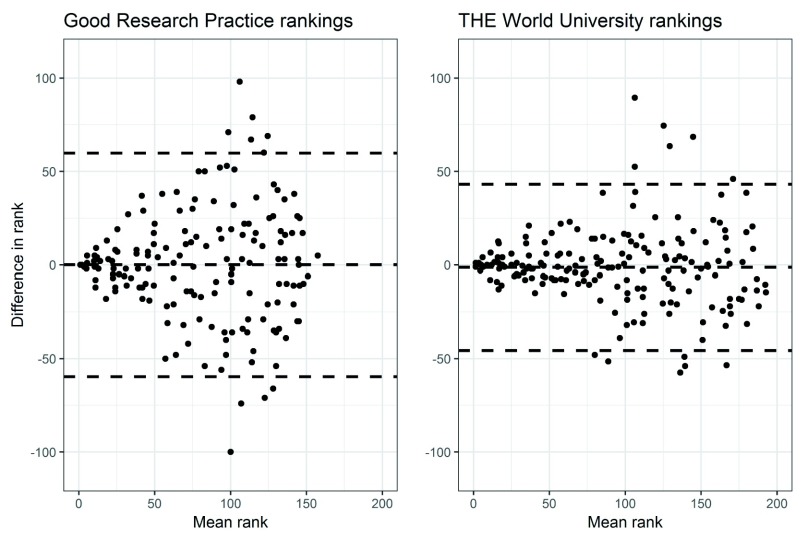
Universities closely watch international league tables because these tables influence governments, donors and students. Achieving a high ranking in a table, or an annual rise in ranking, allows universities to promote their achievements using an externally validated measure. However, league tables predominantly reward measures of research output, such as publications and citations, and may therefore be promoting poor research practices by encouraging the "publish or perish" mentality. We examined whether a league table could be created based on good research practice. We rewarded researchers who cited a reporting guideline, which help researchers report their research completely, accurately and transparently, and were created to reduce the waste of poorly described research. We used the EQUATOR guidelines, which means our tables are mostly relevant to health and medical research. We used Scopus to identify the citations. Our cross-sectional tables for the years 2016 and 2017 included 14,408 papers with 47,876 author affiliations. We ranked universities and included a bootstrap measure of uncertainty. We clustered universities in five similar groups in an effort to avoid over-interpreting small differences in ranks. We believe there is merit in considering more socially responsible criteria for ranking universities, and this could encourage better research practice internationally if such tables become as valued as the current quantity-focused tables.
大学密切关注国际排名榜单,因为这些榜单会影响政府、捐赠者和学生。在榜单中获得高排名,或者排名逐年上升,能让大学利用外部认可的指标来宣传自身成就。然而,排名榜单主要奖励研究产出指标,比如论文发表量和引用次数,因此可能通过鼓励“不发表就淘汰”的心态来助长不良的研究行为。我们研究了是否可以基于良好的研究实践来创建一个排名榜单。我们奖励那些引用了报告指南的研究人员,报告指南有助于研究人员完整、准确且透明地报告他们的研究,其设立目的是减少描述不清的研究造成的浪费。我们使用了赤道原则指南,这意味着我们的榜单大多与健康和医学研究相关。我们使用Scopus来识别引用情况。我们2016年和2017年的横断面榜单涵盖了14408篇论文,涉及47876个作者单位。我们对大学进行排名,并纳入了不确定性的自助法测量。我们将大学分为五个类似的组群,以避免过度解读排名中的细微差异。我们认为,考虑更具社会责任感的大学排名标准是有价值的,如果这样的榜单能像当前注重数量的榜单一样受到重视,这可能会在国际上鼓励更好的研究实践。