Griewahn Laura, Köser Aaron, Maurer Ulrich
Institute of Molecular Medicine and Cell Research, University of Freiburg, Freiburg im Breisgau, Germany.
Spemann Graduate School of Biology and Medicine, University of Freiburg, Freiburg im Breisgau, Germany.
Front Cell Dev Biol. 2019 Jun 28;7:117. doi: 10.3389/fcell.2019.00117. eCollection 2019.
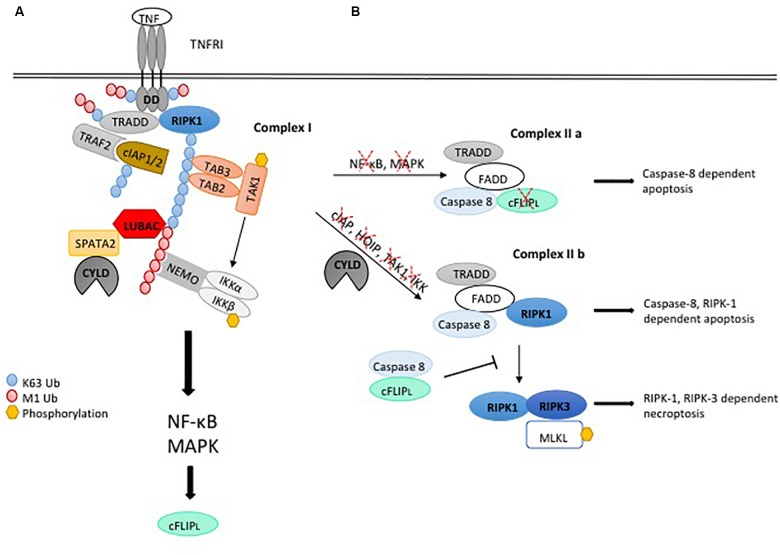
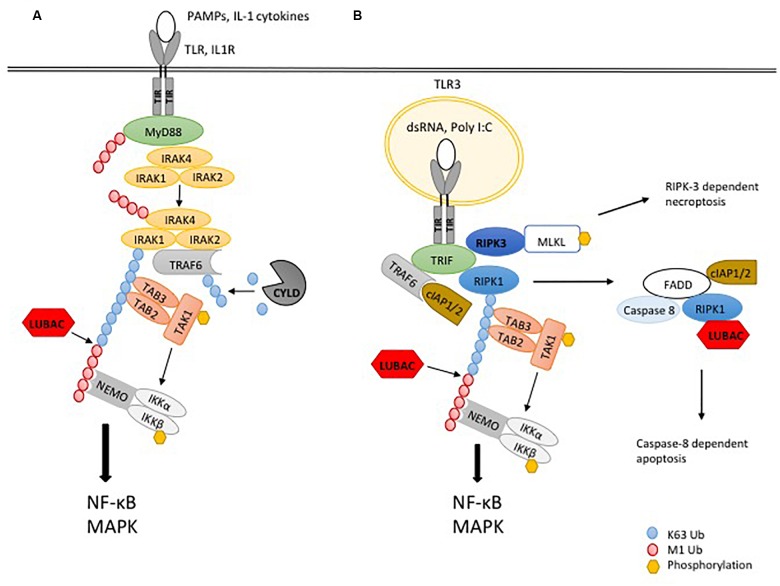
Pro-inflammatory signaling pathways, induced by pathogens, tissue damage or cytokines, depend on the ubiquitylation of various subunits of receptor signaling complexes, controlled by ubiquitin ligases and deubiquitinases. Ubiquitylation sets the stage for the activation of kinases within these receptor complexes, which ultimately regulate pro-inflammatory gene expression. The receptors, which transduce pro-inflammatory signals, can often induce cell death, which is controlled by ubiquitylation as well. In this review, we discuss the key role of ubiquitylation in pro-inflammatory signaling by TNFR1 and TLRs and its role in setting the threshold for cell death induced by these pro-inflammatory triggers.
由病原体、组织损伤或细胞因子诱导的促炎信号通路,依赖于受体信号复合物各种亚基的泛素化,而这一过程由泛素连接酶和去泛素化酶控制。泛素化是这些受体复合物内激酶激活的基础,最终调节促炎基因表达。转导促炎信号的受体通常也能诱导细胞死亡,而这一过程同样受泛素化控制。在本综述中,我们讨论泛素化在肿瘤坏死因子受体1(TNFR1)和Toll样受体(TLRs)介导的促炎信号传导中的关键作用,以及它在设定这些促炎触发因素诱导细胞死亡阈值方面的作用。