Klinikum Ludwigshafen, Medizinische Klinik B, Ludwigshafen, Germany.
Clin Cardiol. 2019 Oct;42(10):866-872. doi: 10.1002/clc.23234. Epub 2019 Jul 17.
Implantable cardioverter defibrillator (ICD) was implemented into clinical routine more than 20 years ago. Since then, ICD therapy became standard therapy for primary and secondary prevention of sudden cardiac death in clinical practice.
Aim of the study was to evaluate the benefit-harm profile of contemporary primary prophylactic ICD therapy.
A total of 1222 consecutive patients of a prospective single-center ICD-registry were analyzed who underwent primary prophylactic ICD implantation between 2000 and 2017. Patients were divided into two groups according to the implantation year: 2010-2017 (group 1, n = 579) and 2000-2009 (group 2, n = 643).
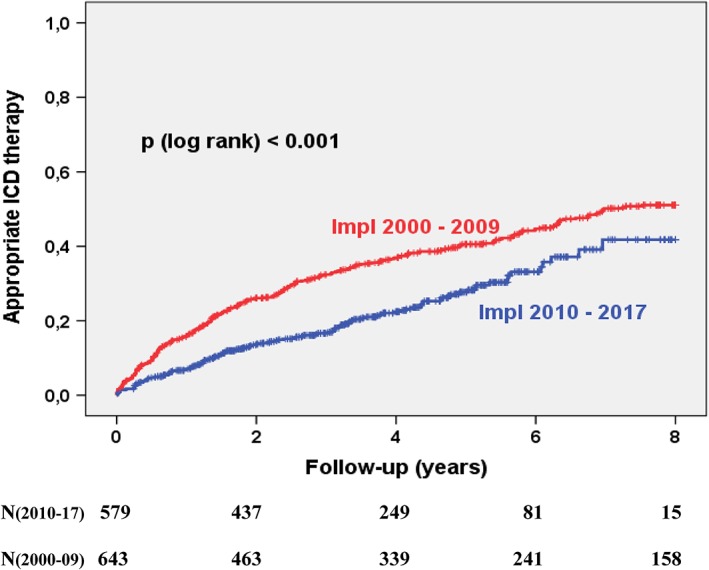
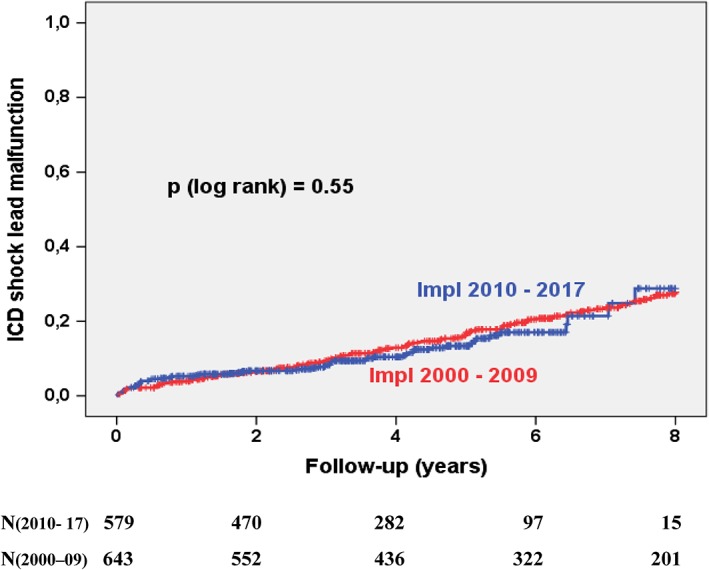
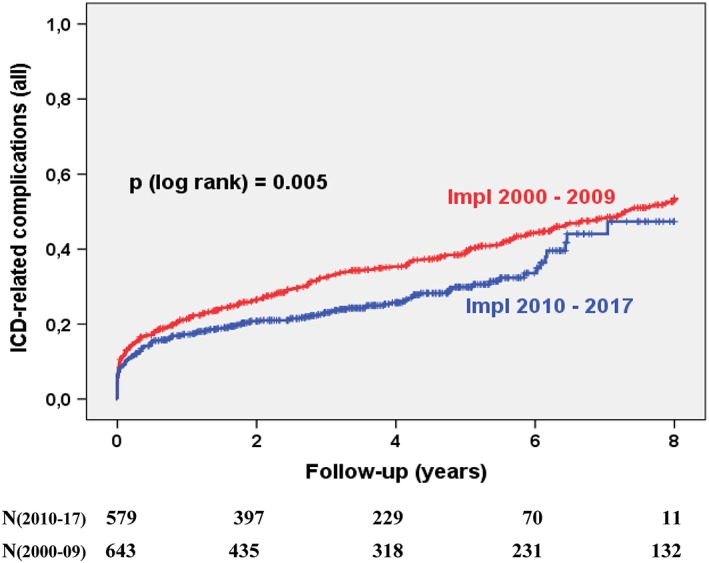
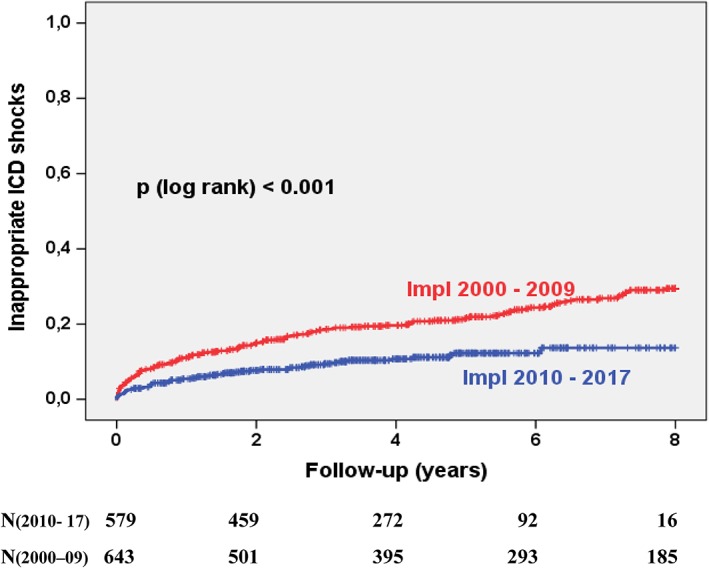
The rate of estimated appropriate ICD therapy after 8 years was 51% in the 2000s and 42% in the 2010s (P < .001). The complication rate changed slightly from 53% to 47% (P = .005). This decline was mainly driven by the reduction of inappropriate ICD shocks (30% vs 14%, P < .001) whereas the rate of ICD shock lead malfunction and device/ lead infection remained unchanged over time. Nonischemic cardiomyopathy was an independent predictor for ICD complications without benefit of ICD therapy (HR 1.37, 95% CI 1.07-1.77).
The ICD therapy rate for ventricular arrhythmias in patients with primary prophylactic ICD implantation is decreasing over the last two decades. Complication rate remains high due to an unchanged rate of ICD shock malfunctions and device infections. Nonischemic cardiomyopathy is an independent predictor for ICD complications without benefit of ICD therapy in primary prophylactic ICD-therapy.
植入式心脏复律除颤器(ICD)在 20 多年前就已应用于临床常规。自那时起,ICD 治疗已成为临床实践中预防心源性猝死的主要和二级预防标准治疗方法。
本研究旨在评估当代原发性预防性 ICD 治疗的获益-风险特征。
对 2000 年至 2017 年间接受原发性预防性 ICD 植入的前瞻性单中心 ICD 注册中心的 1222 例连续患者进行了分析。根据植入年份将患者分为两组:2010-2017 年(组 1,n=579)和 2000-2009 年(组 2,n=643)。
在 8 年后,2000 年代的适当 ICD 治疗估计率为 51%,而 2010 年代为 42%(P<.001)。并发症发生率从 53%略微降至 47%(P=0.005)。这种下降主要归因于不适当的 ICD 电击的减少(30%降至 14%,P<.001),而 ICD 电击导致的故障和器械/导线感染的发生率随着时间的推移保持不变。非缺血性心肌病是 ICD 并发症的独立预测因素,而 ICD 治疗没有获益(HR 1.37,95%CI 1.07-1.77)。
在过去的二十年中,接受原发性预防性 ICD 植入的患者的室性心律失常 ICD 治疗率呈下降趋势。由于 ICD 电击故障和器械感染的发生率保持不变,并发症发生率仍然很高。非缺血性心肌病是非缺血性心肌病患者 ICD 并发症的独立预测因素,而 ICD 治疗没有获益。