Kolašinac Rejhana, Jaksch Sebastian, Dreissen Georg, Braeutigam Andrea, Merkel Rudolf, Csiszár Agnes
Forschungszentrum Jülich GmbH, Institute of Complex Systems: ICS-7 Biomechanics, 52428 Jülich, Germany.
Forschungszentrum Jülich GmbH, Jülich Centre for Neutron Science (JCNS) at Heinz Maier-Leibnitz Zentrum (MLZ), 85748 Garching, Germany.
Nanomaterials (Basel). 2019 Jul 17;9(7):1025. doi: 10.3390/nano9071025.
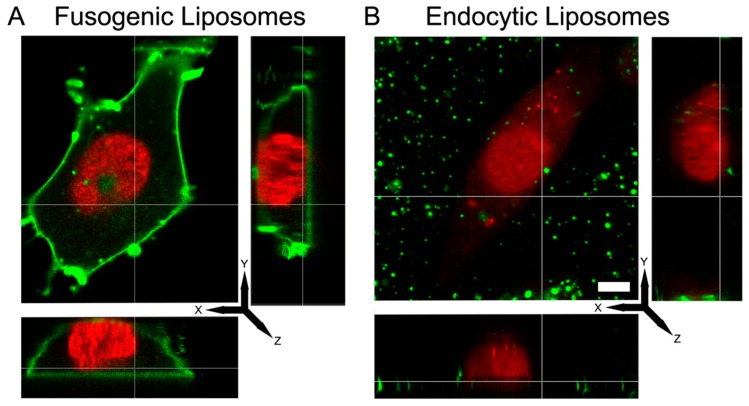
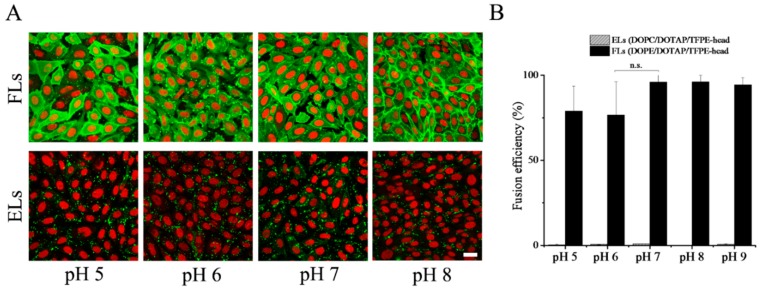
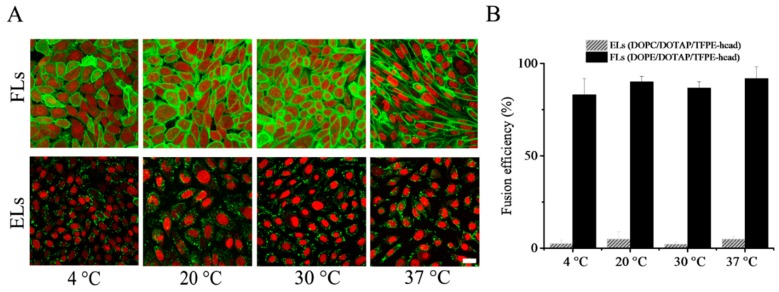
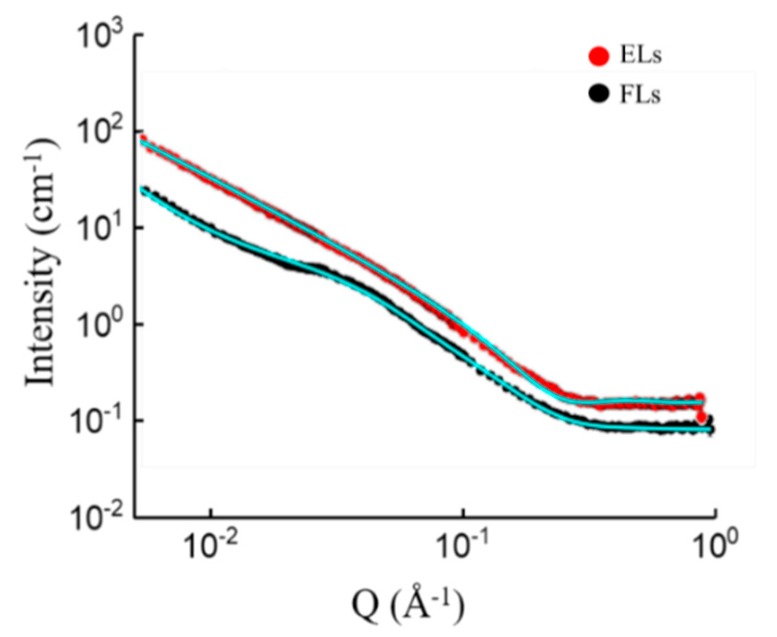
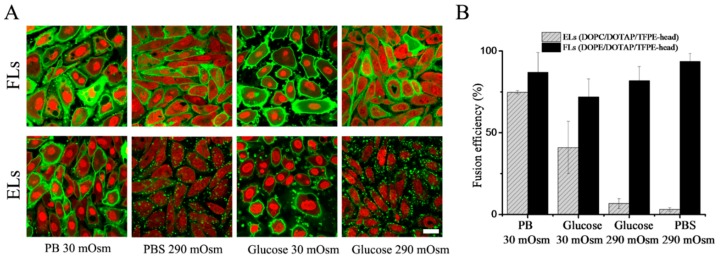
Lipid-based nanoparticles, also called vesicles or liposomes, can be used as carriers for drugs or many types of biological macromolecules, including DNA and proteins. Efficiency and speed of cargo delivery are especially high for carrier vesicles that fuse with the cellular plasma membrane. This occurs for lipid mixture containing equal amounts of the cationic lipid DOTAP and a neutral lipid with an additional few percents of an aromatic substance. The fusion ability of such particles depends on lipid composition with phosphoethanolamine (PE) lipids favoring fusion and phosphatidyl-choline (PC) lipids endocytosis. Here, we examined the effects of temperature, ionic strength, osmolality, and pH on fusion efficiency of cationic liposomes with Chinese hamster ovary (CHO) cells. The phase state of liposomes was analyzed by small angle neutron scattering (SANS). Our results showed that PC containing lipid membranes were organized in the lamellar phase. Here, fusion efficiency depended on buffer conditions and remained vanishingly small at physiological conditions. In contrast, SANS indicated the coexistence of very small (~50 nm) objects with larger, most likely lamellar structures for PE containing lipid particles. The fusion of such particles to cell membranes occurred with very high efficiency at all buffer conditions. We hypothesize that the altered phase state resulted in a highly reduced energetic barrier against fusion.
基于脂质的纳米颗粒,也称为囊泡或脂质体,可作为药物或多种生物大分子(包括DNA和蛋白质)的载体。对于与细胞质膜融合的载体囊泡而言,货物递送的效率和速度特别高。对于含有等量阳离子脂质DOTAP和中性脂质以及额外百分之几芳香物质的脂质混合物,会出现这种情况。此类颗粒的融合能力取决于脂质组成,其中磷酸乙醇胺(PE)脂质有利于融合,而磷脂酰胆碱(PC)脂质有利于内吞作用。在此,我们研究了温度、离子强度、渗透压和pH对阳离子脂质体与中国仓鼠卵巢(CHO)细胞融合效率的影响。通过小角中子散射(SANS)分析脂质体的相态。我们的结果表明,含PC的脂质膜呈层状相组织。在此,融合效率取决于缓冲条件,在生理条件下仍然极低。相比之下,SANS表明对于含PE的脂质颗粒,存在非常小的(约50纳米)物体与较大的、很可能是层状结构的物体共存。此类颗粒与细胞膜的融合在所有缓冲条件下都以非常高的效率发生。我们推测,相态的改变导致了对融合的能量屏障大幅降低。