Centro de Pesquisa sobre o Genoma Humano e Células Tronco (CEGH-CEL), Instituto de Biociências, Universidade de São Paulo, São Paulo, Brazil.
Programa de Engenharia Química, Universidade Federal do Rio de Janeiro, Rio de Janeiro, Brazil.
J Neurodev Disord. 2019 Jul 18;11(1):13. doi: 10.1186/s11689-019-9273-1.
Phelan-McDermid syndrome (PMS) is a rare genetic disorder characterized by global developmental delay, intellectual disability (ID), autism spectrum disorder (ASD), and mild dysmorphisms associated with several comorbidities caused by SHANK3 loss-of-function mutations. Although SHANK3 haploinsufficiency has been associated with the major neurological symptoms of PMS, it cannot explain the clinical variability seen among individuals. Our goals were to characterize a Brazilian cohort of PMS individuals, explore the genotype-phenotype correlation underlying this syndrome, and describe an atypical individual with mild phenotype.
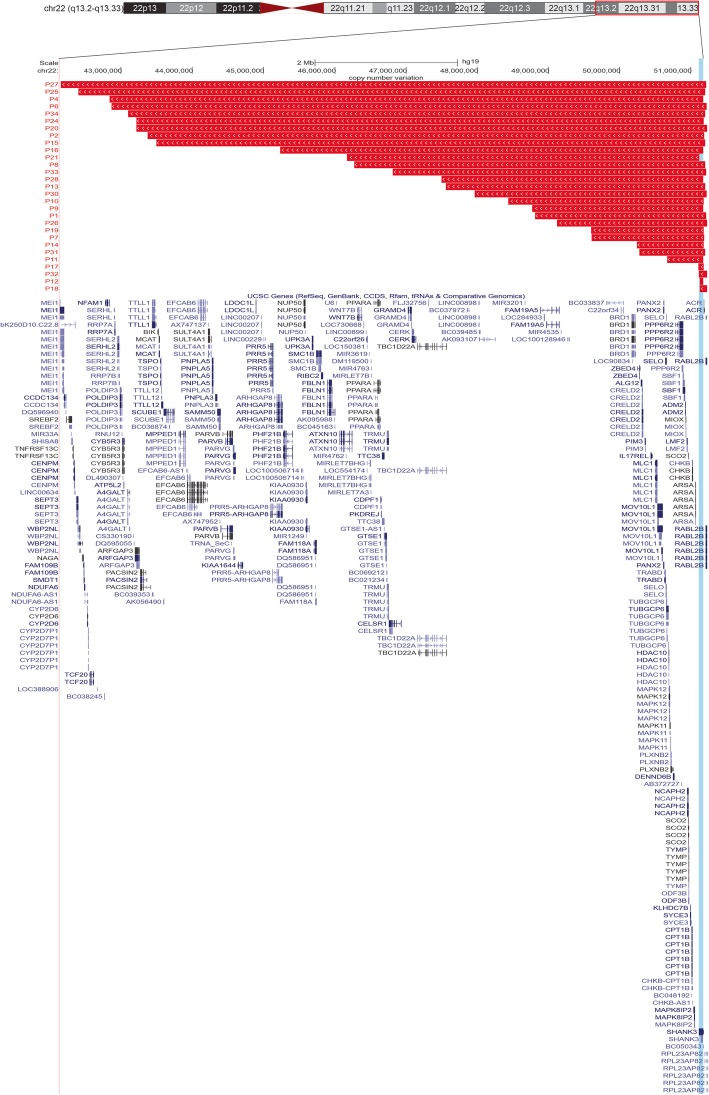
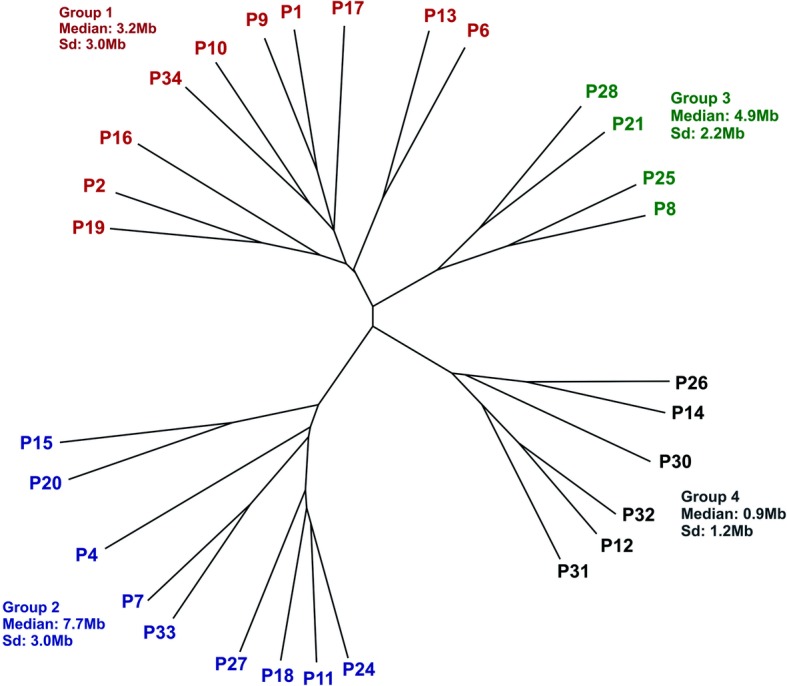
A total of 34 PMS individuals were clinically and genetically evaluated. Data were obtained by a questionnaire answered by parents, and dysmorphic features were assessed via photographic evaluation. We analyzed 22q13.3 deletions and other potentially pathogenic copy number variants (CNVs) and also performed genotype-phenotype correlation analysis to determine whether comorbidities, speech status, and ASD correlate to deletion size. Finally, a Brazilian cohort of 829 ASD individuals and another independent cohort of 2297 ID individuals was used to determine the frequency of PMS in these disorders.
Our data showed that 21% (6/29) of the PMS individuals presented an additional rare CNV, which may contribute to clinical variability in PMS. Increased pain tolerance (80%), hypotonia (85%), and sparse eyebrows (80%) were prominent clinical features. An atypical case diagnosed with PMS at 18 years old and IQ within the normal range is here described. Among Brazilian ASD or ID individuals referred to CNV analyses, the frequency of 22q13.3 deletion was 0.6% (5/829) and 0.61% (15/2297), respectively. Finally, renal abnormalities, lymphedema, and language impairment were found to be positively associated with deletion sizes, and the minimum deletion to cause these abnormalities is here suggested.
This is the first work describing a cohort of Brazilian individuals with PMS. Our results confirm the impact of 22q13 deletions on ASD and several comorbidities, such as hypotonia. The estimation of a minimal deletion size for developing lymphedema and renal problem can assist prediction of prognosis in PMS individuals, particularly those diagnosed in early infancy. We also identified one atypical individual carrying SHANK3 deletion, suggesting that resilience to such mutations occurs. This case expands the clinical spectrum of variability in PMS and opens perspectives to identify protective mechanisms that can minimize the severity of this condition.
Phelan-McDermid 综合征(PMS)是一种罕见的遗传疾病,其特征为全面发育迟缓、智力障碍(ID)、自闭症谱系障碍(ASD)和轻度畸形,这些与 SHANK3 功能丧失突变引起的多种合并症有关。虽然 SHANK3 杂合不足与 PMS 的主要神经症状有关,但它无法解释个体之间的临床变异性。我们的目标是对巴西 PMS 个体的队列进行特征描述,探索该综合征的基因型-表型相关性,并描述一个表型较轻的非典型个体。
对 34 名 PMS 个体进行临床和基因评估。通过父母回答的问卷获取数据,并通过照片评估来评估畸形特征。我们分析了 22q13.3 缺失和其他潜在的致病性拷贝数变异(CNV),并进行了基因型-表型相关性分析,以确定合并症、言语状态和 ASD 是否与缺失大小相关。最后,我们使用了 829 名 ASD 个体和 2297 名 ID 个体的巴西队列来确定 PMS 在这些疾病中的频率。
我们的数据表明,29 名 PMS 个体中有 21%(6/29)存在另一个罕见的 CNV,这可能导致 PMS 的临床变异性。突出的临床特征包括疼痛耐受性增加(80%)、张力减退(85%)和稀疏眉毛(80%)。这里描述了一个在 18 岁时被诊断为 PMS 且智商在正常范围内的非典型病例。在巴西的 ASD 或 ID 个体中,22q13.3 缺失的频率分别为 0.6%(5/829)和 0.61%(15/2297)。最后,发现肾脏异常、淋巴水肿和语言障碍与缺失大小呈正相关,并且建议最小缺失大小可导致这些异常。
这是首次描述巴西 PMS 个体队列的工作。我们的结果证实了 22q13 缺失对 ASD 和多种合并症(如张力减退)的影响。对导致淋巴水肿和肾脏问题的最小缺失大小的估计,可以辅助预测 PMS 个体的预后,特别是那些在婴儿早期诊断的个体。我们还发现了一个携带 SHANK3 缺失的非典型个体,表明这种突变存在一定的抗性。这种情况扩展了 PMS 变异性的临床范围,并为识别可以最小化这种疾病严重程度的保护机制开辟了前景。