Department of Nephrology & Rheumatology, Shanghai Tenth People's Hospital, Tongji University School of Medicine, Shanghai, People's Republic of China.
Department of Biomedical Engineering, University of Houston, 3605 Cullen Boulevard, Houston, TX, 77204, USA.
Arthritis Res Ther. 2019 Jul 18;21(1):176. doi: 10.1186/s13075-019-1959-y.
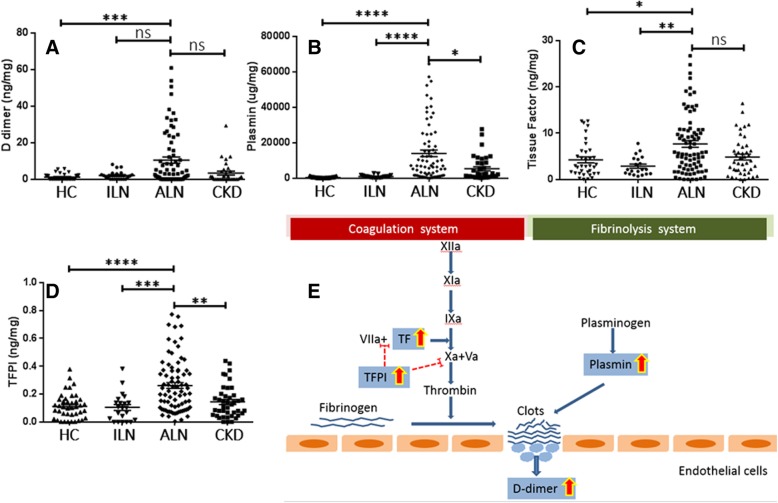
This study evaluates the utility of urinary pro-thrombotic molecules such as tissue factor (TF), anti-thrombotic molecules such as tissue factor pathway inhibitor (TFPI), and fibrinolytic molecules such as plasmin and d-dimer as biomarkers of lupus nephritis (LN).
Urine samples from 113 biopsy-proven LN patients (89 active LN and 24 inactive LN), 45 chronic kidney disease patients, and 41 healthy controls were examined for d-dimer, plasmin, TF, and TFPI levels by ELISA. The area under the receiver operating characteristic curve (AUC) analysis, multivariate regression analysis, and Bayesian network analysis were performed to assess the diagnostic value of the assayed molecules in LN.
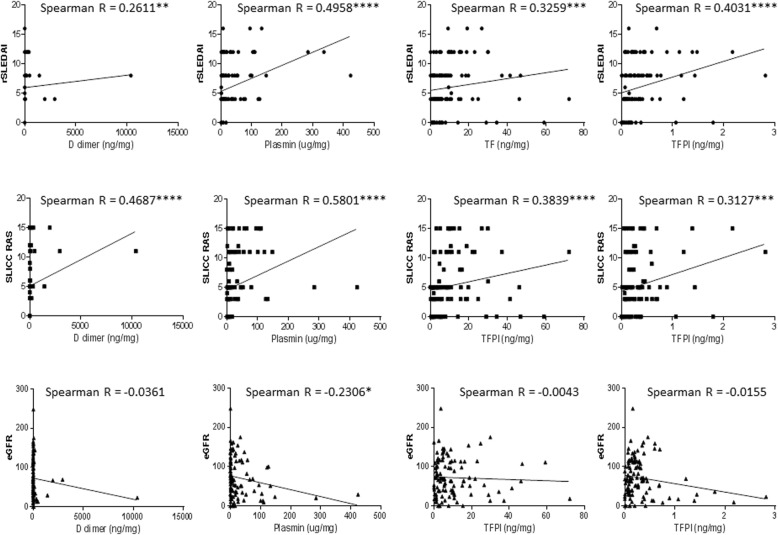
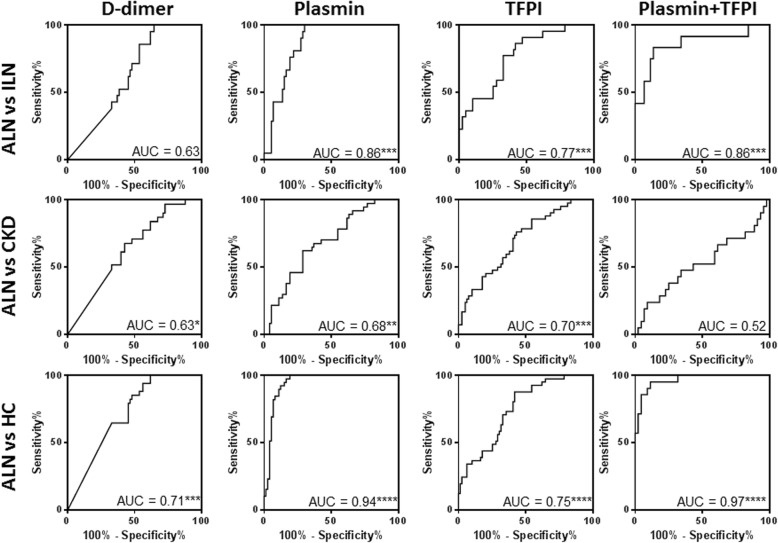
Although urinary d-dimer, plasmin, TF, and TFPI were all elevated in active LN compared to all control groups, and correlated with rSLEDAI and SLICC RAS disease activity indices, urine plasmin emerged as the strongest independent predictor of eGFR and renal disease status, by multivariate regression analysis and Bayesian network analysis. Whereas urine plasmin discriminated active LN from inactive disease with an AUC of 0.84, the combination of urine plasmin and TFPI discriminated ALN from ILN with an AUC of 0.86, with both surpassing the specificity and positive predictive value of traditional markers such as anti-dsDNA and complement C3.
Both thrombogenic and thrombolytic cascades appear to be upregulated in lupus nephritis, with proteins from both cascades appearing in the urine. Of the coagulation cascade proteins surveyed, urine plasmin emerges as the strongest predictor of eGFR and clinical renal disease in patients with LN.
本研究评估尿促血栓形成分子(如组织因子(TF))、抗血栓形成分子(如组织因子途径抑制剂(TFPI))和纤溶分子(如纤溶酶和 D-二聚体)作为狼疮肾炎(LN)生物标志物的效用。
通过 ELISA 检测 113 例经活检证实的 LN 患者(89 例活动期 LN 和 24 例非活动期 LN)、45 例慢性肾脏病患者和 41 例健康对照者的尿液中 D-二聚体、纤溶酶、TF 和 TFPI 水平。进行受试者工作特征曲线(ROC)下面积(AUC)分析、多变量回归分析和贝叶斯网络分析,以评估所测定分子在 LN 中的诊断价值。
尽管与所有对照组相比,活动期 LN 患者的尿液 D-二聚体、纤溶酶、TF 和 TFPI 均升高,且与 rSLEDAI 和 SLICC RAS 疾病活动指数相关,但通过多变量回归分析和贝叶斯网络分析,尿液纤溶酶是 eGFR 和肾脏疾病状态的最强独立预测因子。而尿液纤溶酶区分活动期 LN 和非活动期疾病的 AUC 为 0.84,尿液纤溶酶和 TFPI 的组合区分活动性 LN 和非活动性 LN 的 AUC 为 0.86,均超过了传统标志物(如抗 dsDNA 和补体 C3)的特异性和阳性预测值。
狼疮肾炎中似乎都上调了血栓形成和纤溶级联,两种级联中的蛋白都出现在尿液中。在所研究的凝血级联蛋白中,尿液纤溶酶是 LN 患者 eGFR 和临床肾脏疾病的最强预测因子。