Igarashi Maki, Nogawa Shun, Kawafune Kaoru, Hachiya Tsuyoshi, Takahashi Shoko, Jia Huijuan, Saito Kenji, Kato Hisanori
1Laboratory of Health Nutrition, Department of Applied Biological Chemistry, Graduate School of Agricultural and Life Sciences, The University of Tokyo, 1-1-1, Yayoi, Bunkyo-ku, Tokyo, 113-8657 Japan.
2Department of Molecular Endocrinology, National Research Institute for Child Health and Development, 2-10-1 Okura, Setagaya-ku, Tokyo, 157-8535 Japan.
Genes Nutr. 2019 Jul 5;14:21. doi: 10.1186/s12263-019-0646-6. eCollection 2019.
Japan is traditionally a country with one of the highest levels of fish consumption worldwide, although the westernization of the Japanese diet has resulted in the reduction of fish consumption. A recent meta-analysis of genome-wide association studies (GWASs) on Western populations has identified a single nucleotide polymorphism (SNP) associated with fish intake frequency. Here, we examined the genetic basis for fish intake frequency among Japanese individuals.
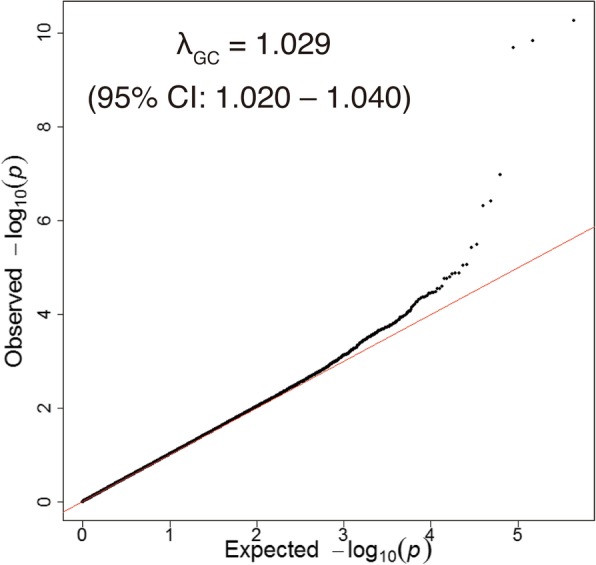
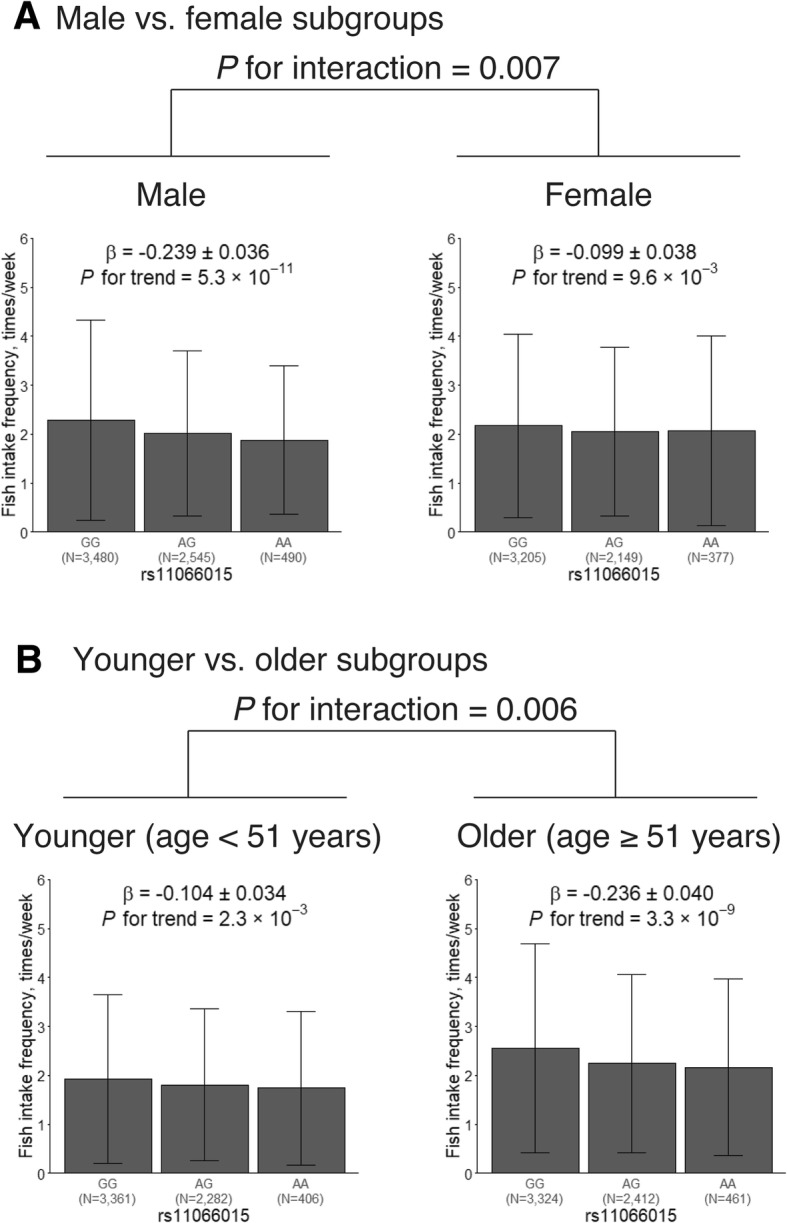
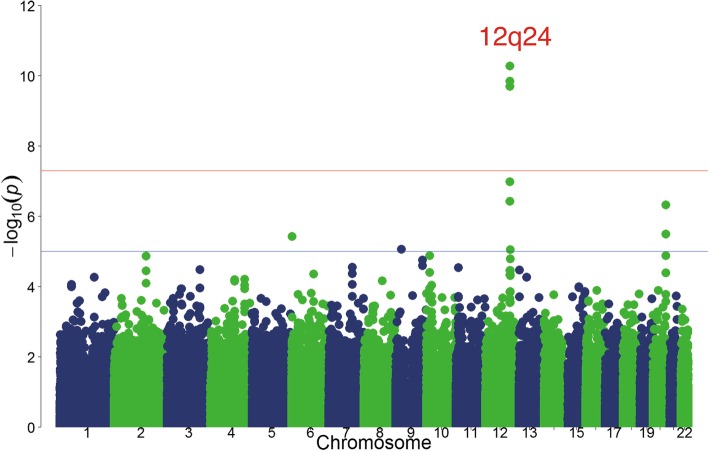
We conducted a meta-analysis of a GWAS including 12,603 Japanese individuals and identified a susceptibility locus for fish intake frequency at 12q24 (lead variant was rs11066015, = 5.4 × 10). rs11066015 was in a strong linkage disequilibrium with rs671, a well-known SNP related to alcohol metabolism. When adjusted for alcohol drinking, the association between rs11066015 and fish intake frequency was substantially attenuated. Subgroup analysis revealed that the effect of the 12q24 variant on fish intake frequency was stronger in males than in females ( for interaction = 0.007) and stronger in the older subgroup than in the younger subgroup ( for interaction = 0.006).
Our findings suggest that the 12q24 locus is associated with fish intake frequency via alcohol drinking. This study can help contribute to personalized nutrition information, suggesting that fish intake should be promoted to consumers who have the rs11066015 minor allele, which is genetically linked to low fish intake frequency, especially in male and older individuals.
日本传统上是全球鱼类消费量最高的国家之一,尽管日本饮食的西方化导致鱼类消费量有所减少。最近一项针对西方人群的全基因组关联研究(GWAS)的荟萃分析确定了一个与鱼类摄入频率相关的单核苷酸多态性(SNP)。在此,我们研究了日本个体中鱼类摄入频率的遗传基础。
我们对一项包含12,603名日本个体的GWAS进行了荟萃分析,确定了12q24处鱼类摄入频率的一个易感位点(主导变体为rs11066015,= 5.4 × 10)。rs11066015与rs671处于强连锁不平衡状态,rs671是一个与酒精代谢相关的知名SNP。在对饮酒情况进行校正后,rs11066015与鱼类摄入频率之间的关联大幅减弱。亚组分析显示,12q24变体对鱼类摄入频率的影响在男性中比在女性中更强(交互作用 = 0.007),在年龄较大的亚组中比在年龄较小的亚组中更强(交互作用 = 0.006)。
我们的研究结果表明,12q24位点通过饮酒与鱼类摄入频率相关。这项研究有助于提供个性化的营养信息,表明对于携带rs11066015次要等位基因(该基因与低鱼类摄入频率存在遗传关联)的消费者,应鼓励其增加鱼类摄入,尤其是男性和年龄较大的个体。