Department of Cell Biology and Biophysics, Faculty of Biology, National & Kapodistrian University of Athens, 15784, Greece.
Oxid Med Cell Longev. 2019 Jun 11;2019:7823285. doi: 10.1155/2019/7823285. eCollection 2019.
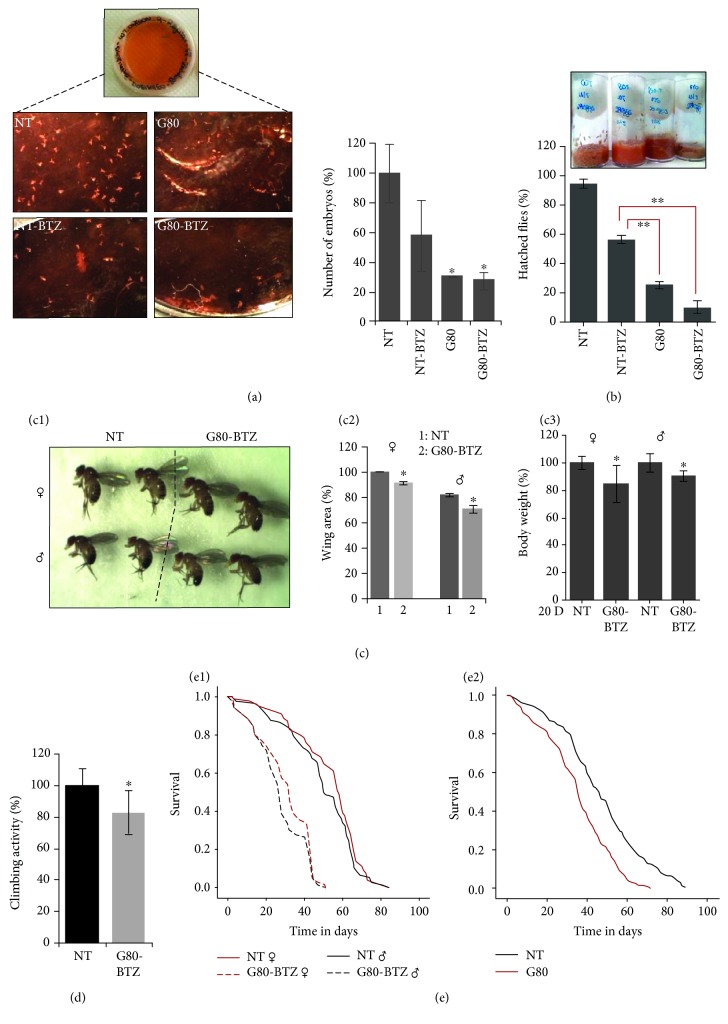
Being an assembly of highly sophisticated protein machines, cells depend heavily on proteostatic modules functionality and on adequate supply of energetic molecules for maintaining proteome stability. Yet, our understanding of the adaptations induced by multigenerational proteotoxic stress is limited. We report here that multigenerational (>80 generations) proteotoxic stress in Oregon flies induced by constant exposure to developmentally nonlethal doses of the proteasome inhibitor bortezomib (BTZ) ( flies) increased proteome instability and redox imbalance, reduced fecundity and body size, and caused neuromuscular defects; it also accelerated aging. flies were mildly resistant to increased doses of BTZ and showed no age-related loss of proteasome activity; these adaptations correlated with sustained upregulation of proteostatic modules, which however occurred at the cost of minimal responses to increased BTZ doses and increased susceptibility to various types of additional proteotoxic stress, namely, autophagy inhibition or thermal stress. Multigenerational proteome instability and redox imbalance also caused metabolic reprogramming being evidenced by altered mitochondrial biogenesis and suppressed insulin/IGF-like signaling (IIS) in flies. The toxic effects of multigenerational proteome instability could be partially mitigated by a low-protein diet that extended flies' longevity. Overall, persistent proteotoxic stress triggers a highly conserved adaptive metabolic response mediated by the IIS pathway, which reallocates resources from growth and longevity to somatic preservation and stress tolerance. Yet, these trade-off adaptations occur at the cost of accelerated aging and/or reduced tolerance to additional stress, illustrating the limited buffering capacity of survival pathways.
作为高度复杂的蛋白质机器的集合体,细胞严重依赖于蛋白质稳定模块的功能和充足的能量分子供应来维持蛋白质组的稳定性。然而,我们对多代蛋白质毒性应激诱导的适应的理解是有限的。我们在这里报告,通过持续暴露于发育非致死剂量的蛋白酶体抑制剂硼替佐米(BTZ)(BTZ 处理组)对俄勒冈蝇进行多代(>80 代)蛋白质毒性应激,增加了蛋白质组的不稳定性和氧化还原失衡,降低了繁殖力和体型,并导致神经肌肉缺陷;它还加速了衰老。BTZ 处理组对增加剂量的 BTZ 具有轻度抗性,且没有与年龄相关的蛋白酶体活性丧失;这些适应性与持续上调蛋白质稳定模块相关,但这是以对增加的 BTZ 剂量的最小反应和对各种类型的额外蛋白质毒性应激(即自噬抑制或热应激)的易感性增加为代价的。多代蛋白质组不稳定性和氧化还原失衡还导致了代谢重编程,这表现在 BTZ 处理组中线粒体生物发生的改变和胰岛素/IGF 样信号(IIS)的抑制。低蛋白饮食可以部分减轻多代蛋白质组不稳定性的毒性作用,延长 BTZ 处理组的寿命。总的来说,持续的蛋白质毒性应激会引发一种高度保守的适应性代谢反应,这种反应由 IIS 途径介导,它将资源从生长和长寿重新分配到躯体保存和应激耐受。然而,这些权衡适应是以加速衰老和/或对额外应激的耐受性降低为代价的,这说明了生存途径的缓冲能力有限。