Department of Medical Oncology, Vall d'Hebron Institute of Oncology, Barcelona, Spain.
Department of Medical Oncology, Vall d' Hebron University Hospital, Universitat Autònoma de Barcelona, Spain.
Mol Oncol. 2019 Sep;13(9):1827-1835. doi: 10.1002/1878-0261.12547. Epub 2019 Jul 31.
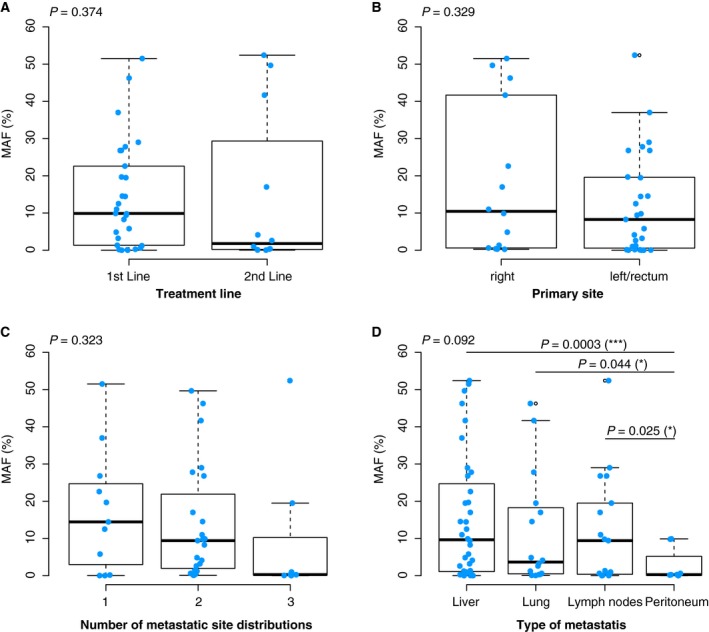
Despite major advances in the treatment of metastatic colorectal cancer (mCRC), the survival rate remains very poor. This study aims at exploring the prognostic value of RAS-mutant allele fraction (MAF) in plasma in mCRC. Forty-seven plasma samples from 37 RAS-mutated patients with nonresectable metastases were tested for RAS in circulating tumor DNA using BEAMing before first- and/or second-line treatment. RAS MAF was correlated with several clinical parameters (number of metastatic sites, hepatic volume, carcinoembryonic antigen, CA19-9 levels, primary site location, and treatment line) and clinical outcome [progression-free survival (PFS) and overall survival (OS)]. An independent cohort of 32 patients from the CAPRI-GOIM trial was assessed for clinical outcome based on plasma baseline MAF. RAS MAF analysis at baseline revealed a significant correlation with longer OS [Hazard ratios (HR) = 3.514; P = 0.00066]. Patients with lower MAF also showed a tendency to longer PFS, although not statistically significant. Multivariate analysis showed RAS MAFs as an independent prognostic factor in both OS (HR = 2.73; P = 0.006) and first-line PFS (HR = 3.74; P = 0.049). Tumor response to treatment in patients with higher MAF was progression disease (P = 0.007). Patients with low MAFs at baseline in the CAPRI-GOIM group also showed better OS [HR = 3.84; 95% confidence intervals (CI) 1.5-9.6; P = 0.004] and better PFS (HR = 2.5; 95% CI: 1.07-5.62; P = 0.033). This minimally invasive test may help in adding an independent factor to better estimate outcomes before initiating treatment. Further prospective studies using MAF as a stratification factor could further validate its utility in clinical practice.
尽管转移性结直肠癌 (mCRC) 的治疗取得了重大进展,但生存率仍然非常低。本研究旨在探讨血浆中 RAS 突变等位基因分数 (MAF) 在 mCRC 中的预后价值。在一线和/或二线治疗前,使用 BEAMing 对 37 名不可切除转移的 RAS 突变患者的 47 份血浆样本进行循环肿瘤 DNA 中的 RAS 检测。RAS MAF 与多个临床参数(转移部位数量、肝体积、癌胚抗原、CA19-9 水平、原发部位位置和治疗线)和临床结果(无进展生存期 (PFS) 和总生存期 (OS))相关。CAPRI-GOIM 试验的另一个独立队列 32 名患者基于血浆基线 MAF 评估临床结果。基线时的 RAS MAF 分析显示与更长的 OS 显著相关[风险比 (HR) = 3.514;P = 0.00066]。MAF 较低的患者也表现出 PFS 延长的趋势,尽管没有统计学意义。多变量分析显示,RAS MAF 是 OS(HR = 2.73;P = 0.006)和一线 PFS(HR = 3.74;P = 0.049)的独立预后因素。MAF 较高的患者对治疗的肿瘤反应是疾病进展(P = 0.007)。CAPRI-GOIM 组基线时 MAF 较低的患者也显示出更好的 OS[HR = 3.84;95%置信区间 (CI) 1.5-9.6;P = 0.004]和更好的 PFS[HR = 2.5;95% CI:1.07-5.62;P = 0.033]。这种微创检测方法可能有助于在开始治疗前增加一个独立因素来更好地估计结果。使用 MAF 作为分层因素的进一步前瞻性研究可以进一步验证其在临床实践中的实用性。