Department of Biological Sciences, Graduate School of Science, The University of Tokyo, Tokyo, Japan.
PLoS Genet. 2019 Jul 19;15(7):e1008297. doi: 10.1371/journal.pgen.1008297. eCollection 2019 Jul.
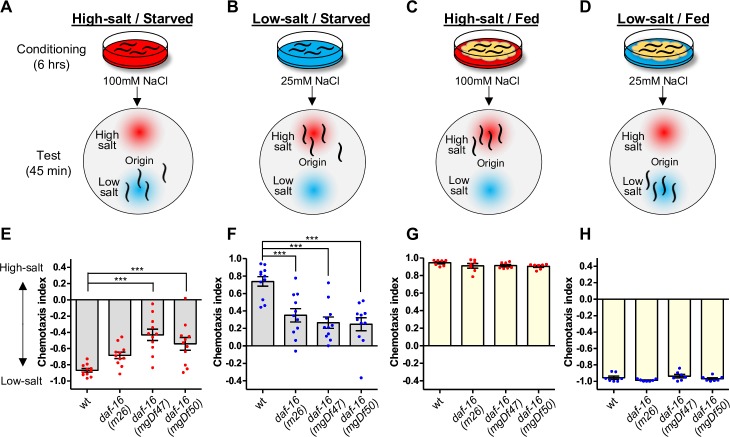
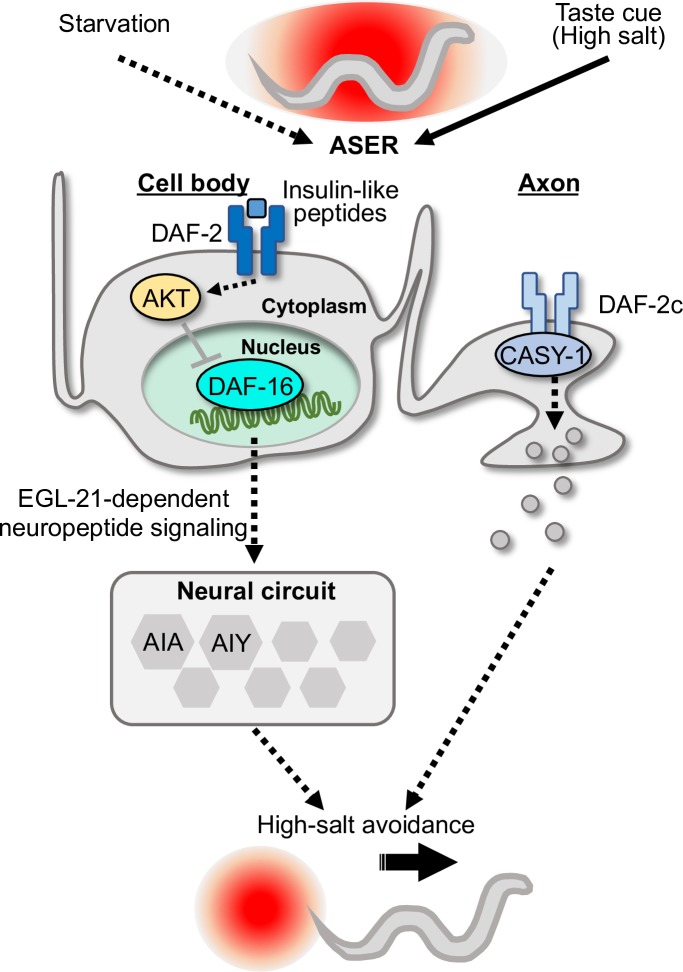
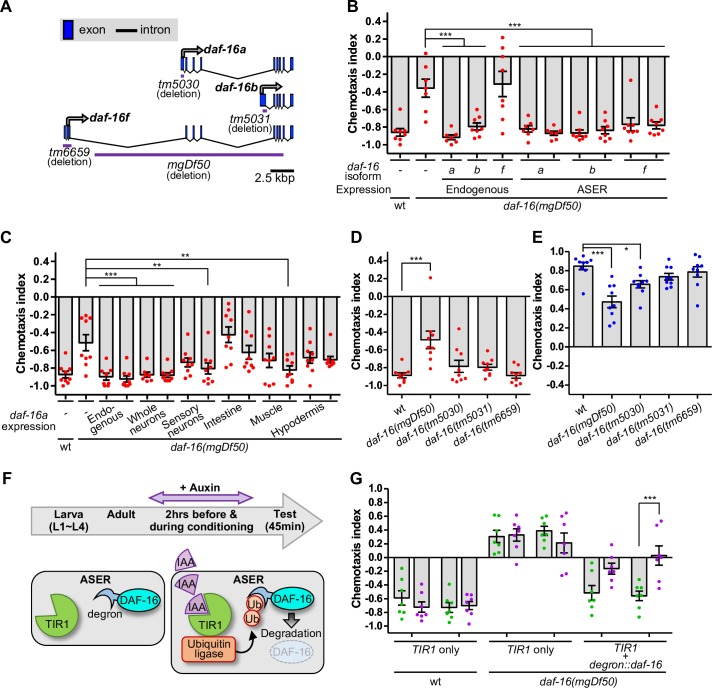
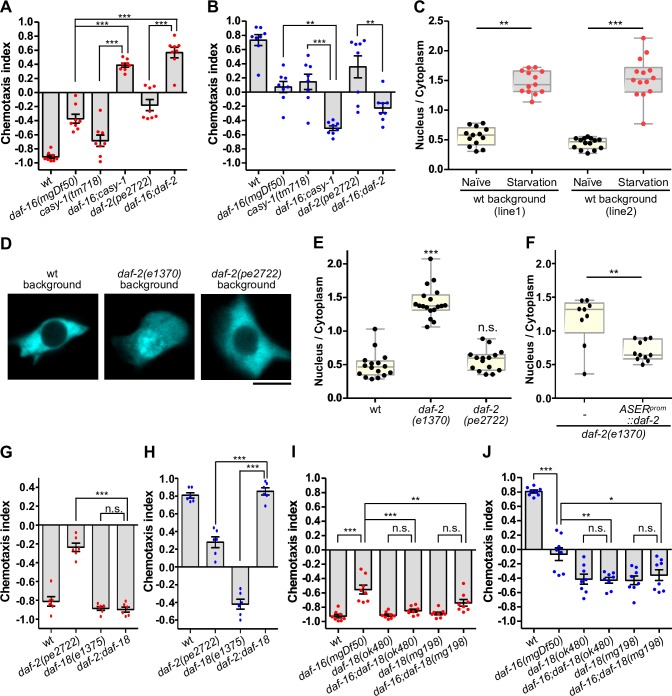
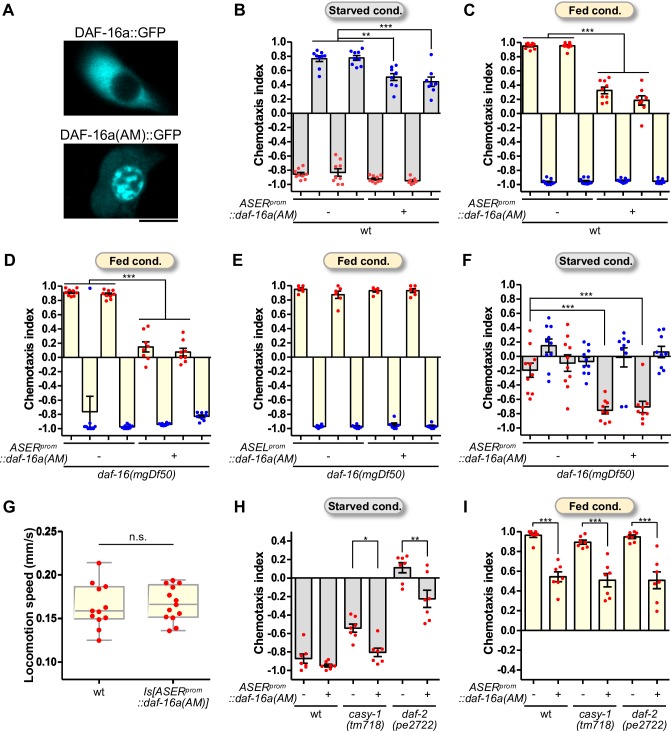
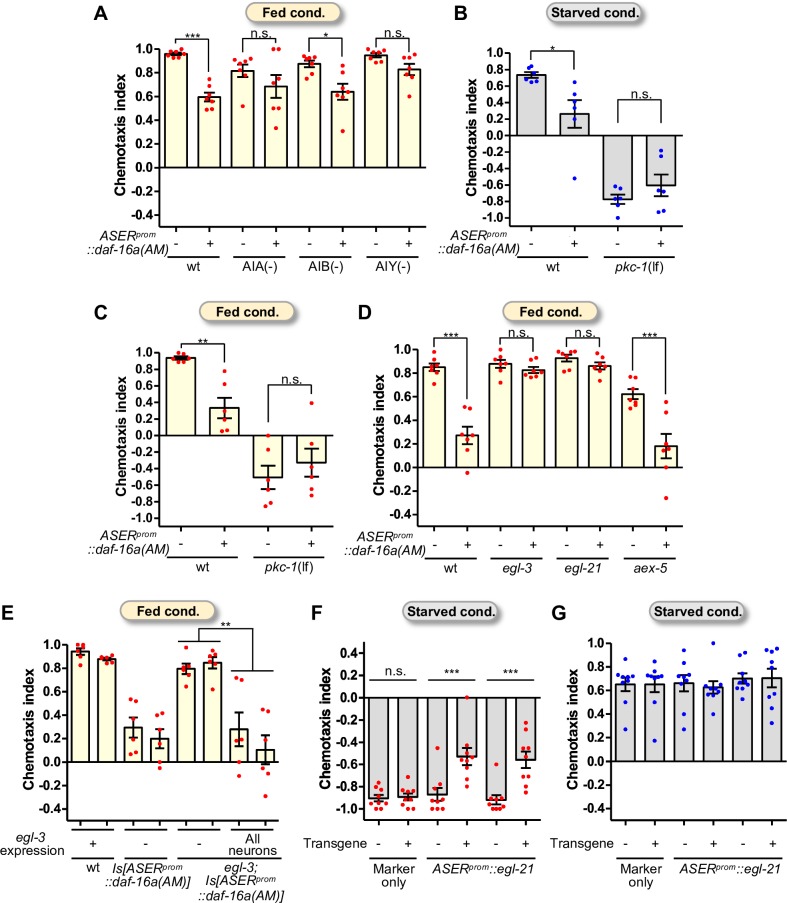
The avoidance of starvation is critical for the survival of most organisms, thus animals change behavior based on past nutritional conditions. Insulin signaling is important for nutritional state-dependent behavioral plasticity, yet the underlying regulatory mechanism at the cellular level remains unclear. Previous studies showed that insulin-like signaling is required for taste avoidance learning, in which the nematode Caenorhabditis elegans avoids salt concentrations encountered under starvation conditions. DAF-2c, a splice isoform of the DAF-2 insulin receptor, functions in the axon of the ASER sensory neuron, which senses changes in salt concentrations. In addition, mutants of a major downstream factor of DAF-2, the forkhead transcription factor O (FOXO) homolog DAF-16, show defects in taste avoidance learning. Interestingly, the defect of the daf-2 mutant is not suppressed by daf-16 mutations in the learning, unlike those in other phenomena, such as longevity and development. Here we show that multiple DAF-16 isoforms function in ASER. By epistasis analysis using a DAF-2c isoform-specific mutant and an activated form of DAF-16, we found that DAF-16 acts in the nucleus in parallel with the DAF-2c-dependent pathway in the axon, indicating that insulin-like signaling acts both in the cell body and axon of a single neuron, ASER. Starvation conditioning induces nuclear translocation of DAF-16 in ASER and degradation of DAF-16 before starvation conditioning causes defects in taste avoidance learning. Forced nuclear localization of DAF-16 in ASER biased chemotaxis towards lower salt concentrtions and this effect required the Gq/PKC pathway and neuropeptide processing enzymes. These data imply that DAF-16/FOXO transmits starvation signals and modulates neuropeptide transmission in the learning.
避免饥饿对于大多数生物的生存至关重要,因此动物会根据过去的营养状况改变行为。胰岛素信号对于营养状态依赖性的行为可塑性很重要,但细胞水平的潜在调节机制尚不清楚。以前的研究表明,胰岛素样信号对于味觉回避学习是必需的,在这种学习中,秀丽隐杆线虫会避免在饥饿状态下遇到的盐浓度。DAF-2c 是 DAF-2 胰岛素受体的剪接异构体,在 ASER 感觉神经元的轴突中发挥作用,该神经元感知盐浓度的变化。此外,DAF-2 的主要下游因子之一的叉头转录因子 O (FOXO) 同源物 DAF-16 的突变体在味觉回避学习中表现出缺陷。有趣的是,与其他现象(如寿命和发育)不同,daf-2 突变体的缺陷在学习中不能被 daf-16 突变所抑制。在这里,我们表明多个 DAF-16 异构体在 ASER 中发挥作用。通过使用 DAF-2c 异构体特异性突变体和 DAF-16 的激活形式进行的上位性分析,我们发现 DAF-16 在细胞核中与 DAF-2c 依赖性轴突途径平行作用,表明胰岛素样信号在单个神经元 ASER 的细胞体和轴突中都起作用。饥饿处理诱导 ASER 中 DAF-16 的核易位,而饥饿处理前 DAF-16 的降解导致味觉回避学习缺陷。在 ASER 中强制核定位 DAF-16 会使化学趋向性偏向较低的盐浓度,并且这种效应需要 Gq/PKC 途径和神经肽加工酶。这些数据表明 DAF-16/FOXO 传递饥饿信号并调节学习中的神经肽传递。