
南极东部石耳地衣共生菌和共生藻的系统发育特征
Phylotypic Characterization of Mycobionts and Photobionts of Rock Tripe Lichen in East Antarctica.
作者信息
Faluaburu Merry Sailonga, Nakai Ryosuke, Imura Satoshi, Naganuma Takeshi
机构信息
Graduate School of Biosphere Science, Hiroshima University, 1-4-4, Kagamiyama, Higashi-hiroshima, Hiroshima 739-8528, Japan.
Applied Molecular Microbiology Research Group, Bioproduction Research Institute, National Institute of Advanced Industrial Science and Technology, 2-17-2-1, Tsukisamu-higashi, Toyohira Ward, Sapporo 062-8517, Japan.
出版信息
Microorganisms. 2019 Jul 18;7(7):203. doi: 10.3390/microorganisms7070203.
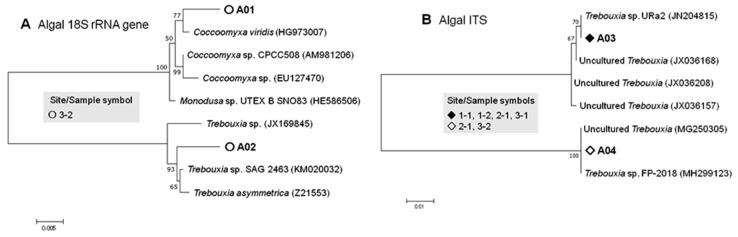
Saxicolous rock ripe lichens that grow on rocks in the East Antarctic fellfields were sampled for phylotypic characterization of its constituent mycobionts (fungi) and photobionts (algae and cyanobacteria). The rock tripe lichen-forming fungal and algal phylotypes were classified under the common lichen-forming genera of ascomycetes, namely, , and green algae, namely, and . However, phylotypes of the green algal chloroplasts and the lichen-associated cyanobacteria showed unexpectedly high diversity. The detected chloroplast phylotypes were not fully affiliated with the green algal genera or . The predominant chloroplast phylotype demonstrated maximum resemblance to , which is neither a known Antarctic species nor a typical lichen photobiont. Another dominant chloroplast phylotype belonged to the atypical Antarctic green algae family. Cyanobacterial phylotypes were dominated by those affiliated with the species rather than the well-known lichen-associates, species. The occurrences of these -affiliated cyanobacterial phylotypes were specifically abundant within the Yukidori Valley site, one of the Antarctic Specially Protected Areas (ASPA). The ASPA site, along with another 50 km-distant site, yielded most of the cryptic diversity in the phylotypes of chloroplasts and cyanobacteria, which may contribute to the phenotypic variability within the rock tripe lichen photobionts.
对生长在东南极冰缘地带岩石上的石耳类成熟地衣进行采样,以对其组成的菌共生体(真菌)和光共生体(藻类和蓝细菌)进行系统发育特征分析。石耳地衣形成真菌和藻类的系统发育型分别归类于子囊菌门常见的地衣形成属,即 ,以及绿藻,即 和 。然而,绿藻叶绿体和地衣相关蓝细菌的系统发育型显示出意外的高多样性。检测到的叶绿体系统发育型并未完全隶属于绿藻属 或 。占主导地位的叶绿体系统发育型与 显示出最大的相似性, 既不是已知的南极物种,也不是典型的地衣光共生体。另一个占主导地位的叶绿体系统发育型属于非典型的南极绿藻科。蓝细菌系统发育型主要由隶属于 物种的类型主导,而非著名的地衣共生体 物种。这些隶属于 的蓝细菌系统发育型在南极特别保护区之一的雪鸟谷地点特别丰富。该南极特别保护区地点以及另一个相距50公里的地点,产生了叶绿体和蓝细菌系统发育型中的大部分隐秘多样性,这可能导致石耳地衣光共生体的表型变异性。




 Zotero 插件